
Lyophilised vs Liquid Peptides Explained
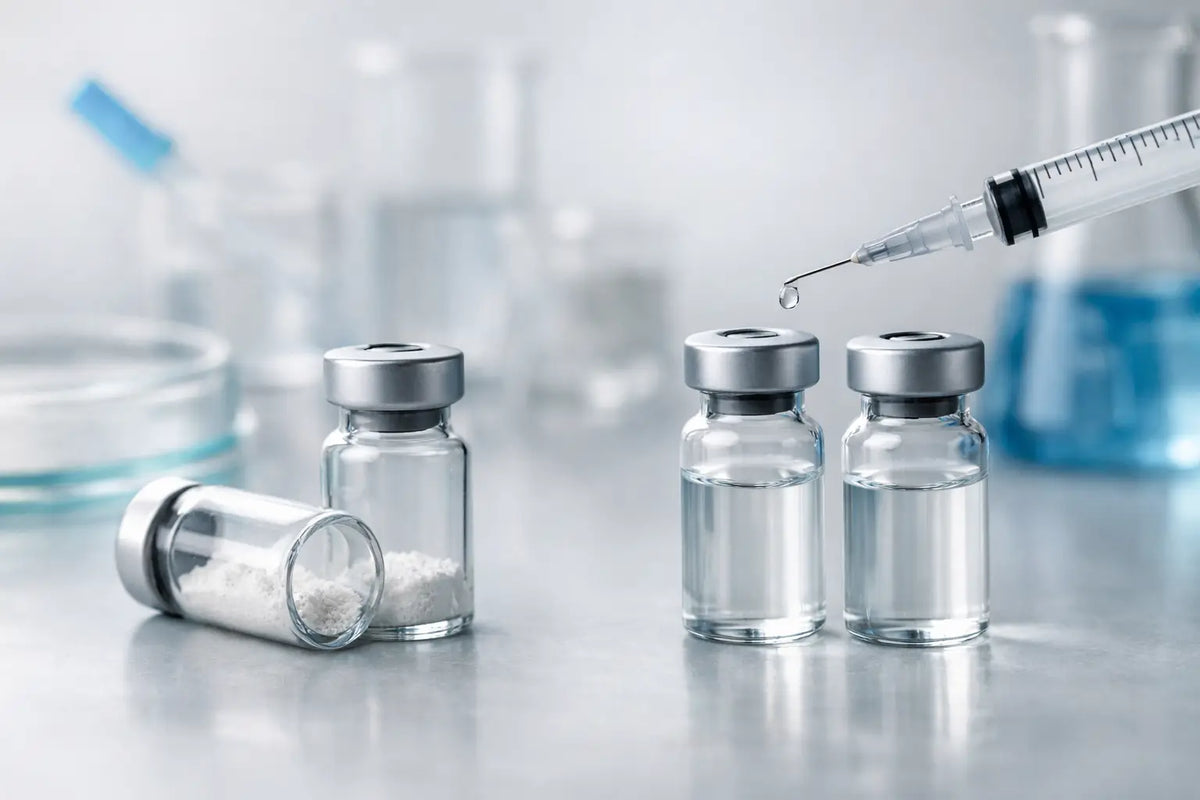
A peptide arriving in poor condition is not a minor inconvenience. For research buyers, it affects storage planning, handling protocols, repeatability, and confidence in the supplier. That is why the question of lyophilised vs liquid peptides matters well before checkout. The format you choose influences stability, transport risk, shelf life, and how much control you retain once the product reaches your lab.
For most research applications, lyophilised peptides are the standard format. They are supplied as a freeze-dried powder and reconstituted when needed. Liquid peptides, by contrast, are pre-mixed into solution before dispatch. Both formats have a place, but they are not interchangeable in every setting, and the better option depends on your handling capability, storage conditions, and timeline for use.
Lyophilised vs liquid peptides: what is the actual difference?
Lyophilisation is a freeze-drying process that removes water from the peptide under controlled conditions. The result is a dry cake or powder that remains inactive until reconstituted with an appropriate solvent, often bacteriostatic water or another research-suitable diluent. Removing moisture reduces degradation pathways and generally improves storage resilience.
A liquid peptide has already been dissolved into a carrier solution. That can make it more convenient from a handling perspective, particularly for buyers who want to avoid reconstitution steps. However, convenience comes with trade-offs. Once in solution, peptides are usually more vulnerable to temperature fluctuation, contamination risk, adsorption to surfaces, and gradual loss of integrity over time.
In simple terms, lyophilised material prioritises stability and control. Liquid format prioritises immediate usability. Serious buyers usually decide between them based on which risk profile is easier to manage.
Why lyophilised peptides are usually preferred
The main reason is stability. A dry peptide generally tolerates storage and transport better than the same compound held in solution. That does not mean lyophilised products are indestructible, but it does mean there are fewer variables acting on the material before the end user reconstitutes it.
This is especially relevant for international orders, bulk purchasing, and buyers who do not plan to use the material immediately. If a peptide may spend time in transit, customs handling, or staged storage before use, the dry format gives a wider margin for preserving quality. For that reason, many research suppliers prioritise lyophilised stock across core compounds.
There is also a practical advantage in batch management. With lyophilised peptides, the researcher can choose when to reconstitute, what volume to use, and how to align concentration with the needs of the protocol. That flexibility matters in labs where different projects require different working concentrations or staggered usage.
Where liquid peptides may make sense
Liquid peptides are not automatically inferior. In some settings, they are simply more convenient. If a researcher needs a ready-to-use preparation for immediate short-term work, a pre-mixed format can save time and reduce preparation steps. It may also be useful where standardisation of an in-house reconstitution process is difficult.
The issue is that the useful window is typically narrower. A peptide in liquid form often demands stricter cold-chain discipline and faster use after receipt. If shipping is delayed, if storage temperatures drift, or if the product is opened and handled repeatedly, degradation risk increases. That makes supplier quality control and fulfilment speed even more important.
For buyers who value long storage life, international delivery tolerance, or precise control over solvent selection, liquid format is often less attractive. For buyers who prioritise speed of use and have tightly managed storage conditions, it can still be a workable option.
Stability, degradation and shelf life
When comparing lyophilised vs liquid peptides, shelf life is usually the deciding factor. Dry peptides tend to remain stable for longer under appropriate storage conditions because hydrolysis and other water-driven degradation processes are reduced. Exposure to heat, light, and repeated temperature changes still matters, but the absence of water is a major advantage.
Liquid peptides face more challenges. Depending on the compound, the solvent system, and storage conditions, degradation may occur more quickly in solution. Some peptides are particularly sensitive once reconstituted and should be used within a tighter timeframe. Others may remain workable for longer, but they still require more careful handling than the lyophilised equivalent.
That is why general claims about one fixed shelf life are rarely useful. Peptide identity, concentration, excipients, container type, and storage temperature all influence real-world performance. Buyers should look for clear storage guidance and batch documentation rather than relying on broad assumptions.
Shipping considerations for research buyers
Format affects shipping more than many buyers first realise. Lyophilised peptides are usually better suited to domestic and international dispatch because they are less exposed to transit-related instability. Temperature excursions are still undesirable, but the material is generally less vulnerable than a pre-mixed liquid.
Liquid peptides place more pressure on fulfilment and logistics. Dispatch speed, packaging standard, seasonal conditions, and courier performance all become more significant. If a parcel is delayed over a weekend or held during customs processing, the margin for error is smaller.
For a supplier serving international markets, that distinction matters. Research buyers need consistency not just in the vial, but across the full delivery chain. A reliable lyophilised product with verified purity and strong documentation is often the safer commercial choice because it reduces the number of variables between dispatch and use.
Reconstitution and handling
The argument in favour of liquid peptides usually starts with convenience, and that is fair. Reconstitution adds a step. It requires the correct diluent, careful technique, concentration planning, and storage discipline after mixing. For experienced buyers, these are standard lab tasks. For less experienced purchasers, they can introduce handling errors.
Even so, reconstitution gives the researcher more control. You can determine the final concentration, prepare only what is needed, and keep the remaining material dry until required. That can reduce waste and support more structured use across multiple runs.
Liquid formats remove that step but also remove that flexibility. You inherit the solvent choice, the concentration, and the stability profile selected before dispatch. If those choices do not align perfectly with your protocol, there is less room to adjust.
Purity is separate from format
One point is worth stating clearly. Lyophilised or liquid format does not by itself tell you whether the peptide is high quality. Purity, batch consistency, and identity verification come from the manufacturing and testing process, not from the physical format alone.
A poor-quality lyophilised peptide is still poor quality. A well-prepared liquid peptide can still be analytically sound. What matters is whether the supplier provides reliable quality controls, including HPLC verification and a Certificate of Analysis for each batch. Without that documentation, format becomes a secondary issue.
For professional buyers, the better question is not simply which format is better. It is which format is better from a supplier that can demonstrate specification integrity, traceability, and dependable fulfilment.
Which format is right for your application?
If your priority is storage flexibility, international shipping resilience, or maintaining maximum control over reconstitution, lyophilised peptides are usually the stronger option. That is why they remain the preferred format for many research compounds sold into serious laboratory and investigational settings.
If your priority is immediate use and your storage conditions are tightly controlled from receipt onwards, a liquid peptide may be suitable. That said, the practical benefit needs to outweigh the shorter handling window and the greater sensitivity during transport.
There is no universal winner for every use case. Short-horizon projects with stable local delivery may tolerate liquid format well. Longer timelines, variable shipping conditions, and larger purchasing volumes usually favour lyophilised stock.
A buying standard that matters more than convenience
For most informed buyers, the decision comes down to risk management. Lyophilised peptides reduce storage and transit risk, while liquid peptides reduce preparation time. In a category where consistency, documentation, and handling integrity directly affect research outcomes, reduced risk usually carries more value than minor convenience.
That is why many experienced purchasers lean towards lyophilised supply from vendors that pair the format with verified purity, batch-level Certificates of Analysis, and fast, controlled dispatch. ApexLink Peptides operates in that standard for a reason. When the compound, the paperwork, and the fulfilment process all align, format becomes a practical choice rather than a gamble.
The most useful approach is simple: choose the format that gives you the highest level of control after delivery, not just the shortest path to opening the vial.
More from the research library.

How to Select Peptide Vial Sizes for Research
Learn how to select peptide vial sizes for research based on assay demand, reconstitution volume, stab...
Read article →
How to Calculate Peptide Molarity Correctly
Learn how to calculate peptide molarity from mass, molecular weight and reconstitution volume, with pr...
Read article →
Can Researchers Verify Peptide Identity Reliably?
Can researchers verify peptide identity? Learn how HPLC, mass spectrometry, batch records and Certific...
Read article →