
HPLC Versus Capillary Electrophoresis Testing
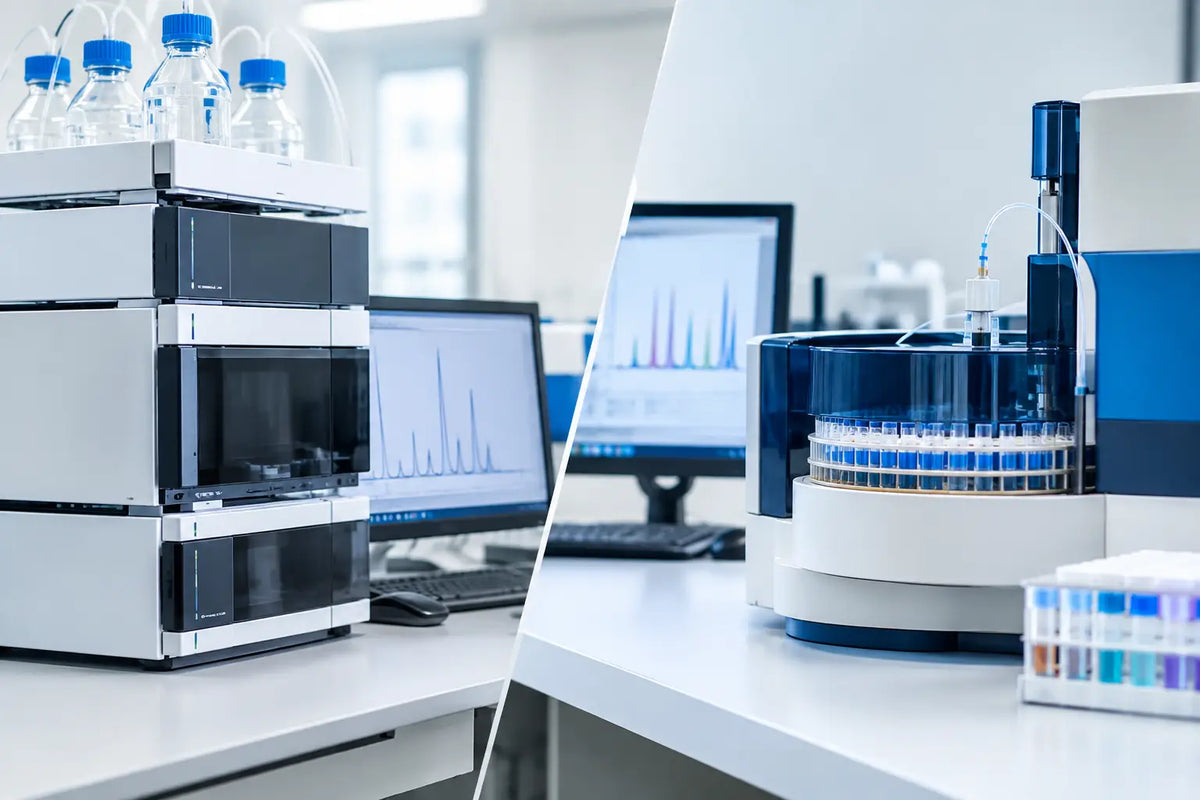
For peptide buyers reviewing analytical documentation, HPLC versus capillary electrophoresis testing is not simply a question of which instrument is more advanced. The meaningful question is what each method can demonstrate about a specific batch, under defined conditions, and whether that evidence is sufficient for the intended research application.
Both techniques separate components in a sample. Both can reveal impurities that would otherwise remain hidden. Yet they rely on different separation mechanisms, produce different types of information, and have different strengths when applied to research peptides. Understanding those differences makes it easier to assess a Certificate of Analysis (COA), compare supplier claims, and specify suitable quality-control requirements for a laboratory project.
HPLC versus capillary electrophoresis testing: the core difference
High-performance liquid chromatography (HPLC) separates compounds as they pass through a packed column under pressure. In peptide testing, reversed-phase HPLC is commonly used. The sample travels through a column with a non-polar stationary phase while a liquid mobile phase changes in composition, often using water and an organic solvent with an acidic modifier. Components interact with the column differently and elute at different retention times.
Capillary electrophoresis (CE) separates compounds inside a narrow, fused-silica capillary using an applied electrical field. Rather than relying primarily on interactions with a packed column, CE separates molecules according to electrophoretic mobility. Charge, size, molecular shape and the pH of the running buffer all influence how quickly a component moves through the capillary.
For peptides, this distinction matters. HPLC is particularly effective at resolving compounds with differences in hydrophobicity. CE can be especially informative where closely related components differ in charge state or where ionic impurities are a concern. Neither technique is automatically the better choice in every case.
Why HPLC is widely used for peptide purity testing
HPLC is a familiar and practical standard for evaluating peptide purity. A chromatogram can show a principal peak corresponding to the target material, alongside smaller peaks that may represent synthesis-related impurities, deletion sequences, oxidation products, residual intermediates or degradation products. The relative area of the main peak is then often reported as a purity percentage.
For a lyophilised research peptide, reversed-phase HPLC offers several operational advantages. It is well established, adaptable to a broad range of peptide sequences, and capable of producing clear, repeatable chromatographic profiles when the method is properly developed. UV detection is commonly used because peptide bonds absorb in the low UV range, although the precise wavelength and detector settings affect sensitivity and selectivity.
An HPLC purity result of 99% or higher is useful evidence of batch quality, but it should be read accurately. It generally indicates that the main detected chromatographic peak accounts for at least 99% of the integrated signal under the stated method. It does not, on its own, prove the complete molecular identity of that peak, establish peptide content by mass, or identify every impurity below the method’s detection threshold.
This is why a credible COA should provide more than a headline purity number. The method, detection conditions, chromatogram, batch reference and test date all add context. For higher-assurance work, HPLC results are commonly considered alongside mass spectrometry and, where relevant, additional assays for water content, residual solvents, counter-ion content or microbial quality.
Where capillary electrophoresis adds value
Capillary electrophoresis is valued for high separation efficiency, low sample consumption and its ability to distinguish analytes based on charge-to-size behaviour. That can make it useful for peptides that are difficult to resolve by chromatography alone, particularly where minor charged variants may co-elute during an HPLC run.
A peptide may exist in several forms depending on sequence, terminal groups, deamidation, oxidation and buffer conditions. CE can sometimes separate these forms with excellent efficiency because even small changes in charge can alter migration time. The technique can also be useful in assessing ionic components, free amino acids or highly polar impurities that may show limited retention in a conventional reversed-phase HPLC method.
However, CE is not a universal replacement for HPLC. Method development can be sensitive to buffer composition, capillary surface interactions, electro-osmotic flow and analyte adsorption. Some peptides interact strongly with the capillary wall, which can affect peak shape and reproducibility unless the method is carefully controlled. Detection can also be less straightforward for compounds with weak UV absorption, although specialised detection methods can improve sensitivity.
For routine commercial peptide batch release, HPLC remains more widely recognised and more easily interpreted by buyers. CE is often most valuable as an orthogonal method - a different analytical approach used to confirm or investigate what HPLC indicates.
A practical comparison for research peptide buyers
| Consideration | HPLC | Capillary electrophoresis |
|---|---|---|
| Primary separation basis | Hydrophobic interaction with the column | Electrophoretic mobility, influenced by charge and size |
| Common peptide use | Purity profiling and routine batch comparison | Charged variants, polar impurities and complementary characterisation |
| Sample consumption | Low | Very low |
| Method familiarity in peptide COAs | Very common | Less common |
| Key limitation | Co-eluting compounds may appear as one peak | Performance can be sensitive to capillary and buffer conditions |
The table should not be read as a verdict in favour of one method. A well-developed HPLC method may provide the most relevant result for one peptide, while CE may expose a critical variant in another. The quality of the method is as important as the instrument category.
What a purity result can and cannot tell you
A chromatographic purity figure is only meaningful when linked to a defined sample and a defined method. If a supplier states a high purity percentage without providing batch-specific supporting material, the claim has limited value for serious research procurement.
When reviewing a COA, first confirm that the product name, batch or lot number and reported test result align with the item being purchased. Then look for a chromatogram that shows a dominant principal peak and a stated purity calculation. Retention time can be useful for batch-to-batch comparison, although retention time alone is not definitive proof of identity because it depends on the method conditions.
It is also sensible to ask what detector was used and whether the reported percentage is based on peak area normalisation. UV area percentage is a common and useful metric, but different impurities can have different UV responses. A sample reported as 99% by UV peak area is not necessarily 99% by mass in every circumstance.
For identity confidence, mass spectrometry is particularly relevant. It measures molecular mass and can help confirm that the principal material is consistent with the expected peptide. HPLC and mass spectrometry answer complementary questions: HPLC helps show how much of the detected material is represented by the main chromatographic component, while mass analysis helps establish what that component is.
Selecting the right approach for the work
The right test package depends on the peptide, the planned experiment and the consequences of an unexpected impurity. For routine research use where consistency between batches is the priority, a batch-specific HPLC chromatogram and COA may be an appropriate baseline. Where a project is sensitive to charged variants, degradation pathways or low-level impurities, an orthogonal method such as CE or LC-MS may be justified.
Consider the sample’s likely failure modes. Hydrophobic by-products and incomplete synthesis sequences may be well suited to reversed-phase HPLC evaluation. Charge-altering modifications, including deamidation or terminal changes, may benefit from CE-based separation. If identity, molecular mass or sequence-related confirmation is central to the work, mass spectrometric data should form part of the assessment.
The same principle applies when comparing vendors. A higher purity figure is not automatically more credible if the underlying method is unclear. Transparent documentation, traceable batch records and a chromatography profile that matches the stated product provide stronger purchasing evidence than an unsupported percentage alone.
Why method transparency matters more than a single number
Research-grade procurement relies on consistency. A peptide that performs differently from one batch to the next can compromise comparative work, waste reagents and create uncertainty that is difficult to trace later. Analytical testing cannot eliminate every variable, but it provides a documented control point before material reaches the laboratory.
At ApexLink Peptides, batch-specific HPLC verification and Certificates of Analysis are used to support this control point. The purpose is not to suggest that one test answers every analytical question. It is to provide clear, relevant evidence of purity for the supplied batch, with documentation that researchers can assess against their own protocol requirements.
For buyers, the most useful approach is to treat HPLC, capillary electrophoresis and mass analysis as complementary tools rather than competing labels. Choose evidence that matches the risk profile of the experiment, retain the batch documentation with laboratory records, and let the method detail carry as much weight as the purity percentage.
More from the research library.
Best Peptides for Mitochondrial Research
Assess the best peptides for mitochondrial research, including SS-31 and MOTS-c, with practical criter...
Read article →
Can Peptides Withstand Freeze-Thaw Cycles?
Can peptides withstand freeze thaw cycles? Learn what affects stability, when to aliquot, and how cont...
Read article →
How to Document Peptide Chain of Custody
Learn how to document peptide chain custody using batch records, receipt checks and storage logs to pr...
Read article →