
Can Peptides Withstand Freeze-Thaw Cycles?
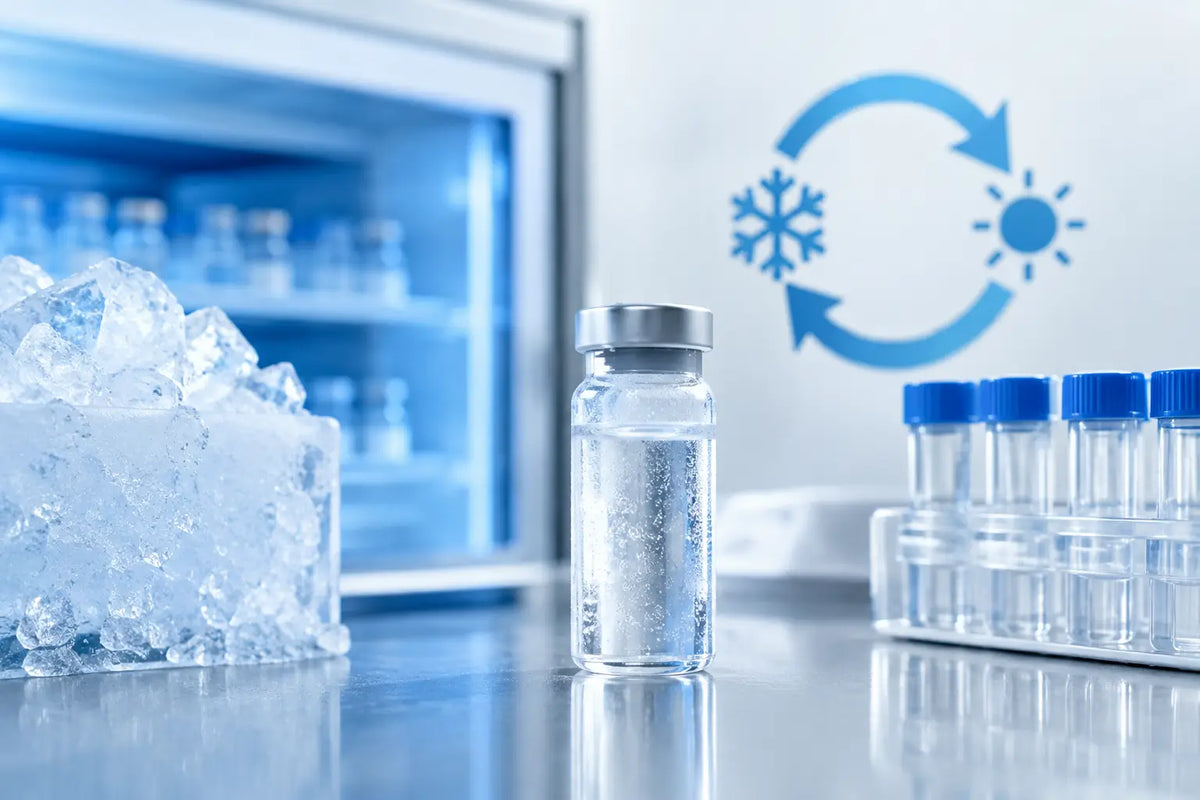
Can peptides withstand freeze thaw cycles? Sometimes, but the useful laboratory answer is not a simple yes or no. A peptide’s tolerance depends on its sequence, formulation, concentration, solvent, container, storage temperature and the number of cycles involved. For reliable research work, freeze-thaw exposure should be treated as a controlled variable rather than an assumedly harmless routine.
A single, well-managed freeze-thaw cycle may have little measurable effect on some preparations. Repeated cycling, however, can increase the risk of aggregation, degradation, adsorption to the vial surface and changes in effective concentration. Where analytical consistency matters, the best practice is to minimise cycles from the outset.
Why freeze-thaw cycles can affect peptides
Freezing does not stop every physical or chemical process equally. As an aqueous peptide solution freezes, water forms ice crystals first. This can concentrate dissolved salts, buffers and peptide molecules in the remaining unfrozen fraction. The resulting local shift in pH, ionic strength and concentration may create conditions that favour peptide aggregation or chemical modification.
The risk is highly peptide-specific. Sequence features such as oxidation-prone residues, disulphide bonds, hydrophobic regions and overall charge can influence stability. A low-concentration solution may also lose material through adsorption to glass or plastic surfaces, while a higher-concentration preparation can be more vulnerable to self-association or precipitation. There is no universal number of cycles that applies safely to every peptide.
Thawing introduces its own variables. Repeated warming, prolonged time at room temperature, vigorous agitation and incomplete mixing can all compromise the consistency of a sample. A vial that appears clear is not automatically unchanged at the molecular level. Visual inspection is useful, but it cannot replace a stability-indicating analytical method where the work requires confirmation.
Lyophilised peptides and reconstituted solutions are different
Lyophilised peptide material is generally more stable than the same peptide in solution because it contains far less available water. That does not mean every freeze-thaw concern disappears, but it does mean the main handling question changes. For unopened, dry material, protection from moisture, heat and repeated temperature fluctuation is usually more relevant than repeated freeze-thaw cycling.
Once reconstituted, the sample becomes more sensitive to handling conditions. Solvent selection is particularly important. The correct reconstitution medium depends on the peptide and the intended research protocol. Water-based systems, buffered solutions and co-solvent approaches can produce very different stability profiles. A solvent that achieves initial dissolution may not necessarily support the best stability during storage.
For this reason, researchers should not transfer storage assumptions from one compound to another. A protocol suitable for one peptide may be unsuitable for another, even when both are supplied as lyophilised powders. Batch documentation confirms identity and purity at release; it does not replace a stability study of the final solution under a specific laboratory protocol.
The practical case for aliquoting
Aliquoting is the most effective way to reduce unnecessary freeze-thaw exposure. Instead of repeatedly opening, thawing and refreezing one primary vial, divide a freshly prepared solution into volumes that match the expected use per experiment or analytical run.
This approach protects the remaining material from repeated temperature changes and reduces contamination opportunities associated with multiple withdrawals. It also makes inventory control more straightforward: each aliquot has a defined preparation date, concentration, storage condition and freeze-thaw history.
A sound aliquoting procedure should use clean, compatible containers and minimise time at ambient temperature. Low-binding tubes may be appropriate for peptides with a known adsorption risk, though container suitability should be assessed against the specific analyte and method. Containers should be securely labelled before filling, including compound identity, concentration, solvent, date prepared and any relevant batch reference.
For many research workflows, one aliquot should support one thawed-use period. If residual material remains after the planned work, refreezing should only be considered where the laboratory has data or method validation supporting that decision.
How to handle a thawed peptide preparation
Thaw samples under conditions appropriate to the study and avoid leaving them out longer than necessary. A slow, controlled thaw can be preferable where rapid temperature shifts are a concern, but the correct approach still depends on the peptide, solvent and intended use.
After thawing, inspect the preparation for visible particles, cloudiness, unexpected colour change or phase separation. These signs do not diagnose every stability issue, but they are valid reasons to pause and investigate before proceeding. Do not assume that warming or vigorous mixing will correct a precipitated or altered preparation.
Mix gently and consistently. In some cases, careful inversion or light pipette mixing is sufficient. Aggressive vortexing can introduce foam and air-liquid interfaces, which may be undesirable for certain peptide solutions. Where reproducibility is critical, document the mixing method as part of the sample preparation procedure.
Keep exposure to light and warm bench conditions proportionate to the compound’s known sensitivity. If a solution must remain thawed during a long run, record the duration. This information becomes valuable when comparing unexpected variation between experimental batches.
Storage temperature is only one part of stability
A lower storage temperature can slow many degradation pathways, but it is not a complete stability solution. A peptide stored at -80°C may still be affected by unsuitable formulation, repeated door opening, freezer temperature excursions or multiple freeze-thaw events. Equally, a peptide held at -20°C may perform acceptably within a validated, short-term workflow.
The decision between -20°C and -80°C should therefore be based on the peptide’s available handling guidance, the intended storage duration and the sensitivity of the downstream work. For high-value or long-term research stocks, separating master material from working aliquots is often sensible. The master stock remains undisturbed while working portions are used for routine experiments.
Avoid relying solely on the freezer’s display temperature. Freezer mapping, alarm systems, sample placement and contingency procedures all influence real-world storage performance. Frost-free freezers can also introduce temperature variation during defrost cycles, which may be unsuitable for sensitive long-term samples.
When should stability be verified analytically?
For exploratory work, a disciplined handling procedure and limited freeze-thaw exposure may be proportionate. For quantitative, regulated, comparative or publication-bound research, the expectation should be higher. Stability under the actual storage and use conditions should be verified using a suitable analytical approach.
HPLC can help assess purity changes and the emergence of degradation-related peaks. Depending on the method and research question, mass spectrometry, chromatographic profiling, potency assays or other fit-for-purpose techniques may also be needed. The objective is not merely to show that a sample remains visually intact, but to establish whether it remains suitable for the intended measurement.
This distinction matters when purchasing research peptides. A Certificate of Analysis and HPLC-verified release purity provide confidence in the incoming material, while your laboratory’s storage and handling controls protect that material after receipt. ApexLink Peptides supplies research-grade compounds with batch documentation, but final stability in a reconstituted system remains dependent on the researcher’s specific protocol.
A controlled freeze-thaw workflow
A practical workflow begins before reconstitution. Plan the expected sample demand, select aliquot sizes that avoid routine refreezing, and prepare labels in advance. Record the solvent, concentration, preparation date, vial type and storage location. If the sample has already been thawed, record that too.
When developing a new protocol, it is sensible to compare fresh material with material exposed to the anticipated number of freeze-thaw cycles. Even a small pilot assessment can reveal whether the intended workflow is likely to affect assay performance. This is especially valuable where results depend on small concentration differences or where a peptide is used over an extended study period.
The practical standard is straightforward: preserve the original quality of the material by avoiding handling that you cannot justify, reproduce or document. Small aliquots, appropriate storage, limited bench time and clear records will usually do more for peptide consistency than repeatedly asking whether another freeze-thaw cycle is probably fine.
More from the research library.

Why Peptide Purity Matters to Research Labs
Why peptide purity matters: understand batch consistency, analytical confidence and reliable research ...
Read article →
Best Peptides for Mitochondrial Research
Assess the best peptides for mitochondrial research, including SS-31 and MOTS-c, with practical criter...
Read article →
HPLC Versus Capillary Electrophoresis Testing
HPLC versus capillary electrophoresis testing compared for peptide quality control, from purity profil...
Read article →