
How to Calculate Peptide Concentration
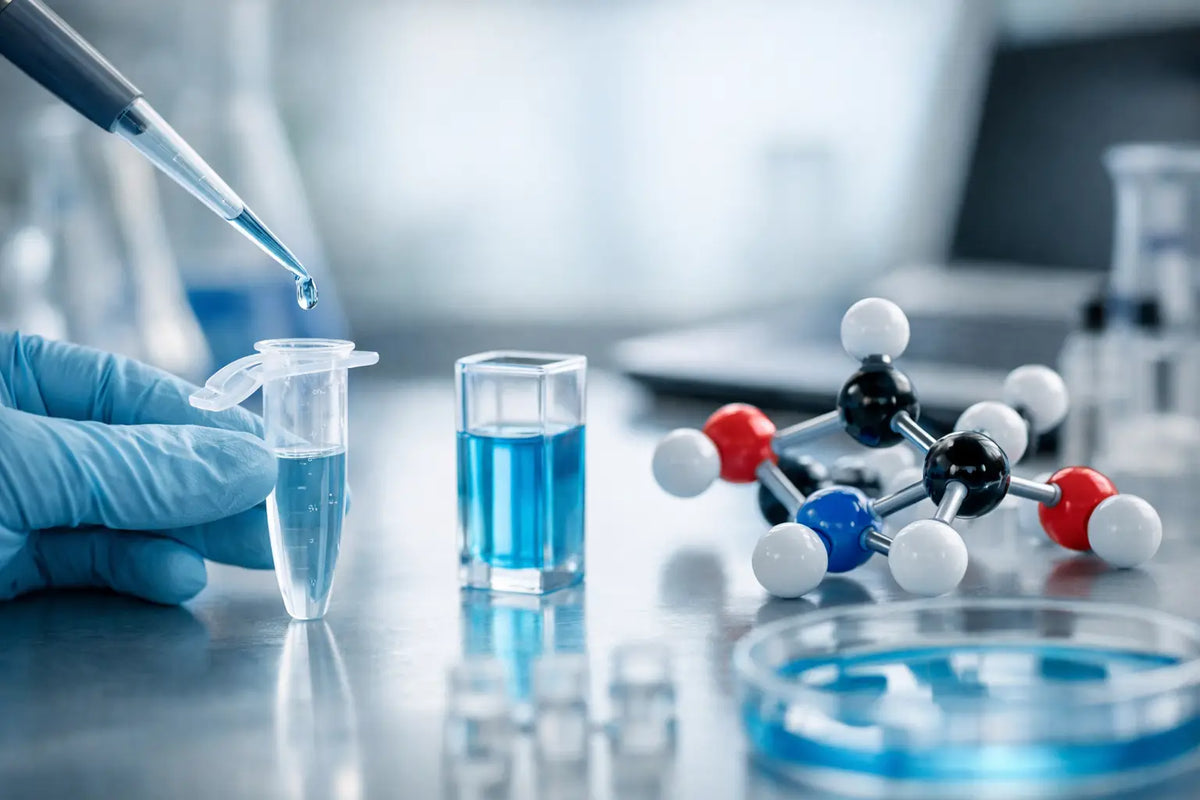
A peptide vial labelled 10 mg tells you mass, not concentration. The concentration only exists once you know how much solvent has been added, and that distinction is where many calculation errors start. If you need to know how to calculate peptide concentration accurately, the process is straightforward, but only if units, reconstitution volume, and intended working concentration all match.
For research buyers, this is not a minor detail. Concentration affects pipetting accuracy, protocol consistency, stock preparation, dilution planning, and reproducibility between runs. A high-purity peptide backed by a Certificate of Analysis still needs to be handled correctly in the lab. Good arithmetic protects the value of the material and the quality of the work.
How to calculate peptide concentration after reconstitution
The core formula is simple:
Concentration = amount of peptide ÷ volume of solvent
In practical terms, peptide amount is usually given in milligrams or micrograms, and solvent volume is usually measured in millilitres. Most researchers express the final result as mg/mL or mcg/mL.
If you reconstitute a 10 mg peptide vial with 2 mL of bacteriostatic water, the concentration is:
10 mg ÷ 2 mL = 5 mg/mL
That same figure can also be written as 5000 mcg/mL, because 1 mg equals 1000 mcg.
This is where accuracy matters. If the peptide mass is recorded in mg and the intended aliquot is measured in mcg, unit conversion has to be exact. Many handling mistakes come from correct arithmetic with mismatched units.
The unit conversions that matter most
Most peptide concentration problems come down to three unit relationships:
1 mg = 1000 mcg
1 mL = 1000 microlitres
So if a solution is 5 mg/mL, it is also:
5000 mcg/mL
5 mcg/microlitre
That final conversion is especially useful for pipetting. If your stock is 5 mcg per microlitre, then drawing 20 microlitres gives you 100 mcg of peptide.
Researchers who work quickly often skip writing this out. That is usually where preventable errors begin. It is better to convert once on paper or in a worksheet and then work from a single, clear concentration figure.
A practical method for calculating peptide concentration
The most reliable method is to work in sequence rather than mentally jumping between values. Start with the peptide mass in the vial. Then confirm the exact volume used for reconstitution. Then calculate the concentration in mg/mL. After that, convert into mcg/mL or mcg/microlitre if your protocol requires smaller measured quantities.
Take a 5 mg vial reconstituted with 1 mL of solvent. The concentration is 5 mg/mL. In smaller units, that becomes 5000 mcg/mL or 5 mcg/microlitre.
Take the same 5 mg vial reconstituted with 2.5 mL instead. Now the concentration is 2 mg/mL. In smaller units, that is 2000 mcg/mL or 2 mcg/microlitre.
The peptide amount did not change. Only the dilution changed. That is the point worth keeping in view throughout all reconstitution work.
Why solvent volume changes everything
Researchers sometimes choose a reconstitution volume based on convenience rather than calculation. That can be sensible, but it has consequences. A smaller solvent volume gives a more concentrated stock, which may reduce the volume needed for each aliquot. A larger solvent volume gives a less concentrated stock, which may make pipetting small amounts easier.
Neither approach is automatically better. It depends on the target concentration required by the research protocol, the precision of the pipettes available, the peptide’s handling characteristics, and how many working aliquots need to be prepared.
If your protocol requires repeated transfers of very small volumes, an overly concentrated solution can create avoidable pipetting error. If the stock is too dilute, you may need impractically large transfer volumes. The right reconstitution plan usually sits between those two extremes.
Worked examples of how to calculate peptide concentration
Example 1: 2 mg vial
A 2 mg peptide vial is reconstituted with 1 mL of solvent.
2 mg ÷ 1 mL = 2 mg/mL
That equals 2000 mcg/mL or 2 mcg/microlitre.
If you need 100 mcg, divide the required amount by the concentration per microlitre:
100 mcg ÷ 2 mcg/microlitre = 50 microlitres
Example 2: 10 mg vial
A 10 mg vial is reconstituted with 4 mL.
10 mg ÷ 4 mL = 2.5 mg/mL
That equals 2500 mcg/mL or 2.5 mcg/microlitre.
If you need 250 mcg, the transfer volume is:
250 mcg ÷ 2.5 mcg/microlitre = 100 microlitres
Example 3: 15 mg vial with a target working level
Suppose you have a 15 mg vial and want a stock concentration of 3 mg/mL.
Rearrange the formula:
Volume = amount ÷ target concentration
15 mg ÷ 3 mg/mL = 5 mL
So you would reconstitute the vial with 5 mL of solvent to produce a 3 mg/mL stock.
This reverse calculation is often the most useful one in practice because many labs start with the desired working concentration rather than the solvent volume.
How to calculate peptide concentration for serial dilution
Stock concentration is only the first step in many workflows. If the initial reconstituted peptide is too concentrated for direct use, a serial or secondary dilution may be needed.
For that, the standard dilution equation is:
C1V1 = C2V2
C1 is the starting concentration, V1 is the volume taken from that stock, C2 is the target concentration, and V2 is the final total volume.
For example, if your stock concentration is 5 mg/mL and you want 1 mL of a 1 mg/mL working solution:
5 mg/mL × V1 = 1 mg/mL × 1 mL
V1 = 0.2 mL
So you would take 0.2 mL, or 200 microlitres, of the stock and add solvent to a final volume of 1 mL.
This matters because concentration calculations do not stop at reconstitution. In many research settings, the initial vial becomes a stock solution, and the actual experimental material is a separately prepared working solution.
Common mistakes when calculating peptide concentration
The most common error is confusing total peptide mass with concentration. A 10 mg vial is not a 10 mg/mL solution unless it has been reconstituted in exactly 1 mL.
The next frequent issue is poor unit discipline. Switching between mg, mcg, mL, and microlitres without writing conversions down creates mistakes that may not be obvious until much later. If a result looks unexpectedly high or low, the first thing to check is the unit basis.
Another problem is assuming the labelled vial amount reflects the exact final liquid volume after mixing. In routine practice, researchers generally calculate from the solvent added, but precision work may require attention to total solution behaviour, especially where viscosity, adsorption, or handling losses are relevant.
There is also the practical issue of pipetting very small volumes. A mathematically correct concentration can still be operationally awkward if the resulting transfer volume is below the reliable range of your pipette. In those cases, changing the reconstitution volume or preparing an intermediate dilution is usually the better choice.
Choosing a useful concentration, not just a correct one
Knowing how to calculate peptide concentration is one thing. Choosing a concentration that fits the protocol is another. A stock that is technically correct but inconvenient to use can slow work and increase variation between operators.
A useful concentration should allow accurate pipetting, sensible aliquot sizes, stable storage planning, and minimal repeated freeze-thaw exposure where relevant. For some peptides, a concentrated stock is efficient. For others, preparing a more moderate stock and smaller working dilutions makes handling more controlled.
This is one reason serious buyers look beyond the label and focus on batch consistency, verified purity, and documentation. When the starting material is reliable, concentration calculations become a matter of lab discipline rather than guesswork. Suppliers such as ApexLink Peptides place emphasis on that chain of reliability because reconstitution and dilution only make sense when the base material is clearly specified.
A simple check before you use any stock
Before using a reconstituted peptide, confirm four points: the mass on the vial, the exact solvent volume added, the final concentration in the units required by the protocol, and the transfer volume needed for each aliquot or dilution step. If those four figures are written down clearly, most concentration errors disappear.
Precision in peptide work often looks unremarkable from the outside. It is usually a line in a notebook, a unit conversion done properly, or a reconstitution volume chosen for the reality of the bench rather than convenience. That quiet accuracy is what keeps research workflows consistent.
More from the research library.
How to Select Peptide Vial Sizes for Research
Learn how to select peptide vial sizes for research based on assay demand, reconstitution volume, stab...
Read article →
How to Calculate Peptide Molarity Correctly
Learn how to calculate peptide molarity from mass, molecular weight and reconstitution volume, with pr...
Read article →
Can Researchers Verify Peptide Identity Reliably?
Can researchers verify peptide identity? Learn how HPLC, mass spectrometry, batch records and Certific...
Read article →