
Lyophilised Peptide Storage: A Practical Guide
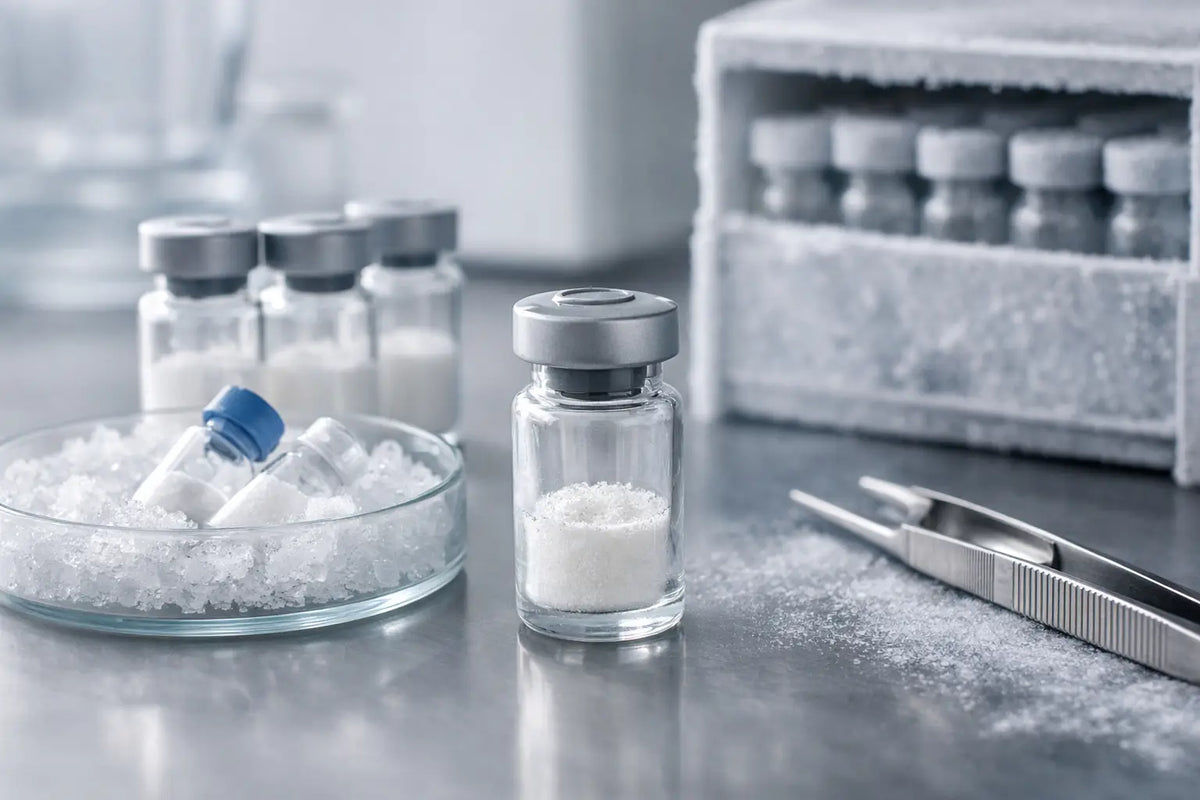
A lyophilised peptide vial can look unchanged while its research value has already been compromised. Lyophilised peptide storage is therefore not simply a matter of placing vials in a freezer. Temperature stability, moisture control, handling discipline and batch traceability all affect whether a material remains suitable for consistent laboratory work.
For research users, the objective is straightforward: preserve the peptide in the state in which it was supplied, minimise avoidable stress and maintain records that support confident use of the material. The supplier's product label, Certificate of Analysis and any product-specific handling guidance should always take priority over general storage advice.
Why lyophilised peptide storage needs control
Lyophilisation removes water from a peptide preparation under controlled conditions, producing a dry powder or cake that is generally more stable than the same peptide in solution. That increased stability is useful, but it is not unlimited. Peptides can still be affected by heat, humidity, oxidation, light exposure and repeated changes in their environment.
Moisture is a particular concern. A vial that is opened while still cold can attract condensation from ambient air. Even a small amount of introduced water may affect the dry material, particularly where the vial is opened repeatedly or stored without an effective seal. The risk is not always visible, which is why a consistent handling procedure matters more than a visual check alone.
Storage requirements also depend on the specific compound, vial format, intended storage duration and manufacturer data. A general rule may be appropriate for stock management, but it should never replace the stated requirements for the individual batch.
Establish the right temperature for the storage period
For unopened, lyophilised research peptides, frozen storage is commonly used to support longer-term stability. Many laboratories use a freezer at approximately -20°C for dry peptide stock, unless the supplier specifies a different condition. For materials requiring extended retention or particularly sensitive applications, lower-temperature storage may be appropriate where validated equipment is available.
The key variable is not only the target temperature but its consistency. A freezer that fluctuates significantly, is opened continuously or is used for mixed general stock may expose vials to repeated thermal stress. Position peptide stock away from the door and avoid placing it in areas prone to warm air exposure during routine access.
Refrigerated storage may be suitable for short holding periods only where the relevant product guidance supports it. Room-temperature storage should not be treated as a default option simply because a lyophilised vial appears dry and stable. Transit conditions, short bench work and long-term storage are different scenarios, and should be managed accordingly.
Avoid repeated temperature cycling
Repeatedly moving an entire vial collection between freezer, bench and refrigerator creates unnecessary variation. Instead, plan access around the experiment. Remove only the vial required, return remaining stock promptly and avoid keeping material at room temperature while preparing unrelated equipment or paperwork.
If a vial has been removed from frozen storage, allow it to reach room temperature before opening. This reduces the chance of moisture condensing inside the vial when the cap is removed. Once the vial is dry at room temperature, it can be handled according to the laboratory's approved procedure.
Keep moisture out from the first delivery to final use
A sealed lyophilised peptide vial should remain sealed until the point of required use. Store it in its original labelled packaging or in a suitable secondary container that protects it from humidity, physical damage and accidental mix-ups. A sealed box, freezer-safe bag or organised cryostorage container can also make stock control simpler.
Where supplied, retain protective materials such as desiccant packs within the secondary packaging unless product-specific instructions state otherwise. Desiccant does not correct poor handling, but it adds a practical layer of protection against moisture in the surrounding storage environment.
Do not leave vials uncapped, loosely capped or on an open bench. A short interruption can become a longer exposure than intended, especially in busy laboratory settings. If a vial must be accessed, keep the procedure focused and return the material to suitable storage without delay.
Protect identity, traceability and batch integrity
Storage is also a documentation issue. A correctly stored peptide without a clear identity, batch reference or receipt date can still become difficult to use with confidence. Every vial should remain associated with its original label and batch documentation throughout its lifecycle.
At minimum, laboratory records should capture the product name, batch or lot number, receipt date, storage location, stated storage condition and the date of first opening. For studies with tighter quality requirements, record freezer temperature checks, deviations, reconstitution details and each instance of material access.
This is where supplier documentation becomes operationally useful. A Certificate of Analysis confirms the identity and quality information associated with a batch at release, while clear internal records show how that batch was handled after receipt. ApexLink Peptides provides batch-specific Certificates of Analysis to support this traceability for research purchasers.
Use a practical labelling system
A secondary label can be helpful if the original vial label is small or likely to become obscured by frost. It should never replace the original supplier information. Record the product name, batch number, date received and any internal inventory reference on the outer container, then use a storage map or inventory log to identify the precise freezer position.
Clear labelling reduces a common but preventable problem: removing multiple similar vials and returning one to the wrong location. For labs handling several peptide formats, a simple location system is often more valuable than an overly complicated database that nobody updates.
Storage after reconstitution is a separate decision
Once a lyophilised peptide is reconstituted, its storage profile changes. A peptide in solution is generally more vulnerable to degradation than the dry material, and the suitable conditions depend on the peptide, solvent, concentration, container and intended study use.
Use an appropriate laboratory-grade diluent as required by the experimental method, and follow the product-specific guidance provided for the compound. Do not assume that the storage period for the dry vial applies after reconstitution. Where repeated access to a solution would introduce avoidable handling risk, aliquoting into suitable sterile containers may be considered as part of an approved laboratory workflow.
The trade-off is clear. Aliquots can reduce repeated access to a primary solution, but they create more containers, more labels and more opportunities for identification errors. Use aliquoting only where it improves control and where the lab can maintain accurate records.
Common failures that shorten usable life
Most avoidable storage failures are procedural rather than technical. Leaving vials on the bench, opening cold containers, storing stock near a freezer door and relying on memory instead of labels all introduce risk. So does treating a shared freezer as a controlled environment without monitoring its actual performance.
Power interruptions and equipment faults deserve a written response plan. If a freezer deviates from its set range, document the event, estimate the exposure period where possible and quarantine affected material until its suitability can be assessed against supplier guidance and internal quality procedures. Do not make a decision based solely on whether the vial still looks normal.
International delivery also requires sensible receipt handling. On arrival, inspect the parcel, confirm the contents against the order and transfer vials to the specified storage condition as soon as practical. Avoid unnecessary delays in warm collection areas, vehicles or unmonitored rooms.
A storage process built for reliable research
The most effective approach to lyophilised peptide storage is simple and repeatable: verify the batch documentation, place unopened vials at the specified condition, protect them from moisture and light, minimise temperature cycling and record every material-handling decision that could affect a result.
Good storage practice does not need to be elaborate, but it must be consistent. When each vial can be traced, each freezer condition is known and each handling step is deliberate, researchers spend less time questioning their stock and more time producing dependable work.
More from the research library.

How to Select Peptide Vial Sizes for Research
Learn how to select peptide vial sizes for research based on assay demand, reconstitution volume, stab...
Read article →
How to Calculate Peptide Molarity Correctly
Learn how to calculate peptide molarity from mass, molecular weight and reconstitution volume, with pr...
Read article →
Can Researchers Verify Peptide Identity Reliably?
Can researchers verify peptide identity? Learn how HPLC, mass spectrometry, batch records and Certific...
Read article →