
When Should Peptide Samples Be Aliquoted in Labs?
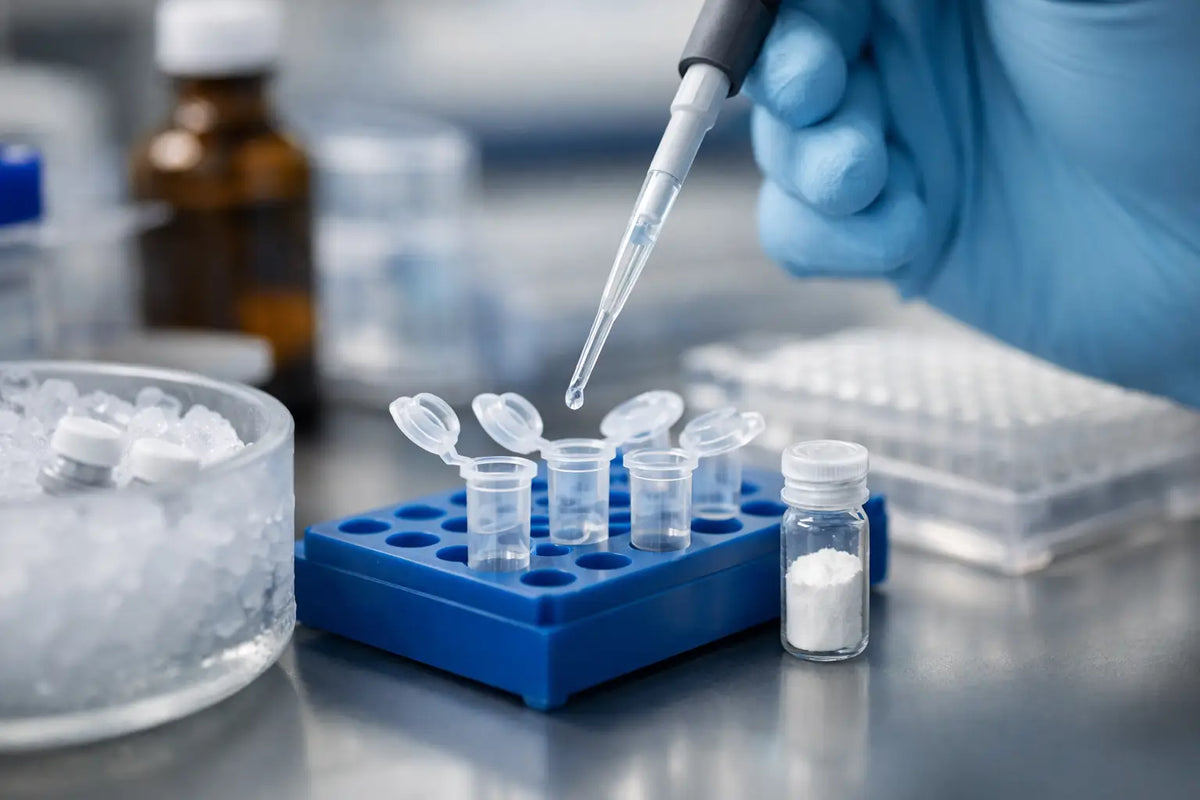
A peptide vial can remain chemically intact yet become less useful to a study if its handling history is unclear. Repeated warming, inconsistent working concentrations and unnecessary container transfers all introduce avoidable variables. The practical question is therefore not simply when should peptide samples be aliquoted, but whether aliquoting will reduce risk for the specific research workflow, storage period and analytical purpose.
For most laboratories, aliquoting is best considered when a reconstituted peptide stock will be accessed more than once. It allows researchers to thaw or prepare only the quantity required for a single planned session while keeping the remaining material protected from repeated temperature cycling and handling.
When should peptide samples be aliquoted?
Peptide samples should generally be aliquoted immediately after preparing a homogeneous stock solution, provided the peptide’s documented solvent compatibility and storage conditions support that approach. This is most relevant where one vial will supply multiple experiments over days or weeks, or where the material is sensitive to repeated freeze-thaw cycles.
The objective is straightforward: each aliquot should represent a defined, traceable portion of the same prepared stock. Once a working aliquot has been thawed or brought to the required temperature, it should be used according to the laboratory protocol rather than returned routinely to long-term frozen storage.
Aliquoting is particularly sensible when the research plan involves small, repeated volumes. Opening a master vial for every run increases the opportunity for contamination, evaporation, concentration drift and labelling errors. It can also make it difficult to determine whether an unexpected result reflects the experimental system or a change in sample condition.
There is no universal aliquot volume. The right volume is the amount likely to be consumed in one experimental session, plus a controlled allowance for pipetting losses where appropriate. Oversized aliquots defeat the purpose because unused material may still need to be discarded or re-frozen. Very small aliquots, however, can create disproportionate loss through adsorption and transfer steps.
The main reason: limit freeze-thaw exposure
Temperature cycling can affect peptide performance, but the extent depends on the sequence, formulation, concentration, solvent, storage temperature and duration. Some peptides tolerate carefully controlled handling better than others. A general rule is not a substitute for peptide-specific stability data.
Still, repeated freeze-thaw exposure is a controllable source of variability. Each cycle can place stress on the prepared solution and can increase the chance of condensation, accidental contamination or incomplete remixing. For research involving comparative assays, analytical measurements or repeated time points, minimising those variables protects the value of the original material.
Aliquoting also improves operational discipline. A frozen master stock should not become a daily-use vial simply because it is convenient. Where a peptide will be used frequently, a better approach is to keep master aliquots under the recommended long-term conditions and prepare a short-term working aliquot only when justified by the study schedule.
Researchers should avoid assuming that all frozen storage is equivalent. A sample held at a stable validated temperature with minimal disturbance is not exposed to the same conditions as one repeatedly removed from storage, left on a bench and returned. Temperature history matters as much as the nominal storage setting.
Reconstitute first, then aliquot in most cases
For many lyophilised research peptides, the most controlled approach is to reconstitute the vial using the appropriate laboratory-grade diluent, mix gently until homogeneous, then divide the prepared stock into pre-labelled aliquots. This approach supports consistent concentration across the aliquots and reduces repeated access to the original vial.
The choice of diluent must be guided by the peptide’s technical information and the intended experimental method. Solvent selection can affect solubility, adsorption, pH and downstream assay compatibility. Do not select a diluent solely because it is commonly used for another peptide.
Splitting dry lyophilised material before reconstitution is usually less practical for small quantities. It can introduce weighing inaccuracies, static-related loss and greater exposure to moisture. Dry aliquoting may be appropriate in a controlled laboratory setting with validated equipment and a clear reason to create multiple independent stocks, but it is not the default solution for routine handling.
When aliquoting may not be necessary
Aliquoting is not automatically the best option. If the full vial will be used in one validated experiment shortly after reconstitution, additional transfers may add more risk than they remove. Every transfer has the potential for sample loss, contamination or adsorption to the vessel surface.
It may also be preferable to retain a single stock where the assay requires a freshly prepared solution, where solution stability is short or uncertain, or where only one or two carefully planned withdrawals are needed. In these cases, the priority is to follow documented stability guidance and record the handling history accurately.
Some workflows benefit from a two-tier arrangement. A master stock is divided into several larger aliquots, while one aliquot is designated as a short-term working stock. This can reduce disturbance to the long-term material without generating an excessive number of tiny tubes. It is a useful option for ongoing programmes where assay demand is predictable but not identical each day.
Building an aliquoting plan that supports reliable data
Aliquoting works best when it is planned before the vial is opened. Calculate the concentration required for the study, the number of planned experimental runs, the expected volume per run and any controlled dead-volume allowance. From there, choose an aliquot size that matches real usage rather than an arbitrary tube volume.
Use compatible, clean containers suited to low-volume laboratory work. Low-binding tubes may be appropriate where peptide adsorption is a concern, especially at low concentrations. The selected container should be consistent across the study where possible, because changes in plastic type, tube geometry or transfer method can affect recovery.
Label every aliquot before filling it. At minimum, the label or associated laboratory record should identify the peptide, batch or lot reference, stock concentration, diluent, preparation date, storage condition and aliquot identifier. If more than one operator handles the material, include preparer initials and a clear status field for whether the aliquot is unopened, in use or discarded.
A disciplined workflow can be organised around four controls:
- Prepare only in a clean, suitable work area using calibrated equipment.
- Mix reconstituted material gently and consistently before division, avoiding unnecessary agitation.
- Freeze or store aliquots promptly under the documented conditions for that peptide and formulation.
- Record each thaw, use event, transfer or disposal decision in the study record.
Protect concentration and identity during handling
Aliquoting is only useful if every tube remains identifiable and representative of the original stock. Poor labelling can turn a well-intended process into a larger risk than repeated access to one vial. Labels should remain legible at the intended storage temperature, and tube positions should be recorded when multiple aliquots are stored together.
Concentration control deserves equal attention. Reconstituting to a convenient concentration may appear efficient, but it should still align with the range required by the method. Extremely dilute stocks can increase adsorption and pipetting uncertainty, while unnecessarily concentrated stocks may require repeated dilution steps before use. Select a concentration that reduces avoidable manipulation.
For light-sensitive or otherwise labile materials, limit exposure during preparation and storage according to available technical guidance. Avoid making assumptions based on peptide name alone. Sequence, modification, conjugation and formulation can materially change handling requirements.
Documentation begins with the supplied batch data
A reliable aliquoting plan starts with a reliable starting material. Review the product specification, batch identification and Certificate of Analysis before preparation, then keep that information connected to the internal sample record. This establishes a clear chain from received vial to prepared aliquot and final research use.
For laboratories purchasing research peptides from ApexLink Peptides, batch documentation and HPLC-verified purity information can form part of that starting record. The laboratory must still validate its own reconstitution, storage and analytical procedures for the intended application.
If stability information is limited, use a conservative approach: prepare smaller amounts, minimise handling, avoid unnecessary temperature cycling and assess performance with suitable controls. Where a programme depends on extended storage after reconstitution, a peptide-specific stability assessment is more defensible than relying on general storage conventions.
A well-designed aliquot is a small operational control with a large effect on consistency. Prepare it only when it fits the study plan, label it so its history is unmistakable, and treat each thaw as part of the experimental record rather than a routine convenience.
More from the research library.
How to Select Peptide Vial Sizes for Research
Learn how to select peptide vial sizes for research based on assay demand, reconstitution volume, stab...
Read article →
How to Calculate Peptide Molarity Correctly
Learn how to calculate peptide molarity from mass, molecular weight and reconstitution volume, with pr...
Read article →
Can Researchers Verify Peptide Identity Reliably?
Can researchers verify peptide identity? Learn how HPLC, mass spectrometry, batch records and Certific...
Read article →