
Peptide Cold Chain Packaging That Protects Quality
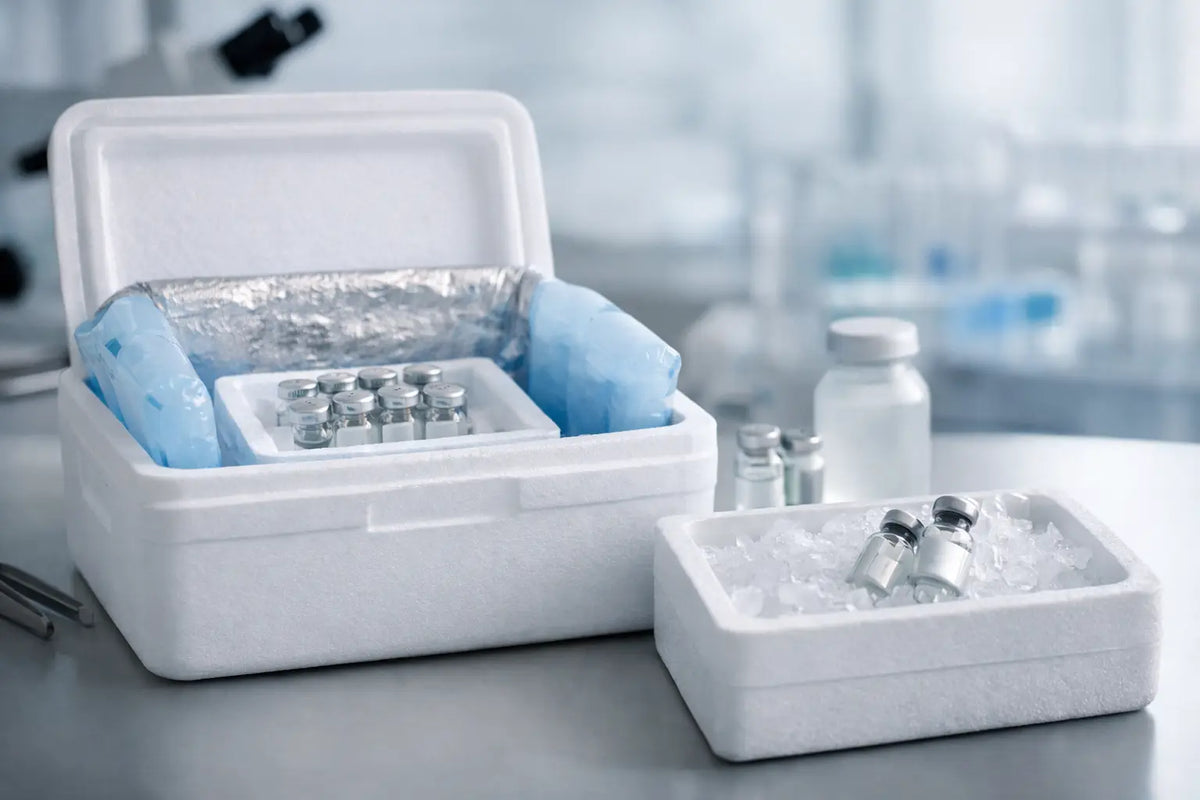
A peptide shipment can leave a controlled facility in excellent condition and still arrive unsuitable for research if temperature exposure is not managed properly. Peptide cold chain packaging is therefore not an optional delivery extra. It is part of the handling system that helps protect product quality between dispatch and receipt, particularly for temperature-sensitive, laboratory-grade compounds.
For research buyers, the question is not simply whether a parcel was sent with a cold pack. The relevant question is whether the packaging design, transit service and receiving process were appropriate for the product format, the expected journey and the conditions it may encounter. A well-documented batch and Certificate of Analysis establish confidence before dispatch. Correct cold chain handling helps maintain that confidence while the order is in transit.
Why peptide cold chain packaging matters
Peptides can be sensitive to heat, moisture, repeated temperature cycling and prolonged exposure outside their recommended storage range. The level of sensitivity depends on the specific compound, its formulation and whether it remains lyophilised or has already been reconstituted. A dry, lyophilised vial is generally more practical to ship than a prepared solution, but it should still be protected from avoidable heat and environmental stress.
Cold chain packaging is designed to create a temporary controlled environment around the order. It slows heat transfer from the outside world and maintains a more suitable internal temperature for the planned duration of transit. It does not eliminate every risk. A delayed parcel, an extreme weather event or prolonged time in an unconditioned depot can exceed the capability of any finite packaging system. The objective is to select protection that matches the risk rather than rely on a generic box and a single cold pack.
This distinction matters for buyers comparing suppliers. Fast dispatch is valuable, but it is only one part of product protection. The dispatch day, carrier route, insulation, refrigerant capacity and packing method all affect the condition in which an order is received.
The components of effective cold chain packaging
A practical peptide cold chain system usually combines insulated outer packaging, a refrigerant source, protective internal packing and a dispatch method chosen to limit time in transit. Each component has a specific role.
Insulation controls the rate of heat gain
Insulated liners, foam shippers and thermal pouches reduce the speed at which external temperatures affect the parcel interior. Better insulation does not create cold temperatures on its own. It preserves the cooling effect provided by refrigerants for longer, which is especially relevant during summer transport, international journeys and periods when parcels may wait before final delivery.
Packaging should also prevent direct contact between a vial and a frozen refrigerant pack where that contact could create an unnecessarily cold localised area. Internal separation and secure positioning help avoid movement, breakage and uneven temperature exposure.
Refrigerants provide the cooling capacity
Gel packs, phase-change packs and dry ice are not interchangeable. Gel packs are commonly used for chilled shipments and can be suitable where the target range and expected journey are well understood. Phase-change materials can be selected to hold a narrower temperature range, although they require more deliberate conditioning before packing.
Dry ice is intended for frozen transport and has additional operational constraints. It sublimates over time, requires appropriate labelling and can be unsuitable for routes or carriers with restrictions. Using the coldest available option is not automatically the correct decision. If a product is intended to remain refrigerated rather than frozen, an incorrectly configured dry ice shipment may introduce a different avoidable risk.
The appropriate refrigerant depends on the product manufacturer's handling guidance, the form of the material and the transport lane. Research buyers should be cautious of one-size-fits-all claims, particularly when shipping conditions vary substantially by destination and season.
Outer protection still matters
Thermal performance is only useful if the vial reaches the destination intact. A secure inner container, cushioning, moisture protection and a suitably sized outer carton reduce the chance of breakage or compromised packaging. Discreet external presentation can also support reliable fulfilment without drawing unnecessary attention to the contents.
Temperature control must account for the full journey
A parcel's transit time is more than the carrier's advertised delivery window. It includes order processing, collection cut-off times, movement through sorting facilities, customs clearance where applicable, the final delivery attempt and any time waiting for collection. International shipments need particular attention because clearance delays can be unpredictable.
The most effective approach is to dispatch early in the week, avoid sending temperature-sensitive goods immediately before a weekend or public holiday where possible, and use a service suited to the destination. Same-day dispatch before the relevant cut-off can reduce unnecessary dwell time, but it should be paired with realistic delivery expectations rather than broad promises.
Seasonality changes the calculation. A package travelling through high summer temperatures may need more insulation or refrigerant capacity than the same parcel shipped during cooler months. Conversely, winter routes can expose parcels to low temperatures that are not appropriate for every product. Packaging is not static. It should reflect the lane, weather exposure and anticipated delivery time.
For wholesale orders, a larger thermal mass can sometimes improve temperature stability, but volume also brings practical considerations. More vials may require a larger shipper, additional coolant and stronger internal organisation. Bulk fulfilment should be planned as a shipment system, not treated as a standard parcel with more units added.
Receiving a cold chain peptide order
The receiving process is the final control point. Research teams should arrange delivery to a location where the parcel can be brought indoors promptly and inspected by someone familiar with the order. Leaving a temperature-sensitive parcel outside, in a vehicle or in an unconditioned reception area can undo the protection built into the shipment.
On receipt, inspect the outer carton and thermal packaging before handling the vials. Check for damage, leakage, loose caps, broken glass or signs that refrigerant has fully depleted earlier than expected. Where a temperature indicator or data logger has been provided, retain it and review the recorded information according to the supplier's instructions.
The material should then be transferred to storage consistent with the product-specific guidance and the laboratory's internal procedures. Do not assume that all peptides have identical requirements. Storage recommendations can differ between compounds and may also differ between lyophilised material and reconstituted solutions. Reconstitution should only be performed in an appropriate research setting using suitable materials and documented handling procedures.
If an order arrives damaged or appears to have experienced a significant transit issue, document the parcel condition promptly with clear photographs, retain the packaging and contact the supplier without delay. Useful evidence includes the delivery time, condition of the refrigerants, photographs of the internal layout and any available temperature-monitoring record. Timely reporting gives the supplier the best opportunity to investigate the shipment route and packing performance.
What reliable suppliers should make clear
Cold chain packaging should sit alongside, not replace, wider quality controls. A supplier's HPLC purity result and Certificate of Analysis provide batch-level documentation. They do not prove that an individual parcel remained within a target temperature range during every minute of transit. Clear communication about these separate controls is a sign of professional handling.
Before placing an order, research buyers should be able to establish the product's stated storage guidance, whether chilled packaging is used when appropriate, the expected dispatch schedule, the carrier service and the process for reporting transit concerns. For international orders, clarity on customs documentation and possible delivery delays is equally useful.
ApexLink Peptides approaches fulfilment with the same emphasis on traceability and operational reliability used for its laboratory-grade catalogue. Batch verification, Certificates of Analysis, prompt dispatch and responsive support give research customers a clearer basis for managing their own receiving and storage procedures.
Cold chain performance is strongest when supplier and recipient each control their part of the process. Select a supplier that communicates specifications clearly, plan delivery around the destination's real conditions, and move the order into the correct storage environment as soon as it arrives. That practical discipline protects the value of the material long after the parcel has been opened.
More from the research library.

How to Select Peptide Vial Sizes for Research
Learn how to select peptide vial sizes for research based on assay demand, reconstitution volume, stab...
Read article →
How to Calculate Peptide Molarity Correctly
Learn how to calculate peptide molarity from mass, molecular weight and reconstitution volume, with pr...
Read article →
Can Researchers Verify Peptide Identity Reliably?
Can researchers verify peptide identity? Learn how HPLC, mass spectrometry, batch records and Certific...
Read article →