
Lab Peptide Calculator: Get Reconstitution Right
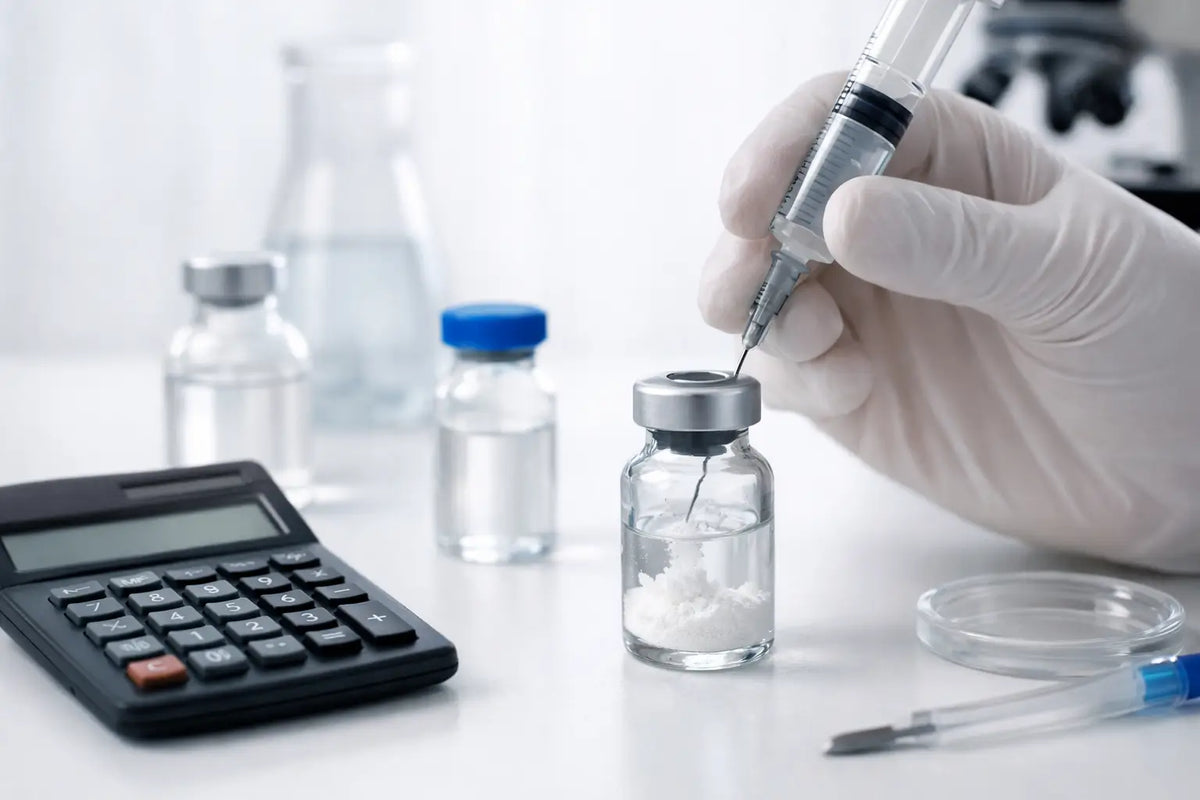
A 5 mg vial, 2 mL of bacteriostatic water, and a target of 250 mcg per marked increment can look straightforward until the numbers stop lining up. A lab peptide calculator exists for exactly this reason - to remove avoidable arithmetic errors from peptide reconstitution and support consistent research handling from the first draw to the last.
For research buyers, calculation mistakes are rarely dramatic at the point they happen. They usually appear later as inconsistent concentrations, poor repeatability between runs, or confusion over how much volume actually corresponds to the intended amount. When compounds are purchased for laboratory and investigational use, precision matters as much as purity. A calculator does not replace technical understanding, but it does reduce routine errors in a part of the workflow where small misjudgements can compound quickly.
What a lab peptide calculator actually does
A lab peptide calculator converts three practical inputs into a usable concentration framework. In most cases, those inputs are the amount of peptide in the vial, the volume of diluent added, and the amount you want to draw or measure. From there, it estimates concentration per mL and helps determine how much liquid corresponds to a selected mcg amount.
That sounds basic, but basic does not mean trivial. Reconstitution errors often come from unit confusion rather than complex maths. Milligrams and micrograms are mixed up. A user remembers the vial size but forgets the final added volume. Syringe markings are interpreted as peptide mass rather than liquid volume. The calculator creates a clean conversion path so each stage is tied to the actual concentration in solution.
In practical terms, if a 10 mg vial is reconstituted with 2 mL of diluent, the concentration becomes 5 mg per mL, or 5000 mcg per mL. If the research protocol requires 250 mcg, the required volume is 0.05 mL. This is exactly the kind of quick conversion a calculator handles well.
Why calculation accuracy matters in peptide handling
Research-grade peptide purchasing is already built around control points. Buyers want HPLC-verified purity, batch consistency, and documentation because variable inputs undermine useful results. Reconstitution is another control point. If the compound is consistent but the concentration is not, the reliability of the handling process is weakened.
The issue is not simply getting close enough. It depends on the context of the research. In some workflows, a minor difference may be tolerable. In others, especially where repeatability matters across multiple preparations, small concentration discrepancies create avoidable noise. A lab peptide calculator helps standardise the arithmetic so the handling process better matches the standard expected from the material itself.
There is also a traceability benefit. When a team records vial strength, added diluent, and resulting concentration in a consistent way, later review becomes easier. That matters for internal records, handovers, and repeat ordering. A clean calculation process supports cleaner documentation.
The core inputs you need before using a lab peptide calculator
Before using any calculator, the source figures must be correct. The first is the peptide quantity in the vial, usually shown in mg. The second is the total volume of diluent added during reconstitution, generally measured in mL. The third is the target amount you want to measure, usually expressed in mcg.
This is where users most often introduce mistakes. The labelled peptide mass is not the same thing as the amount per syringe mark after dilution. That only becomes clear once the total final volume is known. If 5 mg is reconstituted with 1 mL, the concentration is very different from the same 5 mg reconstituted with 2 mL. The vial content has not changed, but the usable concentration has.
It is also worth checking whether the process assumes the full stated volume has been added successfully. If some liquid is lost during transfer or handling, the real concentration may differ from the planned one. A calculator can only work from the inputs given. If those inputs are inaccurate, the output will be inaccurate too.
Unit discipline matters more than people expect
Most avoidable errors come from unit conversion. One milligram equals 1000 micrograms. If that step is missed, every subsequent figure is wrong by a factor of 1000. That is not a small rounding issue. It changes the entire concentration framework.
Likewise, syringe markings must be interpreted as volume, not compound quantity. A marking of 0.1 mL does not mean 0.1 mg or 100 mcg unless the solution concentration has already been calculated. The calculator bridges that gap, but only if the user remains disciplined about what each number represents.
How to use a lab peptide calculator properly
The cleanest way to use a calculator is to work in sequence. Start with the vial amount in mg. Add the chosen diluent volume in mL. Confirm the resulting concentration in both mg/mL and mcg/mL. Only then calculate the volume required for the intended mcg amount.
For example, if a 5 mg vial is reconstituted with 2 mL, the resulting concentration is 2500 mcg/mL. If you need 500 mcg, the draw volume is 0.2 mL. If you need 250 mcg, the draw volume is 0.1 mL. Once the concentration is clear, the rest becomes a simple volume question.
The real value here is consistency. If the same reconstitution approach is used each time for the same compound size, the resulting concentration remains predictable. That makes day-to-day handling easier and reduces the likelihood of recalculating from memory.
Choosing the reconstitution volume
There is no single correct dilution volume for every peptide or every workflow. It depends on the intended concentration, the precision required at measurement, and the practicality of the syringe markings being used. Some researchers prefer a more concentrated solution to reduce draw volume. Others prefer greater dilution because it makes small measurements easier to distinguish.
That is where a calculator becomes especially useful. It lets you compare possible setups before reconstitution. If one configuration produces awkward draw volumes, such as volumes too small to measure comfortably, another may offer better handling precision. The aim is not just mathematical correctness but operational practicality.
Common mistakes a calculator helps prevent
The first common mistake is treating all vial sizes as if they can be reconstituted the same way without consequence. A 2 mg vial and a 10 mg vial diluted with the same liquid volume will not produce the same concentration. The second is relying on memory for frequent conversions. Even experienced buyers can transpose numbers or forget whether a prior setup used 1 mL or 2 mL.
The third is assuming a syringe scale translates directly into mcg. It does not. The same 0.1 mL draw represents very different mcg amounts depending on the concentration in the vial. A calculator keeps the volume-to-amount relationship explicit.
Another issue is overconfidence in informal notes. If records simply say reconstituted as usual, that is not useful for repeatability. A better approach is to record the vial strength, the exact diluent volume, and the resulting concentration. That way the calculator output becomes part of the handling record, not just a one-off convenience.
Calculator use should sit alongside product quality controls
A good calculation process cannot compensate for poor material quality. If batch consistency, purity verification, or product documentation are weak, the arithmetic may be perfect while the research input remains uncertain. Serious buyers tend to evaluate both sides together: quality of compound and accuracy of handling.
That is why tools such as a lab peptide calculator matter most when paired with clear specifications, Certificate of Analysis access, and reliable fulfilment. Precision works best when the full chain supports it, from sourcing through storage and reconstitution to final measurement. ApexLink Peptides approaches buyer support in that practical way - not as marketing decoration, but as part of making research handling more consistent and less error-prone.
When a calculator is helpful, and when it is not enough
A calculator is highly effective for standard concentration maths. It is less useful if the user is uncertain about basic handling requirements, storage conditions, or whether the selected diluent and reconstitution plan make sense for the specific research context. It also does not correct poor lab discipline. If labels are incomplete or records are inconsistent, the numbers alone will not protect the process.
The sensible approach is to use the calculator as one part of a controlled workflow. Confirm the vial size, verify the batch documentation, measure the diluent carefully, record the final concentration, and label the reconstituted solution clearly. That takes only a few moments, but it reduces the chance of confusion later.
For experienced peptide buyers, the strongest reason to use a lab peptide calculator is not because the maths is difficult. It is because repeatable research depends on removing preventable variation wherever possible. If a simple calculation tool can make reconstitution clearer, cleaner, and easier to document, it has done exactly what it should.
More from the research library.
How to Select Peptide Vial Sizes for Research
Learn how to select peptide vial sizes for research based on assay demand, reconstitution volume, stab...
Read article →
How to Calculate Peptide Molarity Correctly
Learn how to calculate peptide molarity from mass, molecular weight and reconstitution volume, with pr...
Read article →
Can Researchers Verify Peptide Identity Reliably?
Can researchers verify peptide identity? Learn how HPLC, mass spectrometry, batch records and Certific...
Read article →