
What Is HPLC Peptide Testing?
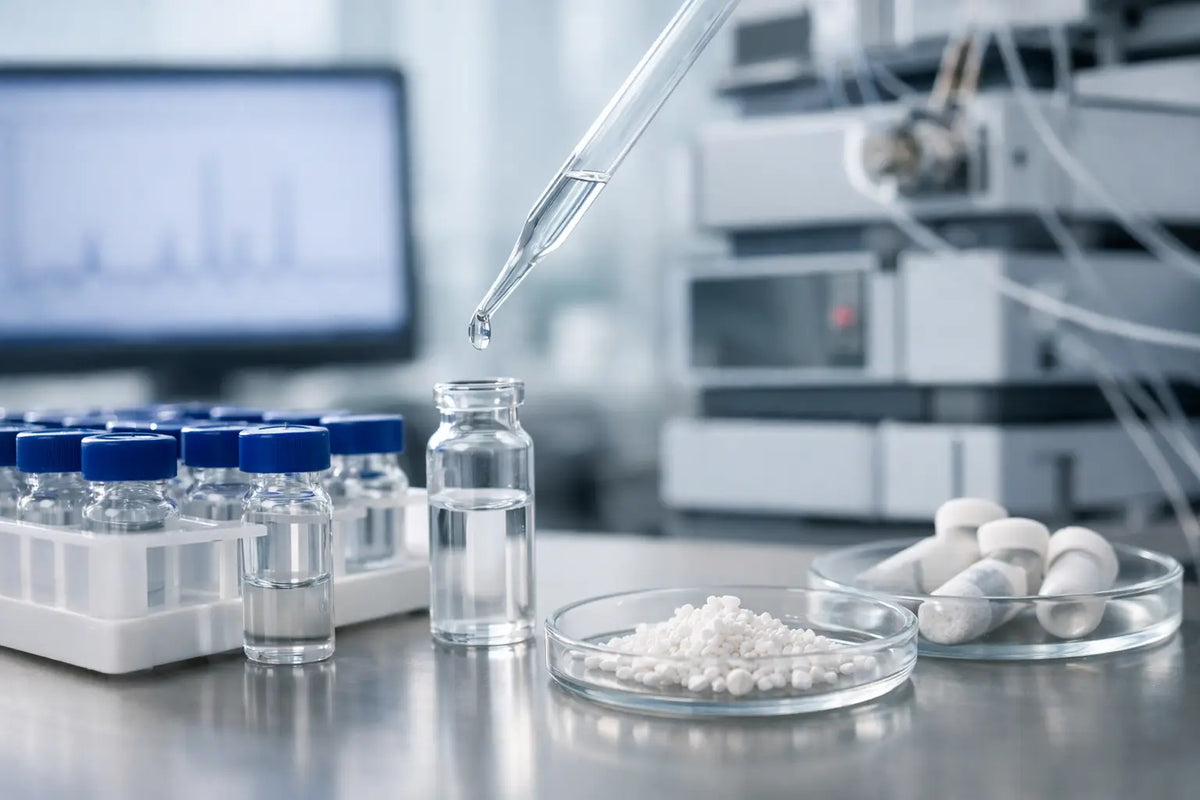
If you are comparing peptide suppliers and one batch claims 99% purity while another simply says "lab tested", the difference usually comes down to documentation. What is HPLC peptide testing, exactly? It is one of the main analytical methods used to assess peptide purity by separating the components within a sample and showing how much of the material matches the target compound.
For research buyers, that matters for a simple reason. A peptide is only as useful as its verified composition. If a batch contains higher-than-expected impurities, inconsistent synthesis by-products, or degradation, your research results can become harder to interpret. HPLC gives you a clearer basis for evaluating whether a peptide batch is suitable for research use.
What is HPLC peptide testing used for?
HPLC stands for High-Performance Liquid Chromatography. In peptide analysis, it is used to separate the different compounds present in a sample so that the primary peptide peak can be measured against any secondary peaks. Those secondary peaks may represent synthesis impurities, truncated sequences, residual by-products, or degradation products.
In practical terms, HPLC peptide testing helps answer a buyer's most immediate question: does this vial contain predominantly the peptide named on the label, or is the sample carrying a meaningful impurity load?
That does not mean HPLC tells you everything about a peptide. It is a strong tool for purity analysis, but it is not the same as a full identity confirmation on its own. Most serious research buyers understand this point already. HPLC is highly useful, but best read alongside batch data such as a Certificate of Analysis and, where relevant, additional analytical methods.
How HPLC peptide testing works
The principle is straightforward. A prepared sample is injected into an HPLC system and passed through a column under pressure. Different components in the sample interact differently with the stationary phase inside the column and the mobile phase moving through it. Because of those differences, compounds separate and exit the column at different times.
As they elute, a detector records their presence as peaks on a chromatogram. The main peak is typically the target peptide. Smaller peaks may indicate impurities or related compounds. The relative area of those peaks is then used to estimate purity.
For example, if the target peptide accounts for around 99% of the total detected peak area under the test conditions, that batch may be reported as 99% pure by HPLC. This is why you often see purity claims paired with chromatograms or Certificates of Analysis. The purity figure is not supposed to be a vague marketing statement. It should come from measured analytical output.
What a chromatogram actually tells you
A chromatogram is the visual result of the HPLC run. For experienced buyers, it is one of the most useful pieces of batch documentation because it gives a direct view of peak distribution rather than only a headline purity number.
A clean chromatogram usually shows one dominant peak and minimal secondary peaks. That is generally what you want to see in a high-purity peptide batch. If the trace shows several significant peaks, the batch may contain more impurities than the label suggests, or the reported purity may need closer review.
That said, interpreting a chromatogram is not always as simple as looking for a single line. Method conditions matter. Column type, solvent system, gradient, detection wavelength, sample preparation, and integration settings can all affect the appearance of the output. Two laboratories can test the same peptide using different validated conditions and produce chromatograms that look somewhat different while still reaching a comparable conclusion.
This is why documentation quality matters as much as the number itself. A supplier that provides clear, batch-specific data is giving you more to work with than one relying on broad, unverified claims.
Why HPLC matters when buying research peptides
For research use, consistency is rarely optional. Whether you are ordering a single vial for analytical work or placing a larger volume order for repeated experimental use, batch quality affects handling, interpretation, and confidence in the material.
HPLC peptide testing matters because it helps reduce uncertainty at the point of purchase. It gives buyers a way to compare batches on something measurable rather than relying on branding alone. A documented purity result, especially when supported by a Certificate of Analysis, helps establish traceability and gives a clearer standard for supplier assessment.
This is particularly relevant in a market where not every seller applies the same level of quality control. Some suppliers advertise peptides with little or no usable batch documentation. Others may publish generic certificates that are not tied to the lot being sold. For serious buyers, that is usually a warning sign.
A batch-specific HPLC result does not eliminate all risk, but it does materially improve transparency. That is why HPLC-verified purity has become one of the baseline expectations for credible peptide sourcing.
What HPLC does not tell you
One common mistake is treating HPLC as a complete analytical answer. It is not. HPLC is highly effective for assessing purity under the test conditions used, but it does not automatically confirm every aspect of identity, content, sterility, or long-term stability.
For instance, a high-purity chromatogram does not by itself prove that a peptide has been stored correctly throughout the supply chain. It also does not replace proper handling after delivery. If a batch is exposed to poor storage conditions, contamination, or repeated temperature stress, that can affect material quality after testing has already taken place.
There is also the issue of method relevance. A purity percentage only means something in the context of the testing method used. Good suppliers understand that analytical data should support, not substitute for, broader quality assurance practices such as controlled production standards, batch traceability, correct packaging, and access to support when buyers need clarification.
What to look for in HPLC peptide documentation
When reviewing a peptide listing, the purity claim should be specific and tied to documentation. A vague statement such as "tested for quality" is not especially useful. A stronger standard is a batch-specific Certificate of Analysis showing the peptide name, lot reference, test method, and reported purity.
If a chromatogram is included, look for a dominant main peak and reasonable integration. If the supplier only publishes a generic image with no batch reference, that is less helpful than documentation linked to the product lot you are actually purchasing.
It is also worth checking whether the supplier presents purity as a minimum batch standard rather than an occasional best-case result. Consistency across the catalogue is often a better indicator of operational reliability than a single impressive figure.
For buyers sourcing laboratory-grade compounds, this is where a supplier's overall process becomes relevant. HPLC data is most useful when it sits within a broader quality framework that includes documented batch control, responsive support, and reliable dispatch. At ApexLink Peptides, that focus on HPLC-verified purity and batch documentation is central because research buyers need more than a claim on a product page.
What is HPLC peptide testing in real purchasing terms?
In plain purchasing terms, HPLC peptide testing is a filter for trust. It helps you distinguish between compounds that are analytically supported and compounds that are simply advertised.
If you are comparing suppliers of BPC-157, GHK-Cu, MOTS-c, SS-31, or combination products such as CJC-1295 no DAC with Ipamorelin, the presence of HPLC-backed purity data gives you a stronger basis for decision-making. It does not mean every high-purity batch is identical in every respect, and it does not remove the need for correct storage and handling. But it does mean you are buying against a measurable standard.
That is especially important for repeat orders and wholesale purchasing. Once you move beyond one-off buying, consistency becomes as important as the listed specification. HPLC supports that consistency by providing a repeatable analytical reference point from batch to batch.
Why experienced buyers ask for more than a purity number
A 99% purity statement catches attention, but experienced buyers usually want to know how that figure was established and whether the documentation is current, specific, and credible. The number alone is useful. The supporting evidence is what makes it actionable.
This is where supplier transparency separates professional operations from weaker ones. A seller that can provide proper batch documentation, explain how purity is assessed, and maintain reliable fulfilment standards is generally easier to work with over time. In a research supply environment, that operational dependability matters almost as much as the analytical result itself.
When you see HPLC on a peptide listing, treat it as the start of due diligence rather than the end of it. Used properly, it is one of the clearest indicators that a supplier understands what serious research buyers expect and is prepared to show the work behind the label.
More from the research library.
How to Select Peptide Vial Sizes for Research
Learn how to select peptide vial sizes for research based on assay demand, reconstitution volume, stab...
Read article →
How to Calculate Peptide Molarity Correctly
Learn how to calculate peptide molarity from mass, molecular weight and reconstitution volume, with pr...
Read article →
Can Researchers Verify Peptide Identity Reliably?
Can researchers verify peptide identity? Learn how HPLC, mass spectrometry, batch records and Certific...
Read article →