
Which Buffer Suits Peptides? A Selection Guide
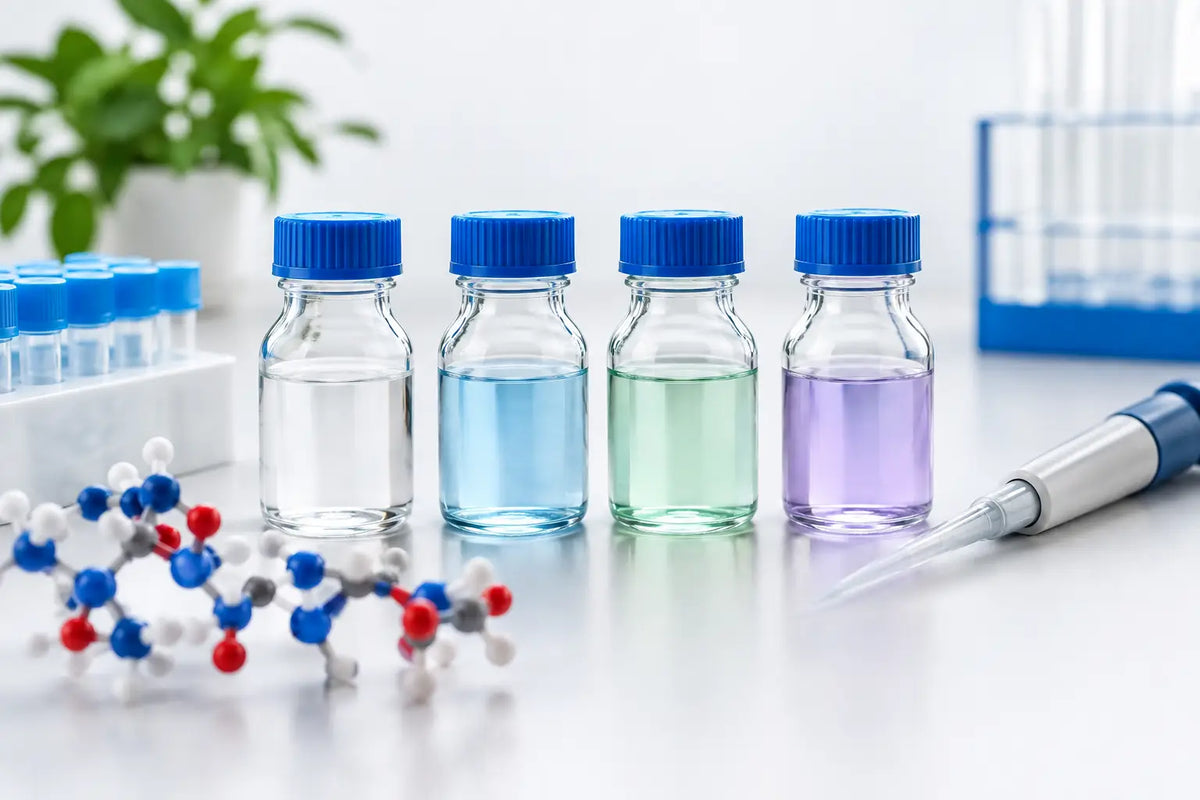
A peptide can meet a high purity specification and still produce inconsistent research results if its buffer environment is unsuitable. The question, which buffer suits peptides, cannot be answered by naming one universal solution. Buffer choice must reflect the peptide sequence, intended analytical method, concentration, storage period and the specific instability risk being controlled.
For research buyers, the practical objective is clear: select a buffer that maintains solubility and structural integrity without introducing interference into the assay, chromatography method or downstream experiment. Batch documentation confirms the starting material; buffer selection helps preserve its usability after preparation.
Which buffer suits peptides in research work?
The best buffer is usually the one that holds the peptide at a pH where it remains soluble and chemically stable, while contributing as little analytical noise as possible. This is why phosphate-buffered saline may be appropriate for one experiment and a poor choice for another.
A useful starting point is the peptide's amino-acid composition. Acidic and basic residues influence net charge at a given pH. A peptide generally has greater solubility when it carries a meaningful net charge, rather than sitting close to its isoelectric point, where self-association and precipitation become more likely. Hydrophobic sequences introduce an additional challenge: even at a favourable pH, they may aggregate at higher concentrations or after repeated freeze-thaw exposure.
The intended use matters equally. A buffer selected for short-term receptor binding work may not be suitable for LC-MS sample preparation. A formulation that improves physical stability can interfere with UV measurements, cell-based assays or mass spectrometry. There is no benefit in improving solubility if the added component compromises the readout.
Start with the peptide's known properties
Before choosing a buffer, review the supplier's Certificate of Analysis, sequence information where available, molecular weight and product handling guidance. The Certificate of Analysis supports identity and purity assessment, but it does not replace compatibility testing under a laboratory's own conditions.
Pay particular attention to cysteine, methionine, tryptophan, asparagine and glutamine residues. Cysteine-containing peptides can be sensitive to oxidation and disulphide exchange. Methionine and tryptophan may be vulnerable to oxidative degradation. Asparagine and glutamine can be susceptible to deamidation, particularly under less favourable pH and temperature conditions. These sequence-level considerations often determine whether pH control, oxygen exposure, light protection or limited storage time deserves the greatest attention.
A small-scale screening exercise is usually more reliable than assuming that a commonly used buffer will work. Evaluate appearance, recovery, concentration consistency and chromatographic profile at the relevant temperature and time point. For higher-value materials, stability-indicating HPLC or LC-MS data provide a stronger basis for selecting a final condition.
pH comes before buffer name
Buffers should be selected around the target pH, not selected by habit. Many peptides tolerate mildly acidic conditions well, making acetate or citrate systems useful candidates for early screening. However, citrate can bind certain metal ions and may not suit methods or systems where metal-dependent behaviour is relevant.
Near-neutral conditions are often required for biological assays. Phosphate, HEPES, histidine and Tris may be considered depending on the experiment. Each has limitations. Phosphate can create compatibility issues with divalent cations and is less convenient for some mass-spectrometry workflows. HEPES is widely used in cell-related work but may not be the best option where photochemical or oxidative effects are a concern. Tris has a temperature-sensitive pH profile, meaning the measured pH can shift between preparation, refrigerated storage and assay conditions.
For alkaline conditions, peptide degradation risk often rises. Base-catalysed reactions, deamidation and aggregation may accelerate for some sequences. A higher pH should therefore be justified by the research method rather than used as a default.
Ionic strength and salts can change solubility
Salt concentration is not a neutral background setting. Moderate ionic strength can reduce unwanted charge interactions in some systems, but excessive salt may promote aggregation or reduce solubility through salting-out effects. The response is peptide-specific.
Sodium chloride is familiar and convenient, particularly where a physiological ionic environment is required. Yet it is not automatically beneficial. Hydrophobic peptides, highly concentrated preparations and methods sensitive to non-volatile salts may perform better in lower-salt conditions. For LC-MS, volatile systems such as ammonium acetate or ammonium bicarbonate are often more compatible than phosphate or high concentrations of sodium chloride, provided the peptide is stable at the selected pH.
Divalent cations require additional caution. Calcium and magnesium can alter peptide behaviour directly or indirectly, especially in phosphate-containing buffers where precipitation may occur. If these ions are necessary for the assay, test the complete final matrix rather than the buffer alone.
Excipients solve some problems and create others
Some research workflows require more than a simple buffer. Low levels of surfactant may reduce adsorption to plastic or glass surfaces, particularly for hydrophobic peptides or low-concentration samples. Protein carriers can also limit surface loss in selected bioassays. These additions can improve apparent recovery, but they may obscure analytical interpretation or interfere with binding studies.
Cryoprotective agents are sometimes evaluated for frozen storage, while antioxidants or chelating agents may be considered where oxidation or trace-metal exposure is a demonstrated concern. None should be treated as universal safeguards. A chelator can alter a metal-dependent assay; an antioxidant can affect redox-sensitive experiments; a surfactant can influence membrane, aggregation or receptor studies.
Keep the formulation as simple as the work allows. Every additional component adds a variable that must be justified, documented and assessed for method compatibility.
Separate reconstitution from the final assay matrix
One common source of confusion is treating the reconstitution medium and experimental buffer as the same thing. They often should not be. A peptide may initially dissolve more reliably under one set of conditions, then be diluted into a different, validated assay matrix. The critical question is whether that transfer causes precipitation, adsorption, pH shock or a concentration error.
For lyophilised research peptides, use a suitable laboratory-grade diluent and follow product-specific handling information. Bacteriostatic water or other aqueous diluents may be relevant to certain research preparations, but suitability depends on the material and protocol. They are not interchangeable with a finished analytical buffer, and they do not establish peptide stability by themselves.
Record the reconstitution solvent, target concentration, final buffer composition, storage temperature and number of freeze-thaw events. This level of traceability is especially valuable when comparing results across batches, analysts or sites.
A practical buffer-screening framework
A focused screen can identify unsuitable conditions quickly without consuming unnecessary material. Start with a small number of chemically distinct candidates around the intended pH range, then assess them at the concentration and temperature that match the actual experiment. Include the final assay components where possible, since compatibility can change once salts, proteins, cofactors or solvents are introduced.
Useful observations include visible clarity, concentration recovery, chromatographic purity, peak shape, mass confirmation and biological assay performance. A clear solution is not proof of stability. Equally, a minor visible change may be caused by the matrix rather than peptide degradation. Analytical confirmation is what separates a convenient preparation from a defensible one.
For sensitive projects, define acceptance criteria before screening. For example, laboratories may require no visible precipitation, acceptable recovery against a freshly prepared control and no material new degradation peak over the intended handling period. The right criteria depend on the research question and method capability.
When to seek additional technical review
Extra evaluation is warranted for long or highly hydrophobic sequences, disulphide-containing peptides, conjugated peptides, peptides intended for prolonged storage, or experiments demanding low-level quantitative accuracy. It is also advisable when moving from exploratory work to a repeatable method used across multiple runs.
ApexLink Peptides provides HPLC-verified research-grade materials with batch-specific Certificates of Analysis, giving researchers a documented starting point for their own method development. From there, the laboratory remains responsible for validating the buffer and handling conditions used in its particular research setting.
The most useful buffer is not the most familiar one. It is the simplest compatible system that keeps the peptide stable, soluble and measurable for the exact period and method your research requires.
More from the research library.
Best Peptides for Mitochondrial Research
Assess the best peptides for mitochondrial research, including SS-31 and MOTS-c, with practical criter...
Read article →
Can Peptides Withstand Freeze-Thaw Cycles?
Can peptides withstand freeze thaw cycles? Learn what affects stability, when to aliquot, and how cont...
Read article →
HPLC Versus Capillary Electrophoresis Testing
HPLC versus capillary electrophoresis testing compared for peptide quality control, from purity profil...
Read article →