
Bacteriostatic Water for Peptides Explained
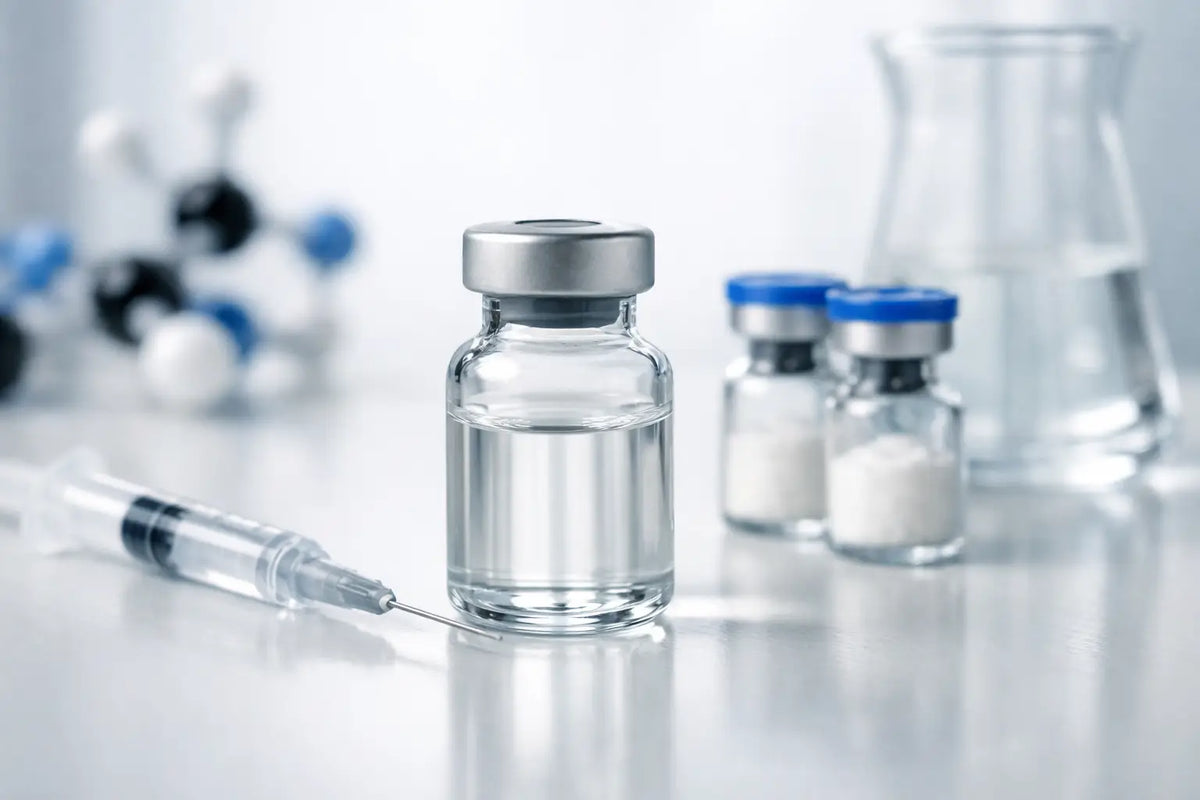
If a peptide arrives lyophilised and your next step is reconstitution, the liquid you choose is not a minor detail. Bacteriostatic water for peptides is commonly used in research settings because it supports cleaner handling across repeated withdrawals, but suitability still depends on the compound, the protocol, and the intended storage period.
For experienced buyers, the question is rarely just what bacteriostatic water is. The more useful question is whether it is appropriate for a specific peptide, how it affects handling after reconstitution, and what standards matter when sourcing it alongside research compounds.
What bacteriostatic water for peptides actually is
Bacteriostatic water is sterile water containing a small amount of benzyl alcohol as a preservative. That preservative helps inhibit bacterial growth in multi-use handling scenarios, which is why it is regularly chosen when a reconstituted vial may be accessed more than once.
In peptide work, that practical benefit matters. Once a lyophilised peptide is reconstituted, every entry into the vial creates an opportunity for contamination. Bacteriostatic water does not remove the need for proper aseptic technique, but it can offer an added margin of handling protection compared with plain sterile water in protocols where repeated withdrawals are expected.
That said, bacteriostatic water is not automatically the right choice for every peptide. Some compounds are more stable under one diluent than another, and some research protocols specify sterile water or another solvent system instead. The right decision depends on the peptide's known handling profile, expected storage time after reconstitution, and how frequently the vial will be used.
Why researchers use bacteriostatic water for peptides
The main reason is workflow control. In laboratory and investigational settings, consistency in reconstitution matters because concentration accuracy affects every downstream calculation. A suitable diluent supports precise measurement, predictable handling, and fewer avoidable errors.
Bacteriostatic water is often selected when researchers want a multi-use option that remains practical after the first withdrawal. If a vial will be reconstituted once and used immediately, the advantage may be less pronounced. If it will be accessed across multiple uses, the preservative system becomes more relevant.
There is also a storage consideration. Reconstituted peptides are generally less stable than their lyophilised form, so any handling choice should be made with a conservative view of degradation risk. Bacteriostatic water may help support use across a short refrigerated period, but it does not guarantee peptide stability. Stability is driven by the peptide itself, temperature, light exposure, concentration, and total time in solution.
When bacteriostatic water may not be the best fit
This is where nuance matters. Some buyers assume bacteriostatic water is the default for every peptide product, but that is too broad. The presence of benzyl alcohol can make it unsuitable in some contexts, particularly where a protocol or product-specific guidance calls for sterile water only.
Peptide chemistry is not uniform. One compound may tolerate reconstitution and short-term storage with minimal issue, while another may show greater sensitivity once in solution. If the peptide has known fragility, or if the research method depends on a tightly defined solvent environment, the diluent should be chosen based on the compound rather than habit.
The same applies to volume choice. Adding too much or too little bacteriostatic water changes the final concentration and can complicate measurement. That is not a fault of the diluent itself, but it is one of the most common handling errors. Reconstitution should always be approached as a calculation exercise, not a guess.
How to handle reconstitution properly
The practical process is straightforward, but precision matters at each step. Start by confirming the amount of peptide in the vial and the target concentration required for the research protocol. From there, calculate the volume of bacteriostatic water needed before opening anything.
When adding the diluent, direct high pressure spray onto the powder can be unhelpful, especially with delicate lyophilised cakes. It is generally better to let the liquid run gently down the side of the vial. Once added, avoid vigorous shaking unless the compound documentation specifically supports it. Gentle swirling is often preferred to reduce unnecessary stress on the peptide.
Temperature control also matters. Reconstituted peptides are commonly stored under refrigeration, with light exposure minimised where relevant. Even then, shorter storage windows are usually safer than stretching usage unnecessarily. If a protocol allows a fresh reconstitution approach, that can reduce uncertainty versus extending the life of a solution beyond a conservative timeframe.
What to check when buying bacteriostatic water
For research buyers, this comes down to documentation, sterility confidence, and supplier reliability. The product should be clearly labelled, appropriately sealed, and sourced from a supplier that treats handling standards seriously. In a category where poor vendor controls are a recurring problem, vague product information is a warning sign.
It also makes sense to buy from a supplier that understands the wider peptide workflow rather than treating bacteriostatic water as an afterthought. If you are sourcing peptides and reconstitution components together, consistency in fulfilment, batch transparency, and technical support becomes more valuable. Delays, packaging issues, or unclear specifications can interrupt projects just as easily as a poor-quality compound.
At ApexLink Peptides, that expectation is built into the wider catalogue approach - research-grade products, documentation-led quality control, and practical support for handling and ordering decisions. For buyers running repeat purchases or managing multiple compounds, that reliability is usually worth more than chasing the lowest headline price.
Common mistakes that affect results
The first is assuming all water products are interchangeable. They are not. Sterile water, bacteriostatic water, and other solvent options exist for different reasons, and using the wrong one can create avoidable compatibility or handling issues.
The second is poor arithmetic. If the reconstitution volume is miscalculated, every subsequent measurement is off. That creates problems not just for dosing precision in a research model, but also for record consistency and repeatability.
The third is treating reconstituted peptides as though they have the same durability as lyophilised stock. Once in solution, the clock changes. Even with refrigeration and careful handling, reconstituted material generally carries a shorter useful window.
Finally, some buyers overlook basic aseptic technique because the term bacteriostatic sounds more protective than it is. The preservative helps inhibit bacterial growth. It does not compensate for careless vial handling, contaminated equipment, or poor storage practices.
Choosing with the peptide in mind
A practical way to think about bacteriostatic water is this: it is a useful tool, not a universal rule. For many peptide workflows, it offers convenience and handling advantages, particularly where repeat withdrawals are part of the process. For other compounds or protocols, another diluent may be the better fit.
That is why serious buyers tend to focus on the full chain rather than one product in isolation. Purity verification, Certificate of Analysis access, sensible storage guidance, accurate calculation, and dependable supply all work together. If any one of those elements is weak, the risk to consistency increases.
The best purchasing decisions in this category are usually the least dramatic ones. Clear specifications, traceable quality, and careful reconstitution practice will carry more weight than marketing claims. If you are buying bacteriostatic water for peptides, choose it for a defined reason, use it with a defined method, and keep the peptide's own handling requirements at the centre of the decision.
More from the research library.
How to Select Peptide Vial Sizes for Research
Learn how to select peptide vial sizes for research based on assay demand, reconstitution volume, stab...
Read article →
How to Calculate Peptide Molarity Correctly
Learn how to calculate peptide molarity from mass, molecular weight and reconstitution volume, with pr...
Read article →
Can Researchers Verify Peptide Identity Reliably?
Can researchers verify peptide identity? Learn how HPLC, mass spectrometry, batch records and Certific...
Read article →