
How to Store Research Peptides Properly
Storage errors rarely look dramatic at first. A vial left on the bench for too long, repeated warming and cooling, or reconstituting more than a project needs can quietly compromise a peptide before any obvious sign appears. If you are looking at how to store research peptides, the core issue is stability. Temperature, moisture, light exposure and handling all affect whether a compound remains suitable for consistent research use.
For research buyers, storage is not a minor afterthought. It sits alongside purity, batch verification and documentation as part of compound integrity. Even a peptide supplied at high purity can degrade if stored badly after delivery. That is why the right answer depends on the peptide format, the expected storage duration and how often the vial will be accessed.
How to store research peptides without degrading them
The first distinction is whether the peptide is still lyophilised or has already been reconstituted. Lyophilised powder is generally more stable than a peptide in solution, which is why most research peptides are supplied in that form. Once liquid is introduced, the clock changes. Hydrolysis, contamination risk and temperature sensitivity become much more relevant.
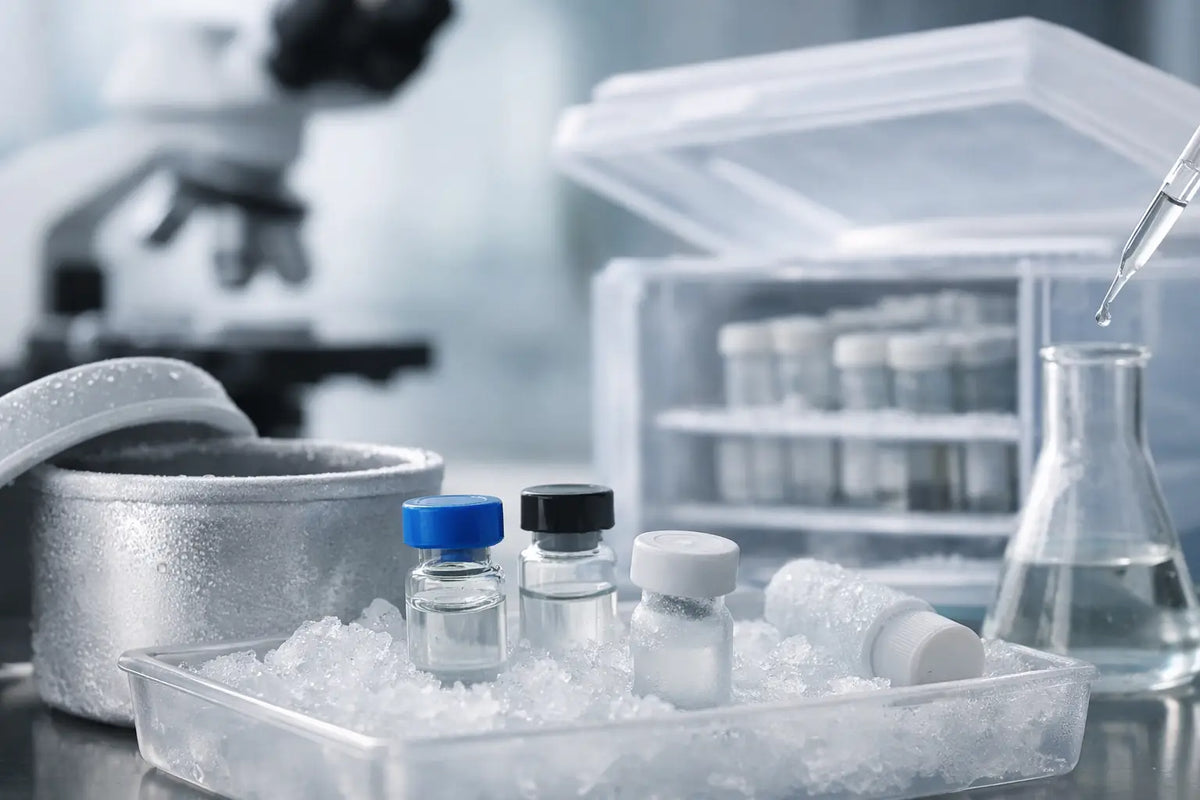
A dry, unopened lyophilised vial is usually best kept cold, protected from light and isolated from moisture. In most lab settings, refrigerated storage is acceptable for shorter-term use, while freezer storage is preferred for longer-term preservation. The exact temperature can vary by peptide, but a common working approach is 2 to 8°C for near-term use and around -20°C for longer storage. Some highly sensitive compounds may warrant colder conditions, but colder is not automatically better if frost cycling and poor handling are part of the process.
The main point is consistency. A stable freezer with minimal door opening is often better than a colder unit that fluctuates throughout the day. Peptides do not benefit from being repeatedly moved between room temperature, fridge and freezer. Each cycle increases condensation risk and can introduce avoidable instability.
Lyophilised vs reconstituted peptides
Lyophilised peptides are freeze-dried to improve storage stability during transport and inventory holding. In practical terms, this means they tolerate normal handling far better than reconstituted solutions. That said, they should still be kept sealed and dry. Moisture ingress is one of the fastest ways to reduce the advantage of lyophilisation, especially if a vial is opened in a humid environment and returned to storage without proper care.
Reconstituted peptides are more vulnerable. Once bacteriostatic water or another suitable diluent is added, refrigeration is usually the standard approach for short-term use. Freezing a reconstituted peptide can work in some cases, but it depends on the compound and on whether freeze-thaw damage is likely. If the solution will be accessed repeatedly over a short period, refrigeration at 2 to 8°C is often more practical than freezing and thawing the same vial multiple times.
This is where planning matters. Reconstituting a large vial simply because it is available can be a poor decision if only a small portion will be used in the near term. Aliquoting can reduce repeated access to the same container and limit contamination risk, but it must be done carefully and under clean conditions.
Refrigerated storage
For reconstituted peptides intended for active use, refrigeration is usually the baseline. A laboratory refrigerator with dependable temperature control is preferable to a general household unit, mainly because temperature drift is lower and door opening tends to be more controlled. If a peptide is being held at 2 to 8°C, place it where the temperature remains stable rather than in the door, where fluctuations are common.
Short-term refrigerated storage can also suit lyophilised peptides that will be used soon after receipt. This is often sensible for working inventory, especially where freezer access is limited or where a compound will be reconstituted within days rather than weeks. The trade-off is shelf life. Refrigeration is convenient, but not ideal for extended holding compared with freezer storage.
Freezer storage
For longer-term storage, freezing is usually the safer option for lyophilised material. A dedicated freezer at around -20°C is a common standard in research settings. The goal is to slow degradation, not just to make the vial cold. Stable low temperatures, reduced light exposure and minimal handling all work together.
If frozen storage is used, avoid frequent removal of the same vial. When a vial is taken out, allow it to reach room temperature before opening so condensation does not form directly inside or around the contents. Refreezing after unnecessary exposure is where handling starts to matter as much as temperature.
Some researchers divide stock into smaller sealed portions before long-term storage. That approach can make sense where repeated access would otherwise expose the full stock to multiple thaw cycles. It is not mandatory in every setup, but for expensive or sensitive compounds it is often the more controlled option.
Light, moisture and handling risks
Temperature gets most of the attention, but it is not the only variable. Light exposure can affect certain peptides, particularly once reconstituted. Amber storage or keeping vials in secondary packaging reduces direct exposure. Moisture matters even more for dry peptide powder. A vial that is opened, used briefly and left in a humid room before resealing may already be on the wrong path.
Handling discipline is where many avoidable problems begin. Keep contact time at room temperature brief. Use clean tools and aseptic technique when reconstituting or aliquoting. Label every vial clearly with the compound name, concentration, date of reconstitution and storage condition. That may sound basic, but in shared or high-throughput environments, poor labelling causes as many integrity problems as temperature mistakes.
It also helps to separate active working stock from reserve stock. If one vial is for regular access, keep the remainder untouched under more protective conditions. This reduces disturbance to the main supply and supports better traceability if results need to be reviewed later.
How to store research peptides after delivery
Once a shipment arrives, inspect it promptly rather than leaving the parcel at ambient temperature for hours. A fast dispatch and careful packing help, but the receiving step still matters. Check that the vial is intact, verify the label against your order and move the product into the correct storage condition as soon as practical.
If the peptide arrives lyophilised and you do not plan to use it immediately, freezer storage is usually the sensible next step. If immediate use is planned, refrigeration may be sufficient until reconstitution. Where a Certificate of Analysis is supplied, keep it with your records. Storage decisions should sit alongside batch documentation, especially for repeat projects where consistency matters.
This is one reason experienced buyers tend to favour suppliers that are clear about purity, batch traceability and handling guidance. A high-quality product can still be undermined by poor post-delivery practice, so the chain of control does not stop at dispatch. ApexLink Peptides provides laboratory-grade compounds with batch-specific documentation, but end-user storage remains critical to preserving that standard once the vial is in your possession.
Common storage mistakes
The most common mistakes are straightforward. Leaving reconstituted peptides at room temperature for convenience is one. Repeatedly thawing and refreezing the same vial is another. Storing vials in the fridge door, opening frozen vials before they have equilibrated, or exposing lyophilised powder to humidity all create avoidable risk.
Another issue is assuming every peptide behaves the same way. Some compounds are comparatively forgiving, while others are less stable in solution or more sensitive to environmental change. If a protocol requires precision, generic storage habits are not enough. Product-specific guidance should always take priority where available.
There is also a practical judgement call between caution and overhandling. Constantly moving a vial because you are trying to protect it can be worse than leaving it undisturbed in a stable, appropriate environment. Good storage is usually quiet, controlled and documented.
A practical standard for most research settings
If you want a reliable working standard, keep unopened lyophilised peptides dry, sealed and frozen for longer-term storage. Use refrigeration for reconstituted peptides that will be used in the short term. Protect both forms from light, minimise room-temperature exposure and avoid repeated freeze-thaw cycles wherever possible.
That approach is not a substitute for compound-specific data, but it is a sound baseline for many common research peptides, including products such as BPC-157, GHK-Cu, MOTS-c, SS-31 and CJC-1295 no DAC with Ipamorelin. The closer your storage conditions are to controlled, documented and consistent, the more likely your material is to remain fit for serious research work.
Good peptide storage is less about elaborate equipment and more about disciplined handling. When purity, traceability and repeatability matter, the best storage protocol is the one your lab can follow correctly every time.
More from the research library.
How to Select Peptide Vial Sizes for Research
Learn how to select peptide vial sizes for research based on assay demand, reconstitution volume, stab...
Read article →
How to Calculate Peptide Molarity Correctly
Learn how to calculate peptide molarity from mass, molecular weight and reconstitution volume, with pr...
Read article →
Can Researchers Verify Peptide Identity Reliably?
Can researchers verify peptide identity? Learn how HPLC, mass spectrometry, batch records and Certific...
Read article →