
Laboratory Peptide Handling Checklist
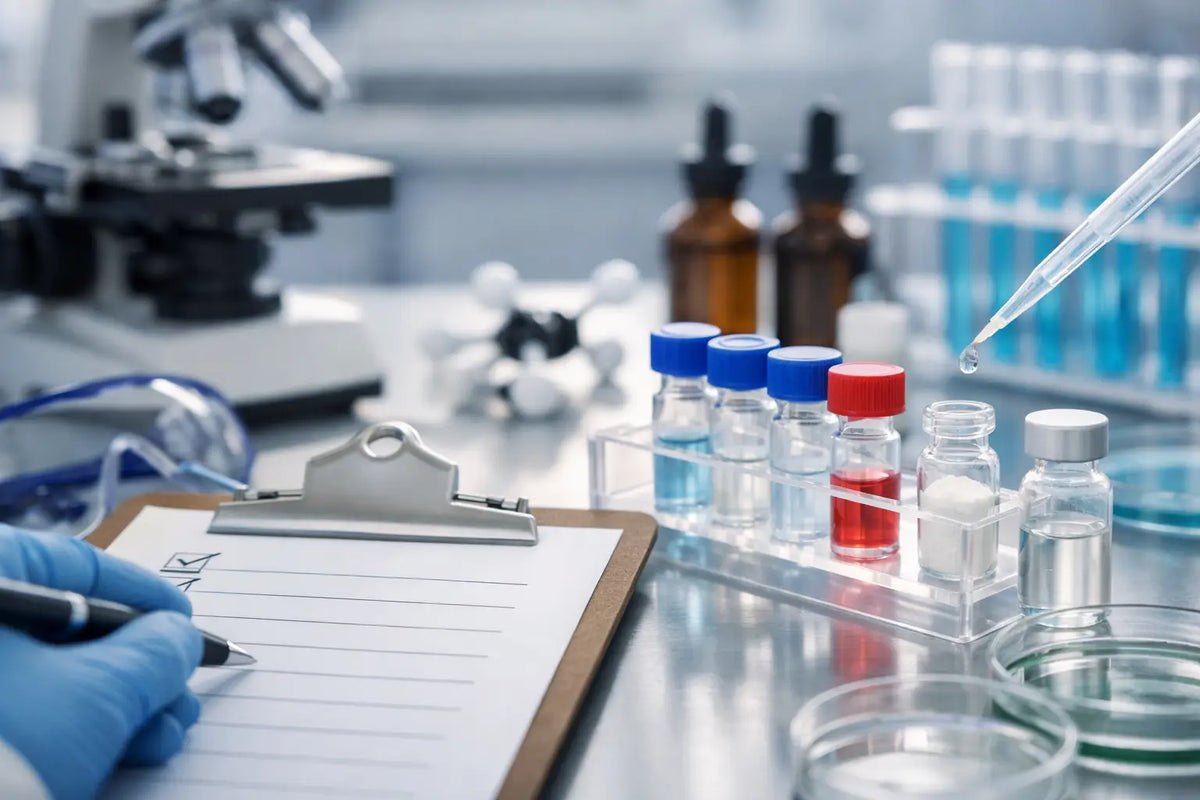
A missed temperature excursion, a rushed reconstitution step, or a poorly labelled vial can compromise weeks of peptide work. A proper laboratory peptide handling checklist is not admin for its own sake. It is a control point for purity, traceability, stability, and repeatable research outcomes.
For research buyers working with compounds such as BPC-157, GHK-Cu, MOTS-c, SS-31, or CJC-1295 (no DAC) + Ipamorelin, handling standards matter just as much as the Certificate of Analysis. High starting purity helps, but peptide integrity still depends on what happens after receipt, during storage, through reconstitution, and across each experimental cycle.
Why a laboratory peptide handling checklist matters
Peptides are not all equally forgiving. Sequence, formulation, moisture exposure, light sensitivity, freeze-thaw frequency, and storage duration can all affect stability. Two labs can begin with the same batch and end up with different results simply because one controlled handling conditions and the other relied on memory.
A checklist reduces that variability. It gives staff and researchers a consistent process for receipt, inspection, documentation, storage, and preparation. That is especially relevant when multiple operators use the same inventory or when compounds move between cold storage, benches, and analytical workflows.
There is also a commercial reality. Research-grade compounds are purchased for consistency. If handling is inconsistent, batch quality becomes harder to evaluate because avoidable lab-side errors cloud the data.
Receipt and verification
The first stage of any laboratory peptide handling checklist starts before the vial is opened. On arrival, inspect the outer packaging for signs of damage, delays, or obvious temperature exposure issues. If the order includes multiple compounds, confirm that each item matches the packing documentation and purchase records.
At vial level, check the label carefully. Product identity, batch or lot reference, quantity, and any supplier documentation should align. Where available, confirm that the Certificate of Analysis corresponds to the batch received. For many research buyers, this is the first trust filter. A batch that cannot be matched cleanly to its documentation should not move straight into active use.
It is good practice to log receipt date, operator name, storage destination, and any condition notes immediately. That record becomes valuable later if a stability question or performance issue appears during the research cycle.
Storage conditions before use
Dry peptide storage is often straightforward in principle and easy to mishandle in practice. Most lyophilised peptides should be placed into appropriate cold storage promptly after receipt, with unnecessary exposure to room temperature kept to a minimum. Exact storage conditions depend on the compound, expected storage duration, and supplier guidance.
Short-term and long-term storage are not the same decision. A peptide due for near-term use may be handled differently from stock intended for extended retention. The key is consistency. Repeated warming and cooling cycles can be more damaging than stable storage at the correct temperature.
Moisture is another common problem. Lyophilised material should remain sealed until preparation is planned. Leaving vials exposed on a bench while other tasks are completed adds avoidable risk. Light exposure may also matter for some compounds, so original packaging or suitable secondary protection should be used where relevant.
Preparing the workspace
A good checklist should force a pause before reconstitution begins. The workspace needs to be clean, organised, and set up with everything required in advance. That usually includes the peptide vial, diluent, sterile handling materials, calibrated measuring tools, labels, and documentation sheets or digital records.
This is where preventable errors often happen. If an operator starts looking for materials halfway through preparation, handling time extends and contamination risk rises. Efficient preparation is not about speed alone. It is about reducing unnecessary exposure and keeping the process controlled.
For teams working across several compounds at once, one-product-at-a-time handling is often the safer option. Similar vial sizes, similar names, and similar volumes create opportunities for mix-ups. Separation by task and clear bench identification are simple but effective controls.
Reconstitution controls
Use the correct diluent and volume
Reconstitution is the point where calculation errors become expensive. The selected diluent, target concentration, and final volume should be confirmed before any fluid is introduced. If bacteriostatic water is being used, it should be appropriate for the research protocol and handled according to sterile technique.
The chosen volume should support accurate downstream measurement, not just convenience. Very small final volumes may increase concentration but can make precise handling harder. Larger volumes may improve measuring ease but affect storage duration and use timelines. It depends on the peptide and the research design.
Add diluent carefully
Diluent should be introduced in a way that minimises physical stress to the peptide material. Direct, forceful spraying onto the powder is best avoided where gentler vial-wall addition is possible. Vigorous shaking is also poor practice for many peptides. Slow dissolution with minimal agitation is generally the better control.
Some compounds dissolve quickly, while others require patience. A checklist should remind the operator not to interpret slow dissolution as a licence for aggressive mixing. If a peptide appears resistant to full dissolution, reassess the method, the volume, and the temperature conditions before assuming the product is at fault.
Labelling and traceability
A peptide vial without complete labelling is a future problem. Once reconstituted, the vial should be marked with the compound name, concentration, diluent used, reconstitution date, and, where relevant, beyond-use or review date according to internal protocol. Batch reference should remain linked to the working vial record.
This is particularly important in shared environments. Researchers may remember what they prepared on the day, but memory is not a traceability system. Clear labelling protects data quality and inventory control at the same time.
Digital logs can help, but only if entries are completed immediately. Delayed record-keeping is one of the easiest ways to create ambiguity around concentration, age, and storage history.
Ongoing handling after reconstitution
Reconstituted peptides usually require tighter discipline than lyophilised stock. Time out of refrigeration or freezer storage should be limited to what is needed for the task. Return the vial promptly after use, and avoid repeated handling by multiple operators unless the workflow genuinely requires it.
Freeze-thaw exposure deserves particular attention. If a peptide will be used over multiple sessions, aliquoting may be the cleaner option than repeatedly cycling a single working vial through storage and thaw conditions. That adds a preparation step at the start, but it can reduce degradation risk over time.
Visual inspection is useful but limited. Changes in clarity, precipitation, or unexpected appearance can indicate a problem, yet a solution that looks acceptable is not automatically stable. A checklist should therefore reinforce both observation and time-based controls.
What to include in your laboratory peptide handling checklist
A practical laboratory peptide handling checklist should cover receipt, batch verification, storage assignment, workspace preparation, reconstitution details, final concentration confirmation, labelling, and post-use storage. It should also record operator initials, dates, and any deviations from standard process.
For higher-throughput labs, a shorter front-end checklist with a more detailed batch record may be more efficient. For smaller research settings, one integrated sheet can be enough. The best format is the one that gets used consistently.
If you are buying from a supplier that provides HPLC-verified purity and a batch-specific Certificate of Analysis, such as ApexLink Peptides, the checklist becomes even more useful because it connects supplier documentation to your in-house handling record. That continuity supports better troubleshooting and cleaner audit trails.
Common handling errors that distort peptide research
Most peptide problems in practice are not dramatic failures. They are small control lapses that accumulate. A vial left too long at room temperature, an undocumented concentration adjustment, a reused label, or uncertainty over how many freeze-thaw cycles have occurred can all weaken confidence in the result.
The difficulty is that these issues do not always announce themselves immediately. A data inconsistency may appear much later, by which point the original handling step is hard to reconstruct. That is why checklists matter most in busy labs, experienced labs, and repeat-purchase environments alike. Familiarity does not remove risk. In some cases, it increases complacency.
Build the checklist around the peptide, not just the process
One final point is worth keeping in mind. There is no universal peptide rulebook that fits every compound equally well. Storage windows, reconstitution preferences, sensitivity to agitation, and use timelines can vary. Your process should therefore be standardised, but not rigid to the point of ignoring compound-specific requirements.
The most reliable labs use a core handling checklist and adapt it where sequence, formulation, or research design demands it. That approach protects consistency without forcing false uniformity. If your aim is cleaner data and better use of every batch received, a disciplined checklist is not extra paperwork. It is part of the research method.
More from the research library.
How to Select Peptide Vial Sizes for Research
Learn how to select peptide vial sizes for research based on assay demand, reconstitution volume, stab...
Read article →
How to Calculate Peptide Molarity Correctly
Learn how to calculate peptide molarity from mass, molecular weight and reconstitution volume, with pr...
Read article →
Can Researchers Verify Peptide Identity Reliably?
Can researchers verify peptide identity? Learn how HPLC, mass spectrometry, batch records and Certific...
Read article →