
Bacteriostatic Water vs Sterile Water
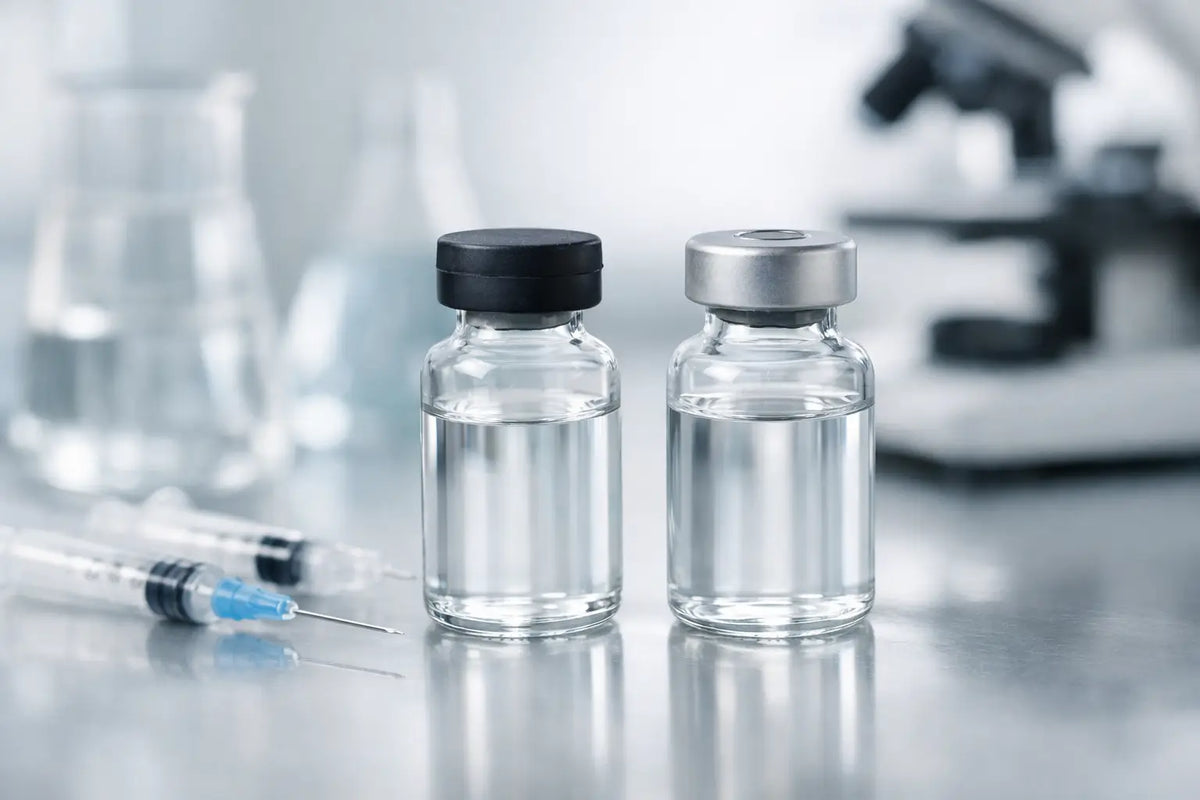
If you are comparing bacteriostatic water vs sterile water, the choice usually comes down to one practical question: are you preparing a solution for single-use handling or for repeated withdrawals during a research workflow? Both are sterile diluents, but they are not interchangeable in every setting, and treating them as if they are can create avoidable handling errors.
For research buyers working with peptides, precision starts before reconstitution. The diluent affects storage behaviour, vial use, contamination risk, and day-to-day convenience in the lab. That makes this less of a minor accessory decision and more of a procedural one.
Bacteriostatic water vs sterile water: the core difference
The main difference is composition. Sterile water for injection is plain sterile water with no antimicrobial preservative. Bacteriostatic water is also sterile water, but it contains a preservative, typically 0.9% benzyl alcohol, to inhibit bacterial growth after the vial has been opened.
That preservative changes how the product is typically used. Sterile water is generally preferred where a solution will be prepared and used immediately or within a tightly controlled single-use process. Bacteriostatic water is generally selected when a vial may need to be accessed more than once over a limited period, because the preservative offers an extra layer of protection against microbial proliferation between withdrawals.
This does not mean bacteriostatic water makes poor technique acceptable. A preserved diluent is not a substitute for clean reconstitution practice, controlled storage, or proper vial handling. It simply adds resistance to bacterial growth that plain sterile water does not provide.
What sterile water is used for
Sterile water is the simpler of the two products. It is purified and sterile, but it contains no preservative and no additional active ingredient. In practical terms, that makes it suitable for applications where the full contents are intended for immediate use or where the reconstituted material is not expected to undergo repeated punctures and storage cycles.
For some researchers, sterile water is preferred because there is no benzyl alcohol in the solution. That matters in protocols where the presence of a preservative is undesirable, whether for compatibility reasons, analytical sensitivity, or product-specific handling preferences.
The trade-off is straightforward. Once opened, sterile water has less built-in protection against contamination. If a researcher expects multiple withdrawals from the same vial over time, sterile water demands stricter discipline and may be less forgiving operationally.
What bacteriostatic water is used for
Bacteriostatic water is widely used in peptide reconstitution because it supports multi-use handling more effectively than plain sterile water. The benzyl alcohol does not sterilise an already contaminated solution, but it can inhibit bacterial growth introduced during repeated access.
That is why experienced research buyers often choose it for routine peptide workflows. If a reconstituted vial will be withdrawn from more than once, bacteriostatic water may offer a more practical margin of safety than sterile water alone.
Even so, compatibility still matters. Not every compound or protocol is best served by a preserved diluent. Some materials are more stable in one environment than another, and some researchers prefer to avoid any additive where the work requires maximum formulation simplicity.
Why the choice matters in peptide reconstitution
In peptide handling, the diluent is part of the system, not an afterthought. Reconstitution affects concentration accuracy, withdrawal consistency, storage planning, and contamination control. Choosing between bacteriostatic water vs sterile water should reflect how the peptide will be handled after mixing, not just what is available on the bench.
If the full vial is reconstituted for near-immediate use in a controlled setting, sterile water may be entirely appropriate. If the peptide will be stored and accessed across multiple withdrawals, bacteriostatic water is often the more practical choice. This is especially relevant for smaller-scale research environments where one vial may remain in active use across several days.
There is also a planning issue. Researchers who choose sterile water for a multi-day protocol may need tighter aliquoting discipline to reduce repeated vial access. Researchers using bacteriostatic water may gain more flexibility, but they still need to observe storage limits, aseptic technique, and compound-specific handling guidance.
Shelf life after opening and after reconstitution
This is where confusion often starts. An unopened sterile vial is sterile until opened. An unopened bacteriostatic vial is also sterile until opened. After opening, the preservative in bacteriostatic water helps reduce the risk of bacterial growth, which is why it is commonly used for multi-dose applications.
After reconstitution, however, the real shelf life question is no longer about the water alone. It becomes a question of the peptide, the final solution, storage temperature, handling technique, and the number of times the vial is accessed. The diluent influences risk, but it does not determine stability by itself.
In other words, bacteriostatic water may support more practical repeated use, but it does not guarantee long-term peptide stability. Sterile water may be suitable for immediate or short-window use, but that does not automatically make it the wrong choice. The correct option depends on the research plan.
Handling and storage considerations
Both products require proper storage and clean handling. That means using sterile equipment, reducing unnecessary punctures, storing according to labelled instructions, and keeping reconstituted materials under appropriate refrigerated conditions where required.
A common mistake is assuming the preservative in bacteriostatic water eliminates contamination risk. It does not. Poor needle hygiene, repeated exposure to non-sterile surfaces, or inconsistent temperature control can still compromise the solution.
Another mistake is choosing sterile water for convenience without considering downstream handling. If the peptide will be re-entered repeatedly, a plain sterile diluent may create avoidable process risk unless the material is aliquoted immediately and managed carefully.
When bacteriostatic water may be the better option
For many peptide researchers, bacteriostatic water is the more operationally efficient choice when repeat withdrawals are expected. It is often better suited to workflows where one reconstituted vial remains in use over several sessions, provided the peptide itself is compatible with that approach.
It may also suit buyers who want a more practical margin for routine lab handling. In research environments where convenience must still align with contamination control, a preserved diluent can make sense.
This is one reason suppliers such as ApexLink Peptides position bacteriostatic water as a standard support product alongside laboratory-grade peptides. It addresses a genuine handling need rather than serving as a generic add-on.
When sterile water may be the better option
Sterile water may be the better fit where the protocol calls for no preservative, where the solution will be used promptly after preparation, or where aliquoting removes the need for repeated access to the same vial. It can also be preferable in workflows that prioritise the simplest possible formulation.
For some research settings, that simplicity is the deciding factor. If repeated withdrawals are not part of the plan, the added preservative in bacteriostatic water may offer little practical advantage.
The key point is that sterile water is not a lesser product. It is simply a different tool with a narrower margin for multi-use handling.
A practical way to decide
If your process involves a single preparation and prompt use, sterile water may be sufficient. If your process involves storing a reconstituted peptide and accessing it multiple times, bacteriostatic water is often the more practical option.
Then add the second filter: compound compatibility. Some peptides and research compounds are better handled with specific reconstitution methods. The right answer is not always the same across every vial in a catalogue.
That is why experienced buyers look beyond the label and think in terms of workflow. What matters is not just whether the water is sterile, but how the full protocol behaves after the seal is pierced.
Choosing the correct diluent is part of running a reliable research process. If the handling plan is clear from the start, the decision between bacteriostatic water and sterile water becomes much easier, and the rest of the workflow tends to follow with fewer problems.
More from the research library.
How to Select Peptide Vial Sizes for Research
Learn how to select peptide vial sizes for research based on assay demand, reconstitution volume, stab...
Read article →
How to Calculate Peptide Molarity Correctly
Learn how to calculate peptide molarity from mass, molecular weight and reconstitution volume, with pr...
Read article →
Can Researchers Verify Peptide Identity Reliably?
Can researchers verify peptide identity? Learn how HPLC, mass spectrometry, batch records and Certific...
Read article →