
Guide to Peptide Reconstitution Volumes
A reliable guide to peptide reconstitution volumes starts with a simple reality: most handling errors happen before any research begins. The peptide may be high purity, the paperwork may be in order, and the storage conditions may be correct, but if the reconstitution volume is chosen poorly, downstream calculations become less efficient and easier to misread. For research buyers working with lyophilised compounds, the question is not just how much bacteriostatic water to add. It is how to choose a volume that produces a concentration that is practical, traceable, and appropriate for the work being planned.
Why reconstitution volume matters
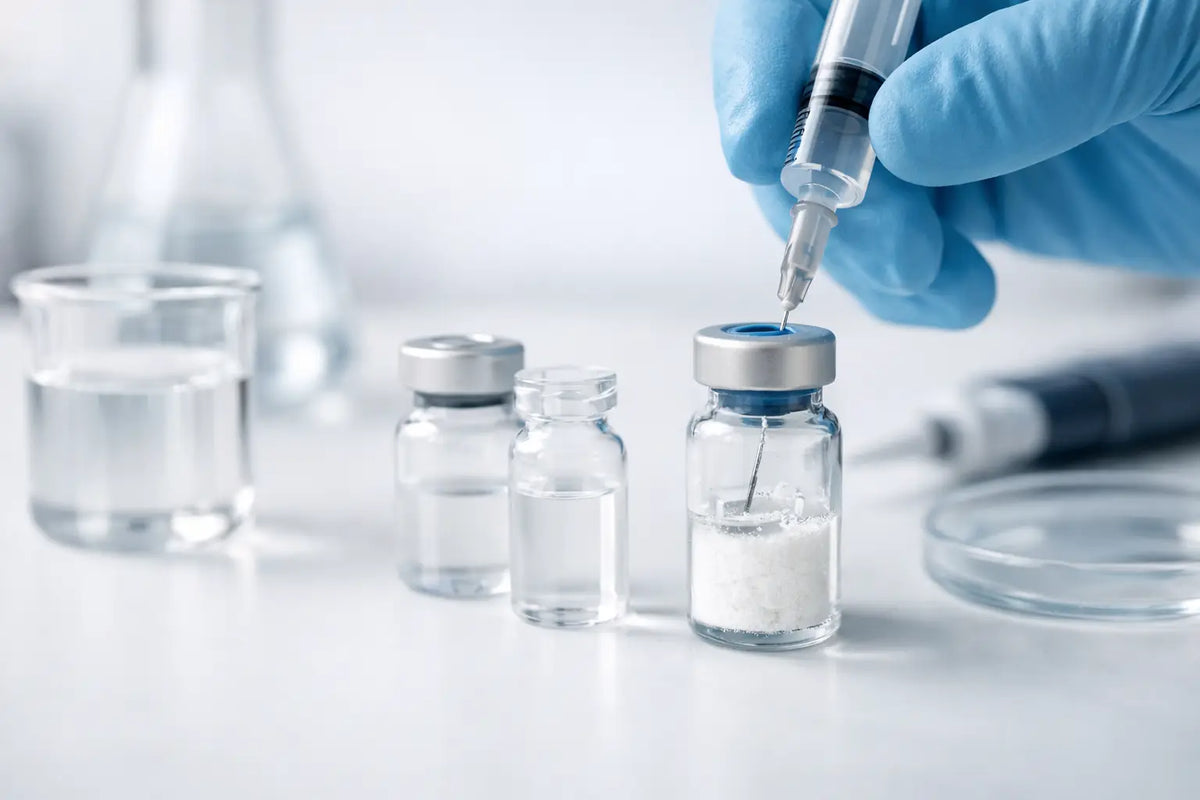
Reconstitution is the process of adding a suitable diluent to a lyophilised peptide so that it can be handled as a solution. The volume used determines the final concentration. That concentration then affects every later calculation, from aliquoting to storage planning to the amount drawn for a given research protocol.
This is why there is no single correct reconstitution volume for every vial. A 5 mg vial can be reconstituted with 1 mL, 2 mL, or another volume entirely, depending on the concentration required. The peptide amount in the vial does not change. What changes is how concentrated the final solution becomes and how easy it is to work with in a real research setting.
A volume that is too low may create an overly concentrated solution that demands very small measuring increments. A volume that is too high may be easier to measure but less efficient for storage or repeated use. The best choice usually sits between precision and practicality.
The core calculation behind peptide reconstitution volumes
Any guide to peptide reconstitution volumes should reduce the process to one relationship: total peptide amount divided by total diluent volume equals concentration.
If a vial contains 10 mg of peptide and 2 mL of diluent is added, the final concentration is 5 mg per mL. If the same 10 mg vial is reconstituted with 4 mL, the concentration becomes 2.5 mg per mL. Nothing about the peptide content has changed. Only the concentration has.
That distinction matters because many handling errors come from confusing total content with concentration. A vial labelled 10 mg still contains 10 mg after reconstitution. Adding more liquid does not increase the amount of peptide. It simply spreads that amount across a larger volume.
For laboratories and experienced independent buyers, it is often helpful to convert concentration into the unit most commonly used in the protocol. Some prefer mg/mL. Others work more comfortably in mcg per 0.1 mL or per insulin syringe unit equivalent. The format is less important than consistency. Once a concentration system is chosen, keep it uniform across records, calculations, and labels.
How to choose the right reconstitution volume
The right volume depends on the research context. In practice, three considerations matter most.
First is measurement convenience. If the resulting concentration requires very small drawn volumes, the chance of handling error increases. Choosing a slightly larger reconstitution volume can make measurement more manageable.
Second is storage strategy. If the solution will be divided into aliquots, the final concentration should suit the intended aliquot size. A concentration that produces awkward fractions creates unnecessary friction during handling.
Third is peptide-specific handling preference. Some researchers prefer more conservative reconstitution volumes for compounds they expect to use repeatedly over a short period. Others optimise around minimal manipulation and prepare only what is required for near-term work. It depends on workflow, solution stability planning, and the number of times the vial will be accessed.
In practical terms, a clean, easy-to-calculate concentration is usually the best option. Elegant maths helps prevent avoidable mistakes. If 2 mL produces a concentration that is easier to document and use than 1.7 mL, the simpler volume is often the better operational choice.
A practical example of dilution logic
Consider a 5 mg vial. If you add 1 mL of diluent, the concentration is 5 mg/mL. If you add 2 mL, the concentration becomes 2.5 mg/mL. If the research plan requires repeated measurement of small peptide quantities, 2 mL may offer better control because each measured increment contains less peptide.
Now consider a 15 mg vial. Reconstituting with 3 mL gives 5 mg/mL. Reconstituting with 6 mL gives 2.5 mg/mL. Again, neither choice is universally right. The better option is the one that matches the intended calculation method and the handling precision available.
This is where buyers often overcomplicate the process. They look for a fixed rule by peptide name, when the more useful approach is to work backwards from the target concentration. Start with the concentration you want to handle, then calculate the diluent volume needed to reach it.
Common errors this guide to peptide reconstitution volumes can help prevent
The most common mistake is assuming there is a standard volume that applies to every vial size and every compound. There is not. Reconstitution volume is a planning decision.
Another frequent error is misreading the vial content after dilution. A 10 mg vial reconstituted with 2 mL does not become a 2 mg vial used five times. It remains a 10 mg vial now distributed across 2 mL.
A third issue is poor labelling. Once a peptide is reconstituted, the vial should be clearly marked with the date, total volume added, final concentration, and any relevant storage note. Without this, even a correct calculation can become unreliable when the vial is revisited later.
There is also the matter of unit conversion. Milligrams and micrograms are regularly confused, especially when calculations move between vial content and drawn volume. One milligram equals 1,000 micrograms. Any guide used in a research environment should treat that conversion as a checkpoint, not an afterthought.
Finally, some buyers choose a reconstitution volume based only on convenience without considering solubility or handling sensitivity. Simpler is good, but only if it still suits the compound and the planned research use.
Diluent choice and handling standards
In many research settings, bacteriostatic water is used for peptide reconstitution because it supports multi-use handling better than plain sterile water. Even so, the choice of diluent should always align with the research protocol and the handling period expected after reconstitution.
The process itself should be controlled. Allow the diluent to move slowly down the inside wall of the vial rather than forcing it directly onto the lyophilised cake. Swirling gently is generally preferred over vigorous shaking, which may be unnecessarily harsh. The aim is complete dissolution with minimal agitation.
Clean handling matters as much as the calculation. Use appropriate sterile technique, minimise repeated vial access where possible, and document the final concentration immediately. A high-purity peptide with batch verification and a Certificate of Analysis still depends on correct post-purchase handling to remain useful in a serious research workflow.
Reconstitution planning for repeat buyers
For repeat purchasers and wholesale buyers, consistency in reconstitution planning improves more than convenience. It improves traceability. When the same vial sizes are routinely reconstituted to the same concentration standard, records are easier to audit and internal training is easier to maintain.
This is particularly useful when handling multiple compounds across a research inventory. A standard concentration framework reduces calculation drift between operators and lowers the risk of one vial being documented differently from another. It also makes stock planning more straightforward because aliquot volumes and use rates become more predictable.
At ApexLink Peptides, this is why educational tools and clear specification data matter. Purity, batch documentation, and reliable fulfilment are only part of the picture. Buyers also need usable guidance that supports clean handling decisions after delivery.
When the best volume is not the most obvious one
Sometimes the mathematically neatest volume is not the best operational choice. If a very dilute solution requires large draw volumes that are inconvenient for the protocol, a more concentrated preparation may be better. Equally, if a concentrated solution forces measurements at the edge of practical accuracy, adding more diluent may be the safer route.
That trade-off is the centre of peptide reconstitution planning. You are balancing calculation simplicity, measurement accuracy, handling frequency, and storage practicality. Experienced researchers know that the right answer is often the one that makes the entire process more repeatable, not merely the one that looks tidy on paper.
A good working rule is to choose a volume that produces a concentration you can calculate quickly, label clearly, and handle with confidence. If those three conditions are met, the reconstitution volume is usually serving its purpose well.
The most useful guide to peptide reconstitution volumes is not a fixed chart. It is a method: start with the vial content, decide the concentration that suits your research handling, calculate the matching diluent volume, and document everything at the point of preparation. Precision begins there, long before the first measurement is taken.
More from the research library.
How to Select Peptide Vial Sizes for Research
Learn how to select peptide vial sizes for research based on assay demand, reconstitution volume, stab...
Read article →
How to Calculate Peptide Molarity Correctly
Learn how to calculate peptide molarity from mass, molecular weight and reconstitution volume, with pr...
Read article →
Can Researchers Verify Peptide Identity Reliably?
Can researchers verify peptide identity? Learn how HPLC, mass spectrometry, batch records and Certific...
Read article →