
Research Peptide Storage Guide That Prevents Loss
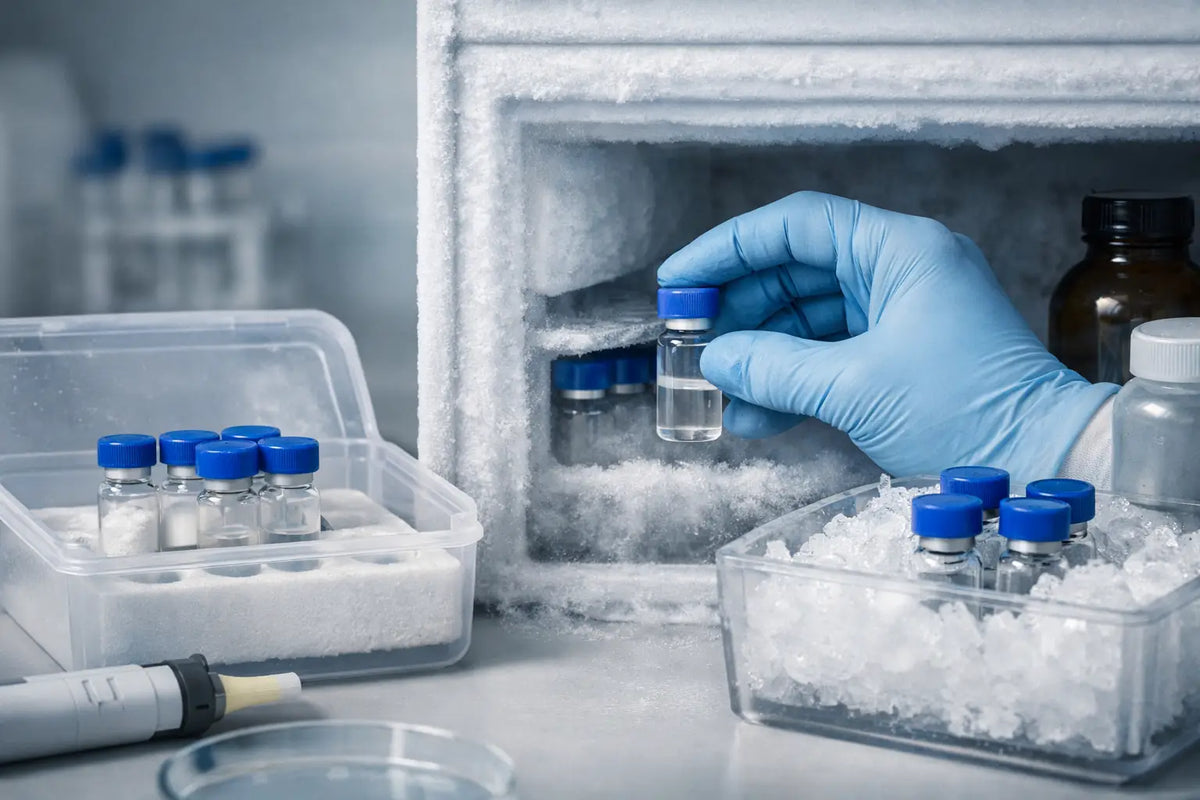
A peptide can test at high purity on paper and still become unreliable if it is stored badly for a week. Heat, moisture, light exposure and repeated handling all work against stability. This research peptide storage guide is written for buyers who need consistent compound handling after delivery, whether they are managing a single vial or a wider research inventory.
Storage mistakes are rarely dramatic. More often, they are small and cumulative - a vial left at room temperature too long, a freezer door opened repeatedly, a reconstituted solution handled without a clear labelling system. The result is avoidable degradation, wasted material and weaker confidence in downstream work. Good storage practice protects both the compound and the integrity of the research built around it.
What this research peptide storage guide covers
The right storage approach depends on the peptide format, the expected storage duration and the handling conditions in your workspace. Lyophilised powders are generally more stable than reconstituted solutions, but that does not mean they are immune to poor environmental control. Reconstituted peptides are more convenient for immediate use, yet they require tighter discipline around temperature, sterility and time in storage.
That distinction matters because buyers often assume a single storage rule applies to every peptide. It does not. A freeze-dried vial of BPC-157, GHK-Cu, MOTS-c or SS-31 should not be treated in exactly the same way as a peptide that has already been mixed with bacteriostatic water. Storage decisions should reflect the actual condition of the material in front of you, not a generic rule picked up elsewhere.
Lyophilised peptides - stable, but not indestructible
Lyophilised peptides are typically the better option for longer-term storage because the absence of water slows many degradation pathways. In practical terms, that means a sealed vial stored cold, dry and protected from light will usually retain stability better than the same peptide once reconstituted.
For short holding periods after delivery, refrigeration is commonly acceptable if the vial remains sealed and protected from condensation. For longer storage, freezing is generally preferred. The precise temperature range can vary by peptide and research protocol, but the principle is consistent: lower temperatures support longer preservation, provided the vial is kept dry and handling is controlled.
Moisture is one of the main threats. Taking a cold vial straight into a warm room can create condensation on the container, and poor handling can allow moisture ingress when opening or resealing. If a vial is being removed from cold storage, allow it to reach room temperature before opening. That simple step reduces the risk of condensation forming where it can do the most damage.
Light exposure is another avoidable problem, particularly for peptides known to be more sensitive in solution. Even when lyophilised, there is no upside to storing vials on an exposed bench. Keep them in their original packaging or in a light-protected storage container, clearly labelled and separated by batch where relevant.
Reconstituted peptides require tighter control
Once a peptide has been reconstituted, stability becomes more time-sensitive. Water introduces convenience for research use, but it also creates conditions in which degradation and contamination become more likely. Refrigeration is usually the standard short-term approach after reconstitution, while freezing may be considered in some cases for longer preservation, depending on the compound and intended use.
The trade-off is straightforward. Refrigeration supports easier access and avoids some stress associated with freezing and thawing, but shelf life is shorter. Freezing may extend usability for certain reconstituted peptides, yet repeated freeze-thaw cycles can compromise the material. If you expect to use a solution across multiple sessions, aliquoting can be the more controlled option.
Aliquoting reduces repeated exposure of the full volume to air, temperature changes and handling. Instead of thawing or opening the same vial over and over, smaller portions can be prepared under controlled conditions and used as needed. This is particularly useful for labs managing several compounds at once or running timed research schedules where consistency matters.
Temperature discipline matters more than chasing exact numbers
A common mistake is to focus only on nominal storage temperature while ignoring fluctuations. A peptide stored in a domestic fridge that is frequently opened, overfilled or poorly calibrated may be under less stable conditions than expected. The same applies to freezers used for mixed-purpose storage with constant access.
Consistency matters. Cold storage should be monitored, organised and not treated as general overflow space. Vials should be stored in a way that minimises disturbance, protects labels and keeps batches identifiable. If you are buying research peptides regularly, temperature logging and basic inventory discipline are not excessive - they are sensible risk control.
It also helps to separate newly arrived stock from in-use material. Constantly moving all vials in and out of storage increases unnecessary exposure. Working stock and reserve stock should be clearly distinguished, especially for wholesale or higher-volume buyers handling multiple batches.
Handling errors that shorten peptide life
Most storage failures begin during handling rather than storage itself. Opening a vial in a humid environment, touching critical surfaces, using poor-quality mixing materials or relabelling inconsistently can all create avoidable problems. Sterile technique and clean workspace control are part of storage practice, not separate from it.
Over-agitation is another issue. Reconstituted peptides are not always best treated with vigorous shaking. Gentle mixing is often more appropriate, as aggressive handling can affect peptide integrity in some cases. If a compound is slow to dissolve, patience is usually better than force.
Labelling should never be treated as an afterthought. At minimum, record the compound name, concentration after reconstitution, batch reference if relevant, date of reconstitution and intended storage condition. If multiple users access the same stock, clear labelling stops minor confusion becoming costly error.
A practical storage workflow
The simplest reliable workflow starts as soon as the shipment arrives. Inspect the package, confirm the batch details and move the material promptly into the correct environment. Do not leave peptides sitting at ambient temperature longer than necessary while other tasks are completed.
For lyophilised vials intended for later use, store sealed units in appropriate cold conditions with light protection and moisture control. For vials that will be reconstituted shortly, bring them to room temperature before opening if they have been refrigerated or frozen. After reconstitution, label immediately and place into the chosen storage condition without delay.
For researchers working with several compounds, it is worth setting a simple internal rule for maximum hold times once reconstituted. The exact duration will depend on the peptide and the protocol, but the key is consistency. A defined internal standard is better than relying on memory or visual inspection.
Why supplier quality and storage guidance go together
Storage does not begin and end in your lab. It starts with the quality of the material supplied and the clarity of the documentation that comes with it. A peptide backed by HPLC verification and a Certificate of Analysis gives you a stronger baseline, but that value is undermined if storage after delivery is careless.
This is where experienced buyers tend to be more selective. They do not only look at product name and price. They look at batch transparency, packaging standards, dispatch speed and whether the supplier provides usable handling guidance. At ApexLink Peptides, that emphasis on documented purity and practical support reflects the reality of peptide research - reliability depends on both supply quality and post-delivery control.
When the right answer is it depends
Not every peptide should be handled identically, and experienced researchers already know that simple rules have limits. Some compounds are less forgiving in solution. Some projects move through stock quickly enough that long-term storage is barely relevant. Others involve low-volume use over extended periods, where aliquoting and stricter freezer management become more important.
The right storage plan depends on the peptide, the format, the timeline and the environment available to you. If your cold storage is inconsistent, a theoretically ideal method may be less useful than a slightly more conservative approach that you can maintain properly. Good practice is not about appearing technical. It is about preserving compound integrity under real working conditions.
A reliable storage routine is one of the cheapest safeguards in peptide research. Treat each vial as a controlled material from the moment it arrives, and you give your work a far better chance of staying consistent from batch receipt to final use.
More from the research library.

How to Select Peptide Vial Sizes for Research
Learn how to select peptide vial sizes for research based on assay demand, reconstitution volume, stab...
Read article →
How to Calculate Peptide Molarity Correctly
Learn how to calculate peptide molarity from mass, molecular weight and reconstitution volume, with pr...
Read article →
Can Researchers Verify Peptide Identity Reliably?
Can researchers verify peptide identity? Learn how HPLC, mass spectrometry, batch records and Certific...
Read article →