
Peptide Storage: A Research Handling Guide
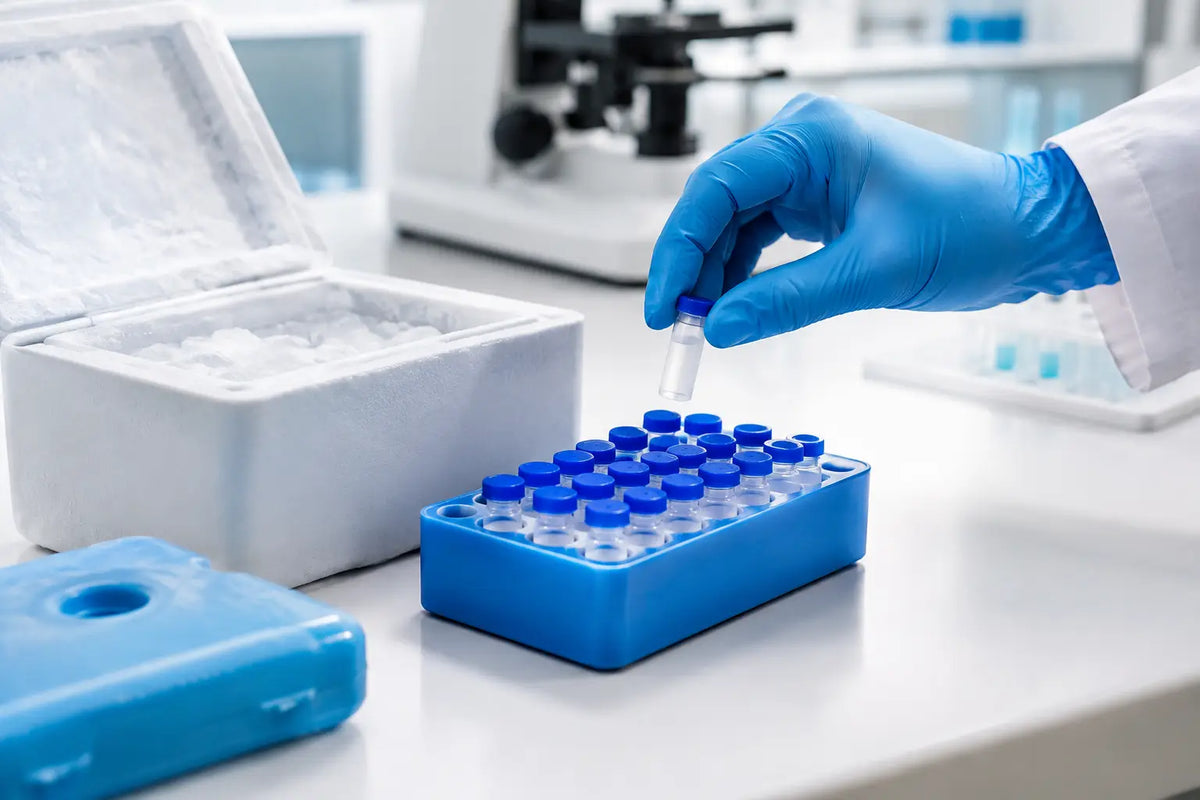
A peptide can leave a supplier with strong analytical documentation and still become unsuitable for reliable work if it is exposed to heat, moisture, repeated temperature cycling or poor record-keeping after delivery. Effective peptide storage is therefore part of experimental control, not an afterthought. The objective is simple: preserve the material’s identity, physical condition and consistency for its intended research use.
For laboratory-grade compounds, storage decisions should begin with the product label, accompanying Certificate of Analysis and any product-specific handling information. There is no single temperature or reconstitution approach that suits every peptide. Sequence, formulation, intended storage duration, solvent choice and the sensitivity of the assay all affect the correct protocol.
Why peptide storage affects research quality
Peptides are susceptible to degradation pathways that can alter the material before any visible change is apparent. Heat and moisture can accelerate degradation in lyophilised material. In solution, hydrolysis, oxidation, adsorption to container surfaces and microbial contamination may become relevant, depending on the peptide and solvent. Repeated freeze-thaw cycles can also introduce unnecessary variation.
The practical consequence is not limited to a weaker sample. A degraded or inconsistently handled material can compromise repeatability, create misleading analytical results and make comparisons between runs difficult to defend. Researchers working with limited quantities should treat each vial as a traceable research material, with defined receipt, storage, reconstitution and use records.
Purity verification confirms the quality of a batch at the point of release. It does not replace correct handling once the product is in the laboratory. This distinction matters when evaluating unexpected results: batch documentation and storage records should be reviewed together.
Peptide storage before reconstitution
Most research peptides are supplied as lyophilised powder because the dry form is generally more stable than a prepared solution. On receipt, inspect the outer packaging and vial label, verify the product identity and lot information, then transfer the vial to the recommended storage environment without unnecessary delay.
For many lyophilised peptides, refrigerated or frozen storage may be appropriate, with colder conditions often preferred for longer-term retention. However, the supplier’s instructions take priority. A storage recommendation suitable for one peptide is not automatically suitable for another, particularly where a sequence contains residues with higher susceptibility to oxidation or other chemical change.
Keep vials tightly sealed and protected from humidity. Condensation is a common avoidable risk. If a vial has been stored cold, allow it to reach room temperature while still sealed before opening it. Opening a cold vial can allow atmospheric moisture to condense inside, which may affect the powder and complicate accurate reconstitution.
Light exposure should also be controlled where relevant. Store materials in their original packaging or an opaque secondary container if the product guidance indicates light sensitivity. A clearly labelled storage box is preferable to loose vials placed in a shared refrigerator or freezer, where misidentification and temperature fluctuations are more likely.
Build a clear inventory record
A minimal but useful record should identify the compound, batch or lot number, quantity received, receipt date, storage location and any reconstitution details. For multi-user laboratories, add the person responsible and the date a vial was first opened.
This is not administrative excess. It allows a research team to distinguish between a product issue and a handling issue, prevents accidental use of outdated preparations and supports consistent work across projects. The Certificate of Analysis should remain associated with the corresponding lot, whether digitally or in the laboratory’s controlled documentation system.
Reconstitution changes the storage calculation
Once reconstituted, a peptide solution requires more careful control than the original lyophilised material. Stability in solution depends on the compound, concentration, solvent, pH, container type and storage temperature. The solvent selected for a particular experiment should be scientifically justified and compatible with the intended analytical or investigational method.
Use appropriate laboratory technique during preparation. Work with clean equipment, minimise the time the vial remains open and avoid introducing contaminants. Do not assume that a clear solution is chemically unchanged. Many forms of degradation cannot be identified by appearance alone.
Where the experimental plan permits, preparing smaller working aliquots is usually preferable to repeatedly accessing one larger vial. Aliquots reduce the number of freeze-thaw events experienced by the main preparation and limit the loss if one container is compromised. Use suitable, clearly labelled containers and ensure the label remains legible at low temperatures.
A reconstituted sample label should state the peptide name, concentration, solvent, preparation date, storage condition and any internal sample identifier. If the concentration is calculated from a nominal vial content, document the calculation and the volume used. This avoids ambiguity later, especially when several similar compounds or concentrations are stored together.
Avoid repeated freeze-thaw cycles
Repeated freezing and thawing is one of the most common preventable handling problems. Every cycle adds time at a less controlled temperature and may increase physical or chemical stress on the sample. The actual impact depends on the peptide and formulation, but reducing unnecessary cycles is good laboratory practice.
Aliquoting is the direct solution. Divide a fresh preparation into volumes aligned with expected experimental use, then thaw only the portion required for the planned work. Do not return a warmed aliquot to storage simply because it appears unused unless the established protocol specifically permits it.
Avoid improvised temperature management, such as repeatedly moving samples between a bench, refrigerator and freezer during a working day. Plan the workflow before removing material from storage. If a sample has been exposed to an unknown temperature excursion, record the event and assess whether it remains suitable for the specific research application rather than treating the uncertainty as irrelevant.
Selecting the right storage equipment
The best equipment choice depends on storage duration, sample volume, laboratory access patterns and the manufacturer’s handling recommendation. A monitored refrigerator may suit short-term prepared samples where refrigeration is specified. A dedicated freezer is more appropriate for longer-term material where frozen storage is required. For highly sensitive compounds or extended retention, lower-temperature storage may be considered where supported by product data and laboratory protocol.
Temperature monitoring is more valuable than a set-point display alone. A freezer showing the correct target temperature at one moment does not prove that it remained stable overnight, during defrost activity or after frequent door opening. Laboratories should use suitable monitoring, alarms and contingency arrangements proportionate to the value and sensitivity of stored materials.
Organisation matters as much as temperature. Keep peptide vials away from unrelated reagents where accidental contact, spills or identification errors are possible. Use secondary containment where appropriate, and do not overload storage units to the point that airflow and temperature recovery are affected.
Common peptide storage errors
Several errors recur across research settings: opening cold vials, storing reconstituted material without a date or concentration, relying on memory instead of labels, using one vial for repeated withdrawals, and treating all peptide sequences as though they have identical stability. Each error can be corrected with a simple written protocol and disciplined use of aliquots.
Another frequent problem is confusing dispatch conditions with long-term storage requirements. Packaging designed to protect a product during transit does not define its laboratory storage protocol after receipt. Review the accompanying product information promptly, particularly after international delivery or any unexpected delay.
For research buyers, supplier transparency is also part of risk control. Batch-linked Certificates of Analysis, clear labelling and accessible technical guidance help establish what was supplied and how it should be handled. ApexLink Peptides provides batch documentation to support this traceability, but the final condition of a material in use still depends on storage practices after delivery.
When a sample may need reassessment
Reassess a sample when there has been a documented temperature excursion, suspected contamination, an unexplained change in experimental performance, loss of label information or prolonged storage beyond the laboratory’s validated internal window. Visible changes such as discolouration, unexpected particulate matter or an altered solution appearance should also be investigated, although the absence of visible change is not proof of stability.
The appropriate response depends on the research risk. For exploratory work, the team may be able to replace the material and repeat the preparation. For data intended to support a larger programme, analytical confirmation or disposal may be the more defensible route. Record the decision and the reason for it.
Good storage practice does not need to be complicated. It needs to be specific, documented and consistent: follow the product guidance, protect materials from avoidable stress, label every preparation and design the workflow around single-use aliquots where practical. Those controls give each peptide batch the best chance of performing as expected in research conditions.
More from the research library.

When Should Peptides Be Aliquoted in Research?
Learn when should peptides be aliquoted, how to minimise freeze-thaw stress, and how to document resea...
Read article →
Best Practices for Peptide Aseptic Handling
Best practices for peptide aseptic handling protect research samples through clean technique, controll...
Read article →
Peptide Stability Examples That Affect Research
Practical peptide stability examples for research workflows, covering degradation routes, storage vari...
Read article →