
When Should Peptides Be Aliquoted in Research?
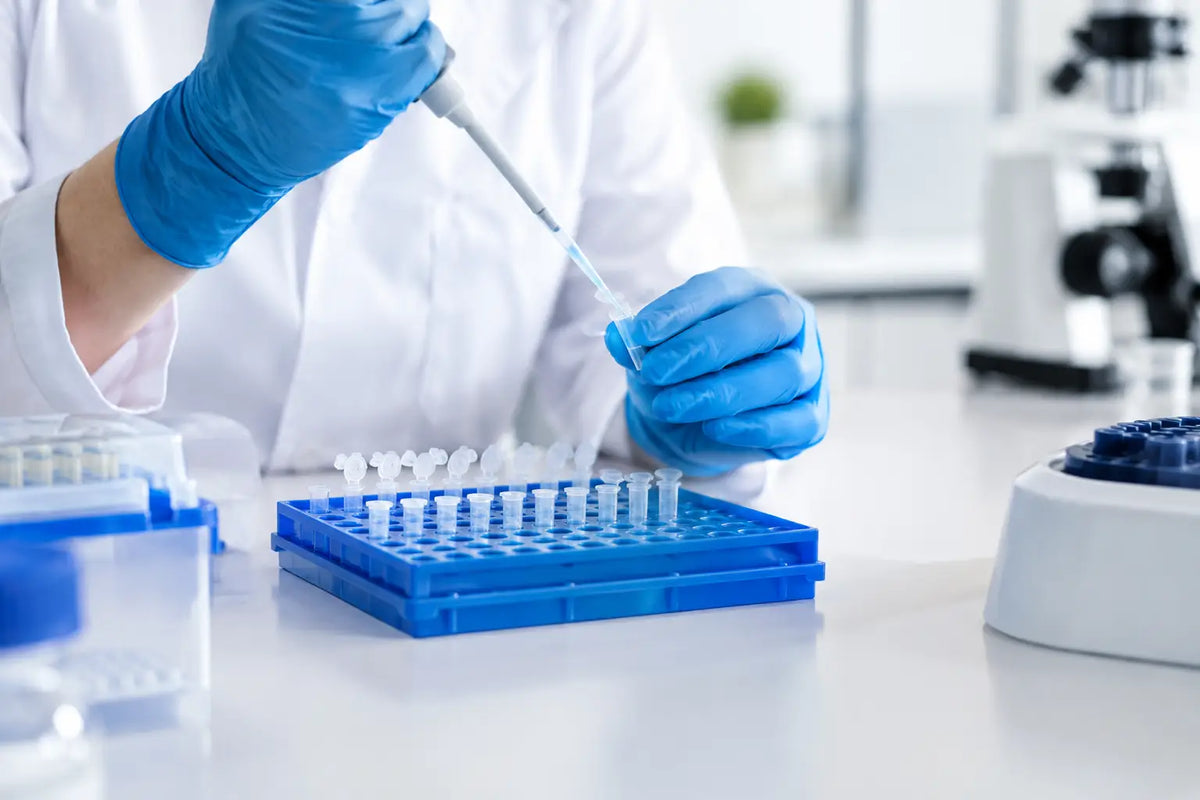
When should peptides be aliquoted? Usually, as soon as a reconstituted peptide has been prepared for repeat use and before it enters a cycle of thawing, handling and refreezing. Aliquoting is not an administrative extra. It is a practical control that helps researchers preserve sample consistency, reduce avoidable degradation risk and maintain traceability throughout an experiment.
For laboratory-grade peptides, storage decisions should be based on the material’s form, intended workflow, solvent compatibility and available stability data. A Certificate of Analysis can confirm identity and purity for a batch, but it does not replace a documented storage plan for the reconstituted material.
When should peptides be aliquoted after reconstitution?
The most appropriate time to aliquot is immediately after the peptide has been fully reconstituted and mixed according to the requirements of the research method. This is particularly relevant where the full vial will be used over several sessions rather than consumed in one continuous experiment.
The purpose is straightforward: each small portion should support one planned use, or a clearly defined short-use window, without repeatedly disturbing the remainder. Once working portions are prepared, the primary sample can remain protected from unnecessary temperature change, light exposure and contamination opportunities.
A peptide does not need aliquoting simply because it exists in a vial. If a study will use the full reconstituted quantity promptly, splitting it may add handling steps with no practical benefit. Conversely, if a sample will be accessed across several days or weeks, aliquoting at the outset is generally the more controlled option.
Why repeated freeze-thaw cycles matter
Repeated freeze-thaw exposure can affect some peptide preparations through aggregation, adsorption to container surfaces, oxidation or other changes that may compromise consistency. The degree of risk varies considerably. Sequence, molecular structure, concentration, solvent, pH, excipients and storage temperature all influence how a particular material behaves.
That variability is why a universal rule such as “one thaw only” is useful as a precaution but not a substitute for product-specific evidence. Where validated stability information is available for a particular peptide and storage condition, it should guide the workflow. Where it is not available, limiting unnecessary freeze-thaw cycles is a sensible conservative measure.
Aliquoting reduces the number of times the bulk preparation is exposed to ambient conditions. It also prevents researchers from repeatedly opening the same container, which can introduce avoidable variability into a sensitive research material.
Plan aliquot size around the study, not convenience
Aliquots should be sized for the actual experimental schedule. Oversized portions defeat the objective because unused material may still need to be returned to storage. Very small portions can also create unnecessary handling losses and increase the chance of labelling errors.
Before preparing aliquots, establish the anticipated volume required per assay, the expected number of experimental runs and whether repeat or contingency runs are likely. Allow for the limitations of the pipetting range in use and any reasonable dead-volume considerations. The aim is to create portions that can be used with minimal residual material, not necessarily to divide every vial into identical volumes.
For example, a peptide used in a repeated cell-based assay may be portioned around the amount required for each scheduled run. A peptide reserved for analytical work may instead be divided according to the batch size needed for each instrument sequence. The best aliquot size is therefore method-dependent.
Keep primary stock and working material distinct
Where the study design permits, it is useful to distinguish between a primary stock and lower-volume working aliquots. The primary stock should be accessed as little as possible. Working portions can then be withdrawn for specific experiments without repeatedly exposing the main material.
This distinction is especially useful where multiple people are working from the same peptide batch. It makes responsibility clearer, reduces unnecessary access to the central stock and supports better investigation if unexpected results appear later.
Aliquoting lyophilised peptides versus reconstituted peptides
Lyophilised peptide material is usually more stable than the same peptide once reconstituted, provided it remains sealed and is stored under the supplier’s stated conditions. For that reason, it is not always necessary or desirable to divide a dry vial before reconstitution. Doing so can create static-related loss, introduce contamination risk and make the sample harder to track.
In most research workflows, aliquoting becomes most valuable after reconstitution. The solvent system used must be compatible with both the peptide and the downstream method. Researchers should use the relevant product documentation, internal method requirements and established laboratory controls when selecting solvents and storage conditions.
Some peptides may be particularly sensitive to solvent composition, concentration or contact with certain plastics. Where adsorption or instability is a known concern, container selection and handling conditions deserve as much attention as aliquot timing. A correctly sized aliquot in an unsuitable vessel is not a complete preservation strategy.
Labelling and documentation are part of sample integrity
An aliquot without a clear identity is not a controlled research sample. Every container should be labelled at the point of preparation, not later when memory is less reliable. At minimum, capture the peptide name or internal identifier, batch or lot reference, concentration, preparation date, solvent or buffer, storage condition and preparer initials where relevant.
A corresponding laboratory record should identify the source vial and link the aliquots to the study or assay in which they are used. This matters when comparing results across runs. If a result is unusual, researchers need to know whether it could be associated with a different batch, altered storage history or repeated use of the same thawed portion.
For purchased research peptides, retain the batch documentation alongside the internal record. At ApexLink Peptides, batch-specific Certificates of Analysis and HPLC-verified purity are intended to support that traceability at the point of supply. After receipt, disciplined handling is what preserves the value of that documentation in the laboratory.
Conditions that may justify a different approach
Aliquoting is good practice in many cases, but it is not automatic. There are situations where a different decision is justified.
If the peptide will be used in full immediately after reconstitution, extra splitting may create more risk than it removes. If the assay requires a freshly prepared solution, storing aliquots may not be appropriate. If validated data demonstrate adequate stability through a defined number of handling events, the workflow can be designed around that evidence rather than a blanket precaution.
Similarly, a highly dilute solution may not be suitable for long-term storage even when frozen, while a more concentrated stock may be preferable for controlled later dilution. Researchers should avoid assuming that a storage recommendation for one peptide or concentration transfers directly to another.
Practical handling controls that support aliquoting
Aliquoting works best as part of a disciplined handling process. Use clean, suitable low-binding consumables where the method requires them, minimise time at room temperature, avoid unnecessary agitation and protect light-sensitive material where applicable. Confirm that the freezer used for storage maintains a consistent temperature and that samples are not repeatedly moved between storage locations.
It is also prudent to inspect reconstituted material before use for unexpected changes such as visible particulates, cloudiness or colour change. Such observations do not diagnose the cause, but they should trigger a review of the material’s storage history and suitability for the intended research method.
Most importantly, do not rely on a calendar alone. A sample that has spent several months undisturbed under suitable conditions may be preferable to one that is newer but has been repeatedly thawed, left on the bench and returned to storage. The handling record provides the context that a date label cannot.
A well-planned aliquot strategy gives each experiment a cleaner starting point: a defined portion, a known history and fewer avoidable variables between the vial and the result.
More from the research library.
Best Practices for Peptide Aseptic Handling
Best practices for peptide aseptic handling protect research samples through clean technique, controll...
Read article →
Peptide Stability Examples That Affect Research
Practical peptide stability examples for research workflows, covering degradation routes, storage vari...
Read article →
Peptide Calculator Reviews: What to Check
Peptide calculator reviews should assess formula accuracy, unit clarity, handling limits and supplier ...
Read article →