
HPLC Versus Mass Spectrometry for Peptide Analysis
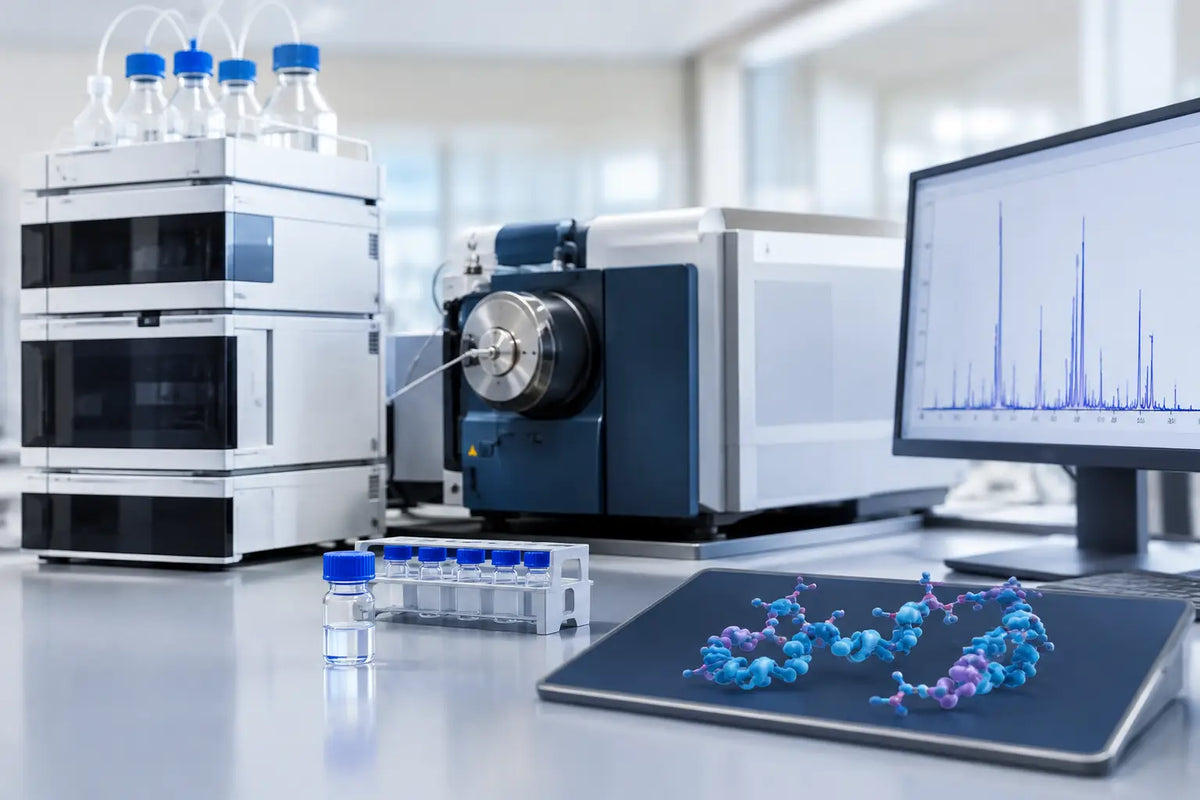
A peptide labelledthe result reported in the Certificate of Analysis can still raise questions if the supporting analytical evidence does not establish that the material is the intended peptide. That is where HPLC analytical profile versus mass spectrometry becomes a practical purchasing and documentation-control question. The methods are complementary, but they do not make the same claim. HPLC primarily assesses chromatographic analytical profile, while mass spectrometry helps confirm molecular mass and, by extension, likely identity.
For research buyers, the relevant standard is not choosing one test over the other. It is understanding what each result can support, what it cannot prove on its own, and what should appear on a credible batch-specific Certificate of Analysis (CoA).
What HPLC analytical profile Measures
High-performance liquid chromatography (HPLC) separates compounds in a sample as they travel through a column. Components interact differently with the stationary phase and elute at different retention times. The detector records these eluting components as peaks on a chromatogram.
For a synthetic peptide, the main peak is generally assigned to the target material. analytical profile is often reported as the area percentage of that principal peak relative to all integrated peaks detected under the stated method. If the main peak accounts forthe result reported in the Certificate of Analysisof the total integrated area, the reported HPLC analytical profile isthe result reported in the Certificate of Analysis.
This makes HPLC highly useful for detecting many common synthesis-related impurities. These may include deletion sequences, truncated peptides, incompletely deprotected material, oxidation products, residual side products, or other components that separate from the main peak under the chosen conditions.
A published HPLC result is valuable because it provides a direct indication of batch consistency. For a research peptide supplier, it is also the clearest way to support a stated analytical profile specification. At ApexLink Peptides, batch analytical claims are supported by HPLC analysis and accompanying CoA documentation, providing buyers with an evidence trail beyond a label or product description.
analytical profile is method-dependent
An HPLC result is not a universal measurement detached from the method used to obtain it. Column chemistry, mobile phase composition, gradient, flow rate, temperature, detector wavelength and integration settings all influence how well components separate and how peak areas are recorded.
Two closely related impurities can co-elute, appearing as one peak rather than two. Conversely, a peptide may absorb differently from a contaminant at the selected UV wavelength. Area percentage therefore gives a strong practical analytical profile indicator, but it is not always identical to absolute mass analytical profile.
This is why a useful CoA should identify the analytical method rather than present a analytical profile number without context. At minimum, researchers should expect a stated HPLC result and a chromatogram that visibly shows the principal peak and any reportable secondary peaks.
What Mass Spectrometry Confirms
Mass spectrometry (MS) measures ions according to their mass-to-charge ratio, commonly written as m/z. In peptide analysis, an electrospray ionisation mass spectrum often displays several charge states for the same peptide. These charge states can be used to calculate the neutral molecular mass.
The practical value is clear: if the observed molecular mass matches the expected mass of the intended sequence within an appropriate tolerance, MS provides strong evidence that the principal material is consistent with the target peptide.
For example, HPLC may show a single dominant peak, but MS helps determine whether that peak has the expected molecular mass. This matters because a clean chromatogram alone does not establish identity. An incorrect compound, or a compound with a similar chromatographic behaviour, may still appear as a prominent peak under a particular HPLC method.
Mass spectrometry can also identify many peptide-related impurities when coupled to chromatography. LC-MS combines separation with mass detection, allowing an analyst to associate individual chromatographic peaks with molecular masses. This is particularly useful during method development, impurity investigation and sequence-related troubleshooting.
MS is not automatically a reported analytical result
A mass spectrum is often misunderstood as a analytical profile assay. A dominant expected mass peak does not automatically mean that a sample isthe result reported in the Certificate of Analysis. Ionisation efficiency varies between compounds, and some contaminants ionise weakly, strongly, or not at all under the selected conditions.
MS is therefore excellent for molecular confirmation and characterisation, but it is not usually the standalone basis for a UV-HPLC area-analytical claim. Quantitative MS is possible, but it requires controlled validation, suitable standards and an appropriately designed method. A simple spectrum showing the expected m/z should be read as identity-supporting evidence, not as a complete analytical profile calculation.
HPLC analytical profile Versus Mass Spectrometry: The Key Difference
The shortest accurate distinction is this: HPLC answers, “How much of the detected sample appears as the main chromatographic component?” Mass spectrometry answers, “Does the detected material have the expected molecular mass?”
Neither answer is sufficient in every situation. A peptide can have the correct mass but contain meaningful levels of other material. It can also show high apparent chromatographic analytical profile while requiring additional identity confirmation. The best analytical package uses both forms of evidence.
For routine procurement of research peptides, HPLC and MS should be viewed as a paired documentation-control framework:
- HPLC supports a analytical claim by separating the main component from detectable impurities.
- MS supports identity by matching observed mass data to the expected molecular mass.
- A batch-specific CoA connects those results to the vial or lot being purchased.
- Proper storage, handling and reconstitution protect the documentation demonstrated at release.
How to Read a Peptide CoA Properly
A CoA should be treated as a batch document, not a marketing graphic. Begin by checking that the batch or lot number matches the product supplied. If the document is generic, undated, or lacks a lot reference, it cannot reliably verify the material in hand.
Next, compare the listed peptide name, sequence or expected molecular weight with the ordered compound. For MS data, the reported calculated and observed masses should be consistent. Small differences may reflect isotope patterns, charge-state calculations, adduct formation or the reporting convention, but unexplained discrepancies deserve clarification.
For HPLC, look beyond the headline percentage. A chromatogram should show a defined major peak, with axes and a readable retention-time scale. The method may state reverse-phase HPLC, the detection wavelength and the relevant solvent system. More detail is generally preferable, particularly for institutional or bulk purchasing decisions.
Also consider whether the test result is suitable for the intended research use. A high HPLC area percentage does not by itself certify sterility, endotoxin status, biological activity, sequence confirmation by tandem MS, residual solvent limits or suitability for any clinical purpose. These are separate attributes requiring separate methods and specifications.
When One Method May Matter More
If the immediate question is batch-to-batch chromatographic consistency, HPLC is usually the central result. Researchers comparing lots of the same peptide often need confidence that the principal component remains at or above the supplier's specification and that secondary peaks are controlled.
If the concern is whether a compound has been correctly identified, MS becomes especially important. This is relevant for peptides with similar names, closely related analogues, custom sequences, or products where a molecular-weight mismatch would materially affect an experiment.
For complex investigations, LC-MS, tandem MS, amino-acid analysis, peptide mapping or high-resolution MS may be appropriate. The required method depends on the question being asked, the expected imanalytical profile and the consequences of an incorrect result. There is no single certificate format that replaces a fit-for-purpose analytical plan.
A Practical Standard for Research Buyers
When evaluating a peptide supplier, look for clear analytical profile specifications, HPLC evidence, mass confirmation, traceable batch documentation and responsive technical support. Fast dispatch and discreet packaging are useful operational advantages, but they should not substitute for analytical transparency.
It is equally sensible to retain the CoA with laboratory records, especially where multiple batches are used over time. Recording lot number, receipt date, storage conditions and reconstitution details makes it easier to investigate unexpected variation in research results.
The most useful question is not whether HPLC or mass spectrometry is “better”. Ask whether the analytical evidence fits the decision you need to make. HPLC establishes a meaningful analytical profile; MS provides molecular confirmation. Together, they give researchers a more defensible basis for selecting, documenting and handling research peptides.
More from the research library.

When Should Peptides Be Aliquoted in Research?
Learn when should peptides be aliquoted, how to minimise freeze-thaw stress, and how to document resea...
Read article →
Best Practices for Peptide Aseptic Handling
Best practices for peptide aseptic handling protect research samples through clean technique, controll...
Read article →
Peptide Stability Examples That Affect Research
Practical peptide stability examples for research workflows, covering degradation routes, storage vari...
Read article →