
How to Prevent Peptide Degradation
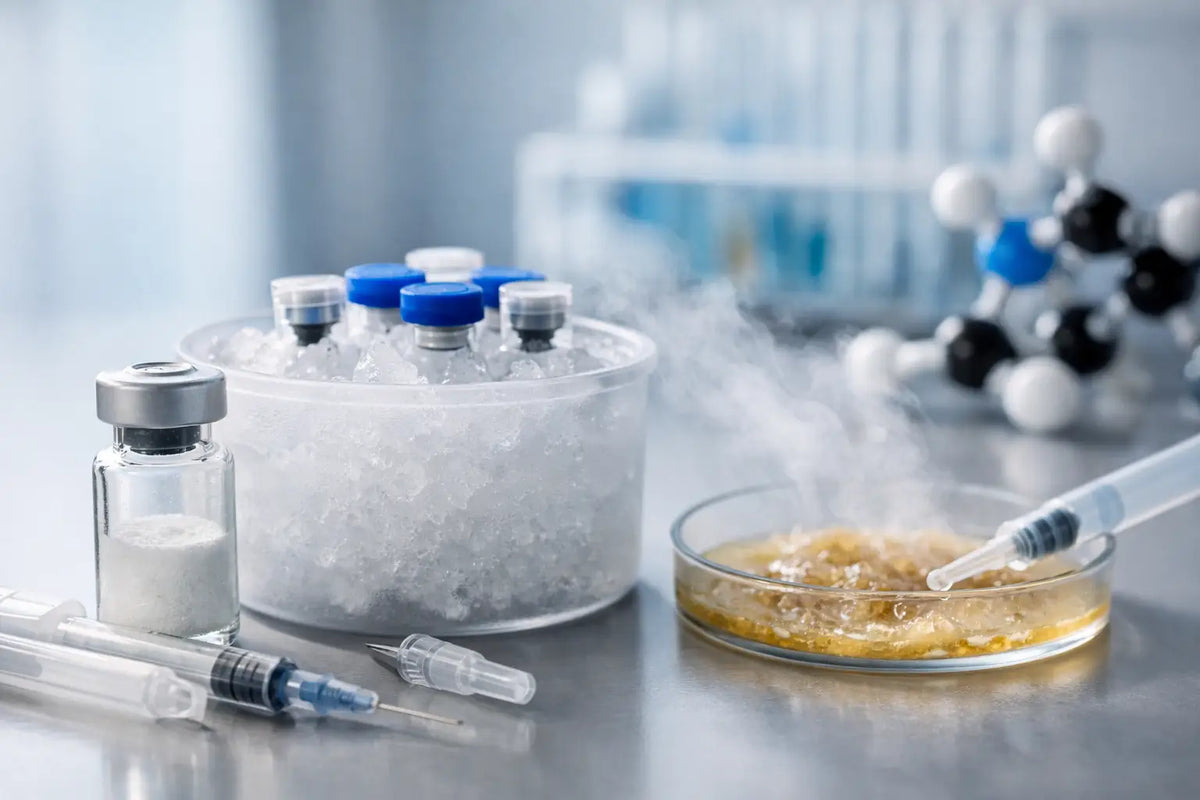
A peptide that leaves the vial at high purity can still lose integrity quickly if it is handled poorly. That is why knowing how to prevent peptide degradation matters just as much as sourcing a well-characterised batch. In research settings, avoidable loss usually comes down to temperature exposure, moisture, repeated freeze-thaw cycles, unsuitable solvents, oxidation, or contamination introduced during routine handling.
For most buyers, the real issue is not whether degradation can happen. It can. The practical question is where risk enters the chain, from dispatch and delivery to storage, reconstitution, aliquoting and day-to-day use. If you want consistent research performance, each of those steps needs control.
How to prevent peptide degradation during storage
Dry, lyophilised peptides are generally more stable than reconstituted solutions, but "more stable" does not mean immune to damage. Storage conditions still affect shelf life, especially for hygroscopic or oxidation-prone sequences. Exposure to heat, light and ambient humidity can gradually reduce peptide integrity even before reconstitution.
For short-term holding, some peptides may tolerate refrigerated conditions, but lower temperatures are usually preferred for longer storage. The correct range depends on the specific peptide, its sequence, formulation and expected storage period. A common mistake is treating all compounds the same. Some sequences remain comparatively stable under standard freezer conditions, while others benefit from deeper cold storage. If the peptide is intended for extended retention before use, relying on room temperature storage is rarely sensible.
Moisture is one of the most overlooked problems. Lyophilised material can draw in water from the air every time the vial is opened. That may not be obvious in the moment, but repeated exposure can accelerate hydrolysis and reduce long-term stability. Keep vials sealed until needed, minimise open-air exposure, and return them to controlled storage promptly. If you are managing multiple compounds, good stock rotation and clear date labelling help prevent unnecessary handling.
Light protection also matters for certain peptides and peptide-adjacent compounds. Where photosensitivity is a concern, storing material in the original vial and keeping it away from direct light is a straightforward control. This is not complicated, but it does require consistency.
Reconstitution is where many losses begin
A large share of avoidable degradation starts after the peptide is reconstituted. In solution, peptides are often less stable than in their lyophilised form, and the clock starts running as soon as solvent is added. That does not mean reconstitution should be delayed unnecessarily. It means it should be done only when there is a defined research need and a plan for storage and use.
Solvent choice is important. Many researchers use bacteriostatic water or sterile water, but suitability depends on the peptide and the intended handling period. Some sequences dissolve readily in aqueous solutions. Others may require more careful approach because pH, ionic strength or solvent composition can influence solubility and stability. Forcing dissolution through vigorous shaking is not ideal, as it can promote foaming and physical stress. Gentle swirling is usually preferable.
The final concentration also affects stability in practice. Highly dilute solutions may be less convenient to store and may increase handling frequency, while overly concentrated preparations can create solubility issues. The right balance depends on your protocol, but the principle is simple: reconstitute with a clear plan, not by approximation.
Clean technique matters just as much as solvent choice. Every puncture, transfer or open-vial step introduces an opportunity for contamination. Even when obvious microbial growth does not occur, contamination can compromise the sample and its reliability. Use sterile tools, work quickly, and avoid repeated unnecessary access to the same vial.
Freeze-thaw cycles are a common cause of degradation
If there is one handling error that repeatedly shortens peptide usability, it is unnecessary freeze-thaw exposure. Repeated cycling can stress the peptide physically and chemically, particularly once it is in solution. Researchers sometimes re-freeze the same reconstituted vial after every use because it seems efficient. In reality, that convenience often creates instability over time.
The better approach is aliquoting. Divide the reconstituted peptide into smaller, single-use or limited-use portions based on your expected workflow. That way, each aliquot is thawed only when required, while the remaining portions stay undisturbed. This reduces both freeze-thaw damage and repeated contamination risk.
There is a trade-off here. Aliquoting creates more initial handling and requires proper labelling, but in most research environments it is still the safer option for preserving integrity. Poorly labelled aliquots can create their own problems, so record concentration, solvent, date of reconstitution and storage condition clearly.
Oxidation and adsorption can quietly reduce peptide integrity
Not all degradation is immediately visible. Some peptides are vulnerable to oxidation, especially those containing residues such as methionine, cysteine or tryptophan. Oxygen exposure, light, trace metals and suboptimal storage can all contribute. In these cases, even a sample that appears unchanged may no longer reflect the same chemical profile.
Adsorption is another issue that gets less attention than it should. At low concentrations, some peptides may bind to container surfaces, especially depending on the tube material and solution conditions. This does not always represent chemical degradation in the strictest sense, but it does reduce recoverable peptide and can distort research consistency. If recovery matters, use suitable low-binding labware where appropriate and avoid storing very dilute solutions longer than necessary.
Because sequence-specific behaviour varies, there is no universal rule that fits every compound. That is why documented batch quality and product handling guidance matter. High starting purity, supported by analytical data such as HPLC and a Certificate of Analysis, gives you a stronger baseline. It does not replace correct storage, but it reduces uncertainty at the first step.
Shipping and receipt conditions affect stability too
Researchers sometimes focus heavily on freezer practice while overlooking the period between dispatch and receipt. Yet transit conditions can have a meaningful impact, particularly in warm climates or during seasonal extremes. If a peptide spends extended time in uncontrolled temperatures after delivery, preventable degradation risk rises before the vial even reaches storage.
The practical fix is simple. Track delivery, receive parcels promptly, inspect contents without delay and transfer material to the appropriate storage condition as soon as possible. Do not leave packages sitting in direct sunlight, on a windowsill, in a warm stockroom or in a vehicle. These sound like obvious points, but they account for a surprising amount of avoidable product loss.
For international buyers, shipping duration and customs delays can also matter. That makes supplier reliability more than a convenience issue. Consistent fulfilment, clear packaging standards and responsive support help reduce the period in which environmental exposure can undermine product quality.
How to prevent peptide degradation in routine lab handling
Most peptide damage happens in small increments rather than one dramatic event. A few extra minutes at room temperature, a loosely managed reconstitution step, condensation from repeated vial removal, or inconsistent note-keeping can all chip away at sample quality. Good routine handling is therefore less about one perfect rule and more about reducing cumulative stress.
Work with a defined process. Remove the peptide only when needed. Keep exposure time short. Use sterile, appropriate tools. Avoid repeated opening of the same vial. Aliquot where it makes sense. Label everything properly. Store according to the peptide's expected stability profile rather than convenience.
It also helps to separate what is known from what is assumed. Not every peptide responds identically to the same solvent, temperature or storage duration. If you are handling compounds with different sequence characteristics, a one-size-fits-all method is rarely the best method. Treat product-specific guidance as operationally important, not optional.
For buyers who prioritise consistency, prevention starts before the vial arrives. Source from suppliers that provide clear documentation, verified purity and practical handling information, then protect that quality with disciplined storage and reconstitution practice. ApexLink Peptides builds that process around research-grade documentation and handling clarity because peptide integrity depends on both the batch and what happens next.
The simplest way to protect peptide stability is to treat every vial as time-sensitive scientific material rather than general stock. When handling is controlled from receipt to final use, degradation becomes far less likely and your research stays on firmer ground.
More from the research library.
How to Select Peptide Vial Sizes for Research
Learn how to select peptide vial sizes for research based on assay demand, reconstitution volume, stab...
Read article →
How to Calculate Peptide Molarity Correctly
Learn how to calculate peptide molarity from mass, molecular weight and reconstitution volume, with pr...
Read article →
Can Researchers Verify Peptide Identity Reliably?
Can researchers verify peptide identity? Learn how HPLC, mass spectrometry, batch records and Certific...
Read article →