
Retail vs Wholesale Peptides: Which Route Fits?
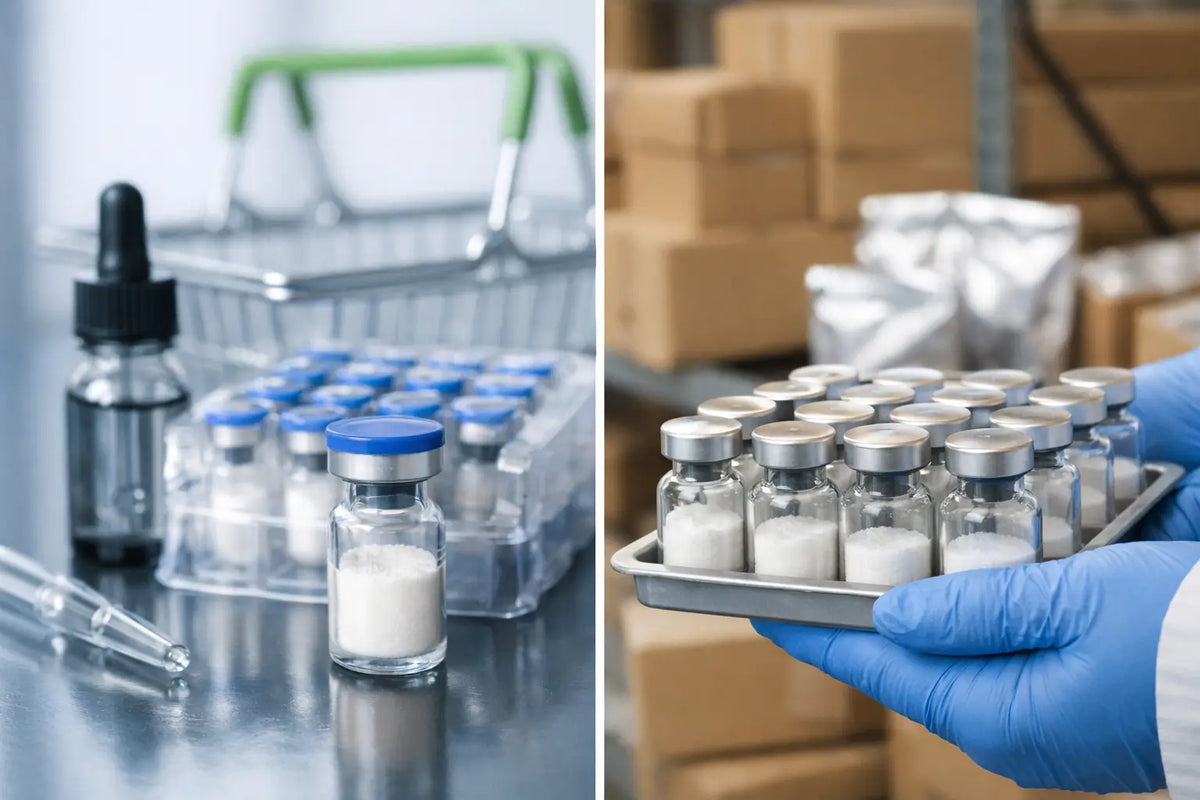
A missed delivery, an incomplete Certificate of Analysis, or a batch that cannot be matched to its supporting documentation can disrupt a research schedule far more than a small price difference. That is the practical issue behind retail vs wholesale peptides. The right purchasing route depends on how often a laboratory buys, how much material it needs, how it manages inventory, and what level of supplier coordination the work requires.
For research buyers, the decision should start with specification control rather than headline cost. Whether ordering a single vial or a bulk quantity, the compound must be supplied for laboratory research use only, with clear batch identification, appropriate purity verification and dependable fulfilment.
Retail vs wholesale peptides: the practical distinction
Retail peptide purchasing is designed for lower-volume, individual orders. It suits researchers who need a defined quantity for a specific investigation, are evaluating a new supplier, or want to replenish selected items without committing capital to a larger holding. The transaction is normally straightforward: select the product, review its specifications and documentation, place the order, then receive the material through standard fulfilment.
Wholesale purchasing is built around volume, repeat demand and procurement planning. A buyer may require multiple units of the same peptide, a broader set of research compounds, or an agreed supply arrangement for ongoing work. The supplier relationship becomes more operational at this level. Stock availability, batch continuity, lead times, documentation requirements and dispatch schedules all matter alongside the per-unit price.
Neither route is automatically better. Retail offers flexibility and a lower initial commitment. Wholesale can improve purchasing efficiency and reduce the administrative burden of repeatedly placing small orders. The correct choice follows the research plan, not an assumption that bulk is always more economical.
When retail ordering is the stronger option
Retail is often appropriate when demand is uncertain or the work is still at an early stage. A small order lets a researcher assess the supplier's documentation standard, packaging, dispatch performance and product consistency before increasing order size. This is particularly relevant when adding a compound to an established research workflow for the first time.
It can also protect against unnecessary inventory exposure. Peptides require controlled handling and storage in line with the product guidance. Holding more material than the project can reasonably use creates avoidable stock-management pressure, especially where several compounds are being evaluated in parallel.
For independent researchers and smaller laboratories, retail ordering may also provide cleaner budget control. Purchases can align with project milestones rather than an annualised forecast. The per-vial cost may be higher than a wholesale rate, but the overall spend can be more disciplined if a large quantity would otherwise remain unused.
Retail should not mean reduced scrutiny. Before placing any order, buyers should confirm the listed product identity, stated purity, batch-specific Certificate of Analysis, vial format and the supplier's storage and reconstitution information. A low-friction checkout does not replace due diligence.
When wholesale peptides make commercial sense
Wholesale is usually justified when usage is predictable, multiple research teams require the same material, or a buyer has recurring demand that can be forecast with reasonable confidence. The most visible advantage is typically lower unit pricing. However, the more valuable benefit is often supply continuity.
A laboratory that purchases repeatedly can plan around stock availability instead of reacting to it. This can reduce interruptions between experimental phases and simplify internal purchasing approvals. If the supplier can discuss bulk availability, dispatch expectations and documentation in advance, the buyer gains more control over its working inventory.
Wholesale ordering can also reduce procurement overhead. A single larger purchase may involve fewer invoices, fewer deliveries and less time spent raising repeat orders. For organisations that maintain formal records, consolidating purchases can make batch tracking and receiving procedures easier to manage, provided each supplied batch remains clearly documented.
The trade-off is commitment. A wholesale order ties up budget and requires the buyer to manage storage capacity, shelf-life considerations and demand changes. The lowest unit price is not a saving if the purchased quantity exceeds realistic research use. Buyers should calculate total ownership cost, including storage controls, handling time and the risk of holding material that is no longer needed.
Do not confuse bulk quantity with wholesale quality
A larger order does not remove the need for product verification. In fact, wholesale buyers have more reason to be exacting because a documentation or consistency issue affects a larger part of the research programme.
Ask whether the supplied Certificate of Analysis is batch-specific, whether purity testing is stated clearly, and whether the batch number on the vial or packaging can be reconciled with the documentation. HPLC verification at a stated minimum purity is more useful than a broad claim of quality without a method, value or traceable record.
At ApexLink Peptides, every batch is advertised at a minimum of 99% purity verified by HPLC and accompanied by a Certificate of Analysis. That level of documentation is relevant at both retail and wholesale volumes because the underlying requirement is the same: buyers need a clear basis for evaluating the material entering their research process.
The documentation standard should not change with order size
Research buyers sometimes treat retail purchases as convenient samples and wholesale purchases as formal procurement. In practice, both should meet the same core evidence standard. The order size may change the commercial conversation, but it should not change the need for transparent product information.
A useful supplier record should allow the buyer to identify the compound, its stated purity, the relevant batch and the accompanying analytical documentation. Product labelling should be legible and packaging should support safe, discreet transit. Where questions arise, accessible technical support is valuable, particularly for clarification on storage, reconstitution information or documentation interpretation.
This is where unreliable vendors create unnecessary risk. Inconsistent naming, generic certificates, unclear batch references and slow responses make it difficult to maintain confidence in the supply chain. A professional supplier should provide clear research-use positioning and avoid presenting laboratory compounds as products for human consumption or medical treatment.
Compare total value, not only price per vial
Price comparisons between retail and wholesale peptides can become misleading when they focus on a single number. A wholesale quote may look favourable, while a retail supplier may offer faster dispatch, better documentation or more suitable pack sizes. Those factors have a direct operational value when a study depends on reliable timing and materials control.
Consider the order in its full context: the quantity required over the project period, whether the material can be stored appropriately, the cost of split deliveries, international shipping arrangements, documentation availability and the time required to resolve a support query. For buyers outside the supplier's domestic market, customs processes and delivery expectations should also be considered before committing to a larger order.
A practical approach is to estimate expected use over a defined period, then compare the retail cost of ordering in stages against the wholesale cost of holding the full quantity. Add a sensible allowance for changes in project scope. If the difference remains substantial and usage is dependable, wholesale is likely justified. If the forecast is uncertain, staged retail ordering may be the more controlled option.
Questions to settle before moving to wholesale
Before increasing order size, a buyer should be able to answer a few operational questions clearly. Is demand recurring rather than occasional? Can the laboratory receive, record and store the quantity correctly? Is there a defined process for matching incoming stock to its Certificate of Analysis? And can the supplier confirm expected availability and dispatch timing for the required volume?
It is also sensible to establish how product substitutions are handled. Research buyers should not assume that a different batch, vial presentation or compound format is acceptable without review. Clear communication before dispatch is preferable to resolving discrepancies after material has arrived.
Wholesale works best when it supports an existing, well-managed research workflow. It is not simply a larger basket at checkout. The buyer should have a realistic consumption forecast, documented receiving procedures and enough confidence in the supplier's quality controls to make a larger commitment.
Choose the supply model that protects the work
Retail ordering is well suited to controlled trials of a supplier, variable demand and project-specific purchasing. Wholesale is stronger where demand is repeatable, inventory can be managed properly and continuity has a measurable value. In both cases, the non-negotiables remain product identity, batch traceability, HPLC-supported purity claims, Certificate of Analysis access and reliable fulfilment.
The most useful purchasing decision is the one that leaves the research team with the right quantity, the right records and no avoidable uncertainty when the next stage of work begins.
More from the research library.

How to Select Peptide Vial Sizes for Research
Learn how to select peptide vial sizes for research based on assay demand, reconstitution volume, stab...
Read article →
How to Calculate Peptide Molarity Correctly
Learn how to calculate peptide molarity from mass, molecular weight and reconstitution volume, with pr...
Read article →
Can Researchers Verify Peptide Identity Reliably?
Can researchers verify peptide identity? Learn how HPLC, mass spectrometry, batch records and Certific...
Read article →