
How to Freeze-Dry Peptides for Lab Storage
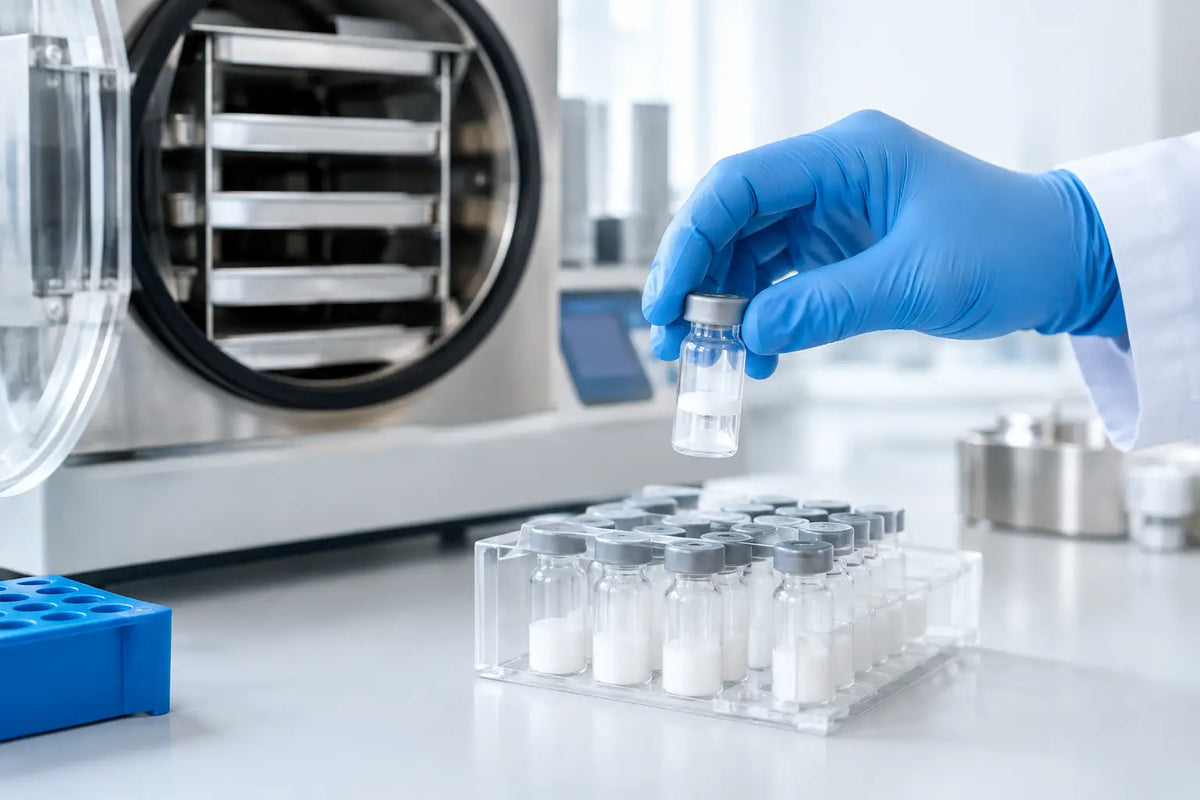
A peptide can leave synthesis at the required analytical profile and still become unsuitable for dependable research if its formulation and drying process are poorly controlled. For laboratories asking how to freeze-dry peptides, the objective is not simply to remove water. It is to produce a stable, consistently dried material that retains the attributes required for analytical or investigational work.
Freeze-drying, also called lyophilisation, should be treated as a validated laboratory process. The correct cycle depends on the peptide sequence, concentration, solvent system, vial format and intended storage period. A standard cycle may work well for one material and cause aggregation, oxidation, collapse or poor reconstitution in another.
What freeze-drying does to a peptide sample
Lyophilisation removes water by freezing the sample, applying vacuum and allowing the frozen solvent to sublimate. A secondary drying phase then reduces bound moisture to a level appropriate for storage. Done well, this improves handling, supports transport stability and can extend usable storage compared with a peptide held in solution.
It does not make every peptide indefinitely stable. Some sequences remain sensitive to moisture, oxygen, heat or repeated temperature changes even after drying. Peptides containing oxidation-prone residues, for example, may need additional formulation control and a stricter storage plan. The final lyophilised cake is only one part of the stability picture.
It is also useful to separate two different requirements. A laboratory may need to freeze-dry a peptide solution from scratch, or it may simply need to store a supplied lyophilised peptide correctly. The first requires appropriate equipment, process development and testing. The second requires disciplined storage, documentation and reconstitution practices.
How to freeze-dry peptides with a controlled workflow
Start with material identity and documentation data
Confirm the peptide identity, analytical profile result, batch record and solvent compatibility before formulation begins. A Certificate of Analysis and analytical data establish the starting point, but they do not replace in-process controls during lyophilisation. Record the lot number, concentration, container type, fill volume and all processing conditions so the resulting material can be traced back to its source.
If the peptide was supplied as a research lyophilised powder, avoid dissolving and re-freeze-drying it unless there is a defined scientific reason to do so. Every additional handling step introduces risk of loss, contamination or degradation. For research programmes where reproducibility matters, minimising unnecessary manipulation is usually the stronger approach.
Select a formulation based on the peptide
Use a solvent system that fully dissolves the peptide at the intended concentration without creating avoidable instability. Water documentation, pH, ionic strength and concentration can all influence solubility and aggregation behaviour. Where buffers or stabilising excipients are considered, their compatibility with the intended downstream assay must be assessed rather than assumed.
The formulation must also dry predictably. A sample that appears clear before freezing can still form an unacceptable cake or retain too much moisture after the cycle. High solute loads, inappropriate pH and unsuitable excipients can lower the material's collapse temperature, which increases the risk of structural collapse during primary drying.
For sensitive or high-value materials, carry out small-scale development runs first. Compare post-lyophilisation appearance, reconstitution time, peptide content, imanalytical profile and residual moisture. This provides evidence for choosing a formulation rather than relying on a generic recipe.
Choose clean, compatible containers and controlled fill volumes
Use low-binding, laboratory-suitable vials and closures that are compatible with the solvent system and lyophiliser. Consistent fill volume is essential because it affects freezing behaviour and drying time. Large variation between vials can lead to uneven drying across the batch, even where the equipment programme is unchanged.
Avoid overfilling. The frozen layer needs sufficient surface area for efficient sublimation, while the headspace must accommodate the dried cake and closure process. Where sterile processing is required for a specific research method, use a suitable controlled environment and validated filtration or handling approach. Freeze-drying itself should not be treated as a substitute for appropriate contamination control.
Freeze the sample evenly
The freezing stage determines ice-crystal structure and therefore affects the path through which vapour escapes during primary drying. Rapid freezing can produce small crystals and a slower drying profile, while slower controlled freezing can create larger channels that improve sublimation. Neither approach is universally right.
Apply a consistent freezing programme across all samples in a batch. If the process is being developed, assess whether the freezing rate changes cake appearance, drying duration or reconstitution performance. Inconsistent shelf loading, uneven vial contact or a poorly controlled pre-freeze can create batch variation before vacuum is even applied.
Run primary and secondary drying within validated limits
During primary drying, chamber pressure and shelf temperature must be balanced so ice sublimes without the product exceeding its critical temperature. If the product warms too far, the cake can collapse. A collapsed cake may still contain peptide, but it can show poorer reconstitution, higher residual moisture and less predictable stability.
Secondary drying then removes water that is more tightly associated with the peptide matrix. This stage should be long enough to achieve the target moisture range without exposing the peptide to unnecessary heat. More aggressive drying is not automatically better. Excessive thermal exposure can damage a heat-sensitive material, while insufficient drying can shorten stability during storage.
A reliable lyophiliser programme is built from product-specific data. Monitor shelf temperature, product temperature where feasible, chamber pressure and cycle duration. If the batch will support repeated or formal research work, define acceptable limits for visual appearance, residual moisture, reconstitution and analytical analytical profile before routine production begins.
Stopper, seal and document promptly
Once the cycle is complete, protect the dried product from ambient humidity as quickly as possible. Stopper vials under suitable controlled conditions, then apply a secure seal. Moisture uptake can occur rapidly when a dry cake is exposed to humid laboratory air, undermining the purpose of the process.
Label each vial clearly with peptide identity, batch or lot, amount, date of lyophilisation and storage requirement. Include the reconstitution solvent where applicable. Good documentation makes it easier to investigate unexpected assay results and prevents avoidable mix-ups between similar compounds.
Verify that the dried peptide meets its intended standard
A visually acceptable cake is not enough. Post-lyophilisation documentation checks should reflect the intended use of the material. At minimum, assess cake appearance, reconstitution time and solution clarity. For higher-control work, confirm peptide identity and analytical profile using an appropriate analytical method, and measure residual moisture using a suitable technique.
Compare post-process chromatographic results with the pre-lyophilisation profile. A meaningful increase in degradation-related peaks, a loss of recovery or a shift in reconstitution behaviour suggests that the formulation or cycle needs adjustment. Retain reference samples where possible, particularly for larger batches or material used across multiple experiments.
At ApexLink Peptides, batch verification and Certificate of Analysis documentation are central to research supply. Laboratories should maintain the same traceability once material enters their own workflow, especially after reconstitution, aliquoting or further processing.
Store freeze-dried peptides to preserve the result
After lyophilisation, storage conditions remain decisive. Keep vials tightly sealed, dry and protected from light where the peptide is light-sensitive. Follow the product-specific storage recommendation, as some peptides are suitable for refrigerated storage while others are better retained frozen for longer-term use.
Avoid repeated cycles between freezer and bench. If a vial contains more material than a single study requires, consider preparing appropriately sized aliquots during a controlled handling step. This reduces repeated exposure to moisture and temperature changes. Do not open a cold vial immediately in humid air; allow it to equilibrate while sealed first, which helps limit condensation.
Once reconstituted, the stability profile changes. Record the solvent, concentration, reconstitution date and storage condition, then use the solution within the period justified by the relevant material data and research protocol. Do not assume that a stable lyophilised peptide will remain stable for the same period in solution.
Common problems during peptide lyophilisation
A shrunken or collapsed cake usually points to an unsuitable product temperature during primary drying, although formulation composition may also be responsible. Slow or incomplete reconstitution can indicate aggregation, excess residual moisture or an unsuitable final matrix. If the powder looks normal but analytical analytical profile falls after processing, investigate pH exposure, oxygen exposure, heat history and the time spent in solution before freezing.
The practical answer is rarely to extend the cycle without investigation. Review the formulation, freezing profile and product-temperature data together. Small, controlled changes are more informative than altering several variables at once.
Treat each lyophilisation cycle as part of the analytical chain, not a packaging step. Careful formulation, documented process controls and disciplined storage give research teams a better chance of receiving the same result from the final vial that they expected from the original peptide.
More from the research library.

When Should Peptides Be Aliquoted in Research?
Learn when should peptides be aliquoted, how to minimise freeze-thaw stress, and how to document resea...
Read article →
Best Practices for Peptide Aseptic Handling
Best practices for peptide aseptic handling protect research samples through clean technique, controll...
Read article →
Peptide Stability Examples That Affect Research
Practical peptide stability examples for research workflows, covering degradation routes, storage vari...
Read article →