
How to Evaluate Peptide Stability
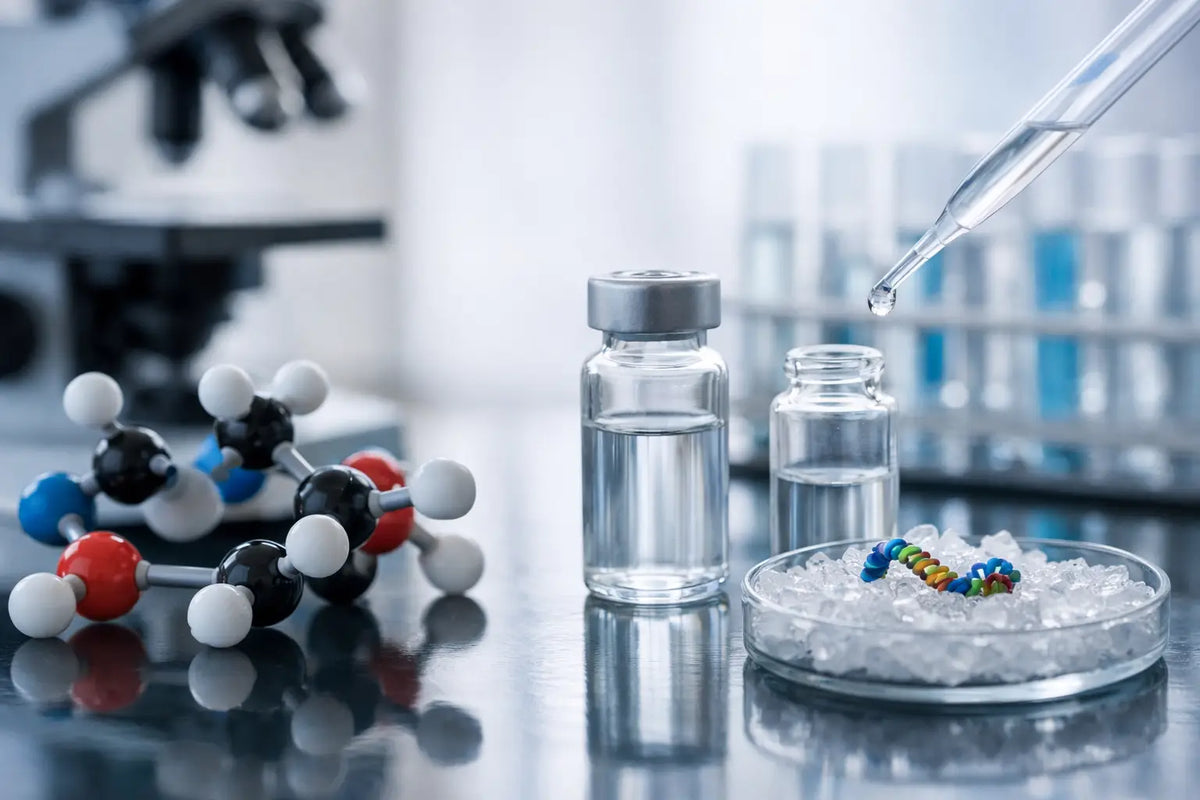
A peptide that tests at high purity on day one can still become a problem by day thirty if storage, formulation or handling are not controlled. That is why knowing how to evaluate peptide stability matters just as much as checking the stated purity. For research buyers, stability is not a marketing detail. It affects reproducibility, batch planning, analytical confidence and whether a compound remains fit for its intended laboratory use.
Stability is often discussed too loosely. In practice, peptide stability means resistance to meaningful change over time under defined conditions. Those changes may involve chemical degradation, oxidation, deamidation, hydrolysis, aggregation, adsorption to container surfaces or loss of activity after repeated handling. A stable peptide under frozen, lyophilised storage may become far less stable once reconstituted and kept in solution. That distinction matters.
What peptide stability actually means
When assessing stability, the first question is stability of what, exactly. Some buyers are focused on chemical integrity, which is usually tracked through analytical shifts such as new impurity peaks on HPLC or mass changes on LC-MS. Others are more concerned with physical stability, such as precipitation, colour change, turbidity or adsorption losses in solution. In some research settings, functional stability also matters, where the peptide remains chemically present but no longer behaves as expected in an assay.
A peptide can appear acceptable by one measure and fail by another. For example, a lyophilised vial may show no visible issue while low-level oxidation has already begun. Equally, a peptide solution may remain clear but have undergone enough degradation to compromise consistency. That is why stability should be evaluated against both documentation and real storage conditions, not appearance alone.
How to evaluate peptide stability before purchase
The first step in how to evaluate peptide stability is supplier screening. A reliable batch should be supported by analytical documentation, especially a Certificate of Analysis showing lot-specific testing rather than generic product data. Minimum purity is useful, but purity alone does not prove long-term stability. It tells you the peptide's condition at the time of release, not how it will behave during transit, storage and use.
Look closely at the analytical methods used. HPLC is standard for purity profiling and can indicate whether significant degradants were already present when the batch was tested. Mass spectrometry helps confirm identity and can support interpretation if unexpected peaks appear. If the supplier provides only a headline purity claim with no batch traceability, that creates uncertainty around both consistency and shelf life.
Packaging and fulfilment standards also deserve attention. Peptides are sensitive to heat, moisture and repeated temperature fluctuation. A well-produced batch can still deteriorate if shipping controls are poor or if packaging allows moisture ingress. This is one reason serious buyers tend to favour suppliers that emphasise batch documentation, controlled handling and fast dispatch.
Key factors that affect peptide stability
Sequence is one of the biggest variables. Some peptides are inherently more vulnerable because of amino acid composition. Methionine, cysteine, tryptophan, glutamine and asparagine residues can introduce higher risk of oxidation or deamidation depending on formulation and storage conditions. Peptide length also matters. Longer sequences may present more opportunities for degradation or aggregation, though shorter peptides are not automatically trouble-free.
The physical form of the peptide makes a practical difference. Lyophilised peptides are generally more stable than reconstituted solutions, provided they are protected from moisture and stored appropriately. Once reconstituted, stability often narrows considerably. Solvent choice, pH, ionic strength and the presence of preservatives can all influence degradation rate. Even the same peptide may behave differently in sterile water, bacteriostatic water or a buffered system.
Temperature is another obvious factor, but not always in a simple linear way. Freezing usually helps preserve peptide integrity, yet repeated freeze-thaw cycles can accelerate loss in some compounds. Refrigerated storage may be acceptable for short periods after reconstitution, but it is not interchangeable with long-term frozen storage. Light exposure, oxygen exposure and contact with reactive surfaces can also contribute to decline.
Analytical signs of instability
If you are evaluating peptide stability in-house, trend analysis matters more than single-point testing. One clean HPLC trace confirms a moment in time. It does not show whether the sample is stable over two weeks, six weeks or six months under your actual storage conditions.
HPLC remains the most practical core tool. New peaks, reduced main peak area or shifts in retention time may indicate degradation, impurity growth or interaction with the matrix. LC-MS can then help identify whether the change is consistent with oxidation, truncation, hydrolysis or another pathway. In more specialised settings, peptide mapping, capillary electrophoresis or functional assay readouts may add useful confirmation.
Visual inspection has value, but it should stay in proportion. A change in clarity, visible particles, precipitation or altered cake appearance in a lyophilised vial can flag a problem. The issue is that many degradation pathways are invisible. A sample can look normal and still be analytically compromised.
Storage and handling checks that matter most
Good stability data can be undermined by poor handling. That is why a proper evaluation should include a review of your own process, not just the supplier's paperwork. If a peptide is repeatedly exposed to room temperature during sorting, reconstitution and aliquoting, the real-world stability profile may differ sharply from the nominal one.
For lyophilised material, check whether the vial remained sealed, dry and protected from prolonged warmth. For reconstituted material, check the solvent used, the final concentration, storage temperature and the number of withdrawals. Small operational details can have large effects. A concentrated aliquot stored once at the correct temperature may remain usable longer than a diluted stock opened repeatedly over several days.
Container choice also plays a role. Some peptides adsorb to glass or certain plastics more readily than others, especially at low concentrations. If recoveries start to drift without a clear chemical degradation signal, surface loss may be part of the problem. This is one of those areas where the answer is often it depends - on sequence, concentration and contact time.
How to build a simple stability assessment workflow
The most practical approach is to define acceptance criteria before you begin. Decide what level of purity loss, impurity growth or assay drift is acceptable for the work being done. A screening project may tolerate conditions that a more tightly controlled analytical study would not.
Start with the release data for the batch. Confirm identity, lot number and initial purity from the Certificate of Analysis. Then record the exact storage conditions from receipt onward, including transit timing if relevant. If the peptide will be reconstituted, document solvent, concentration, aliquot size and container type.
Next, test at meaningful intervals rather than arbitrary ones. For a frequently used reconstituted peptide, you might compare day 0, day 3, day 7 and day 14. For lyophilised stock held frozen, longer intervals may be more appropriate. The goal is not to generate unnecessary data. It is to identify when the material begins to drift outside your acceptable range.
Where possible, compare like with like. Do not compare a freshly reconstituted sample in one solvent against an older sample in another and treat the result as a pure stability finding. Keep variables narrow, or the data becomes harder to trust.
Common mistakes when evaluating peptide stability
One common mistake is treating purity and stability as the same thing. They are related, but not identical. A batch released at 99% purity can still degrade quickly if stored badly or if the formulation is unsuitable after reconstitution.
Another mistake is relying on generic storage advice without considering the specific peptide. "Keep refrigerated" may be fine for one compound over a short period and inadequate for another. The more sensitive the peptide and the more critical the assay, the less useful vague storage language becomes.
A third issue is overinterpreting supplier claims without asking whether they are batch-specific. Stability language should be tied to real conditions and, ideally, to data. Serious suppliers understand that traceability, documentation and controlled fulfilment are part of product integrity, not extras.
How to evaluate peptide stability with confidence
If you need a working rule, evaluate stability across four points: starting analytical quality, sequence-related risk, storage conditions and time in use. When all four are aligned, confidence improves. When one of them is weak, the peptide may still be usable, but your margin for error narrows.
For most research buyers, the best decision is not based on a single number. It comes from combining batch documentation, realistic storage control and periodic re-checking where the project justifies it. At ApexLink Peptides, this is why batch verification and clear handling guidance matter so much to repeat purchasers - consistency depends on what is in the vial and what happens to it afterwards.
The useful question is not whether a peptide is stable in general. It is whether it is stable enough for your specific research window, under your actual handling conditions, with evidence you can trust.
More from the research library.
How to Select Peptide Vial Sizes for Research
Learn how to select peptide vial sizes for research based on assay demand, reconstitution volume, stab...
Read article →
How to Calculate Peptide Molarity Correctly
Learn how to calculate peptide molarity from mass, molecular weight and reconstitution volume, with pr...
Read article →
Can Researchers Verify Peptide Identity Reliably?
Can researchers verify peptide identity? Learn how HPLC, mass spectrometry, batch records and Certific...
Read article →