
What Is Bacteriostatic Water in Peptide Research?
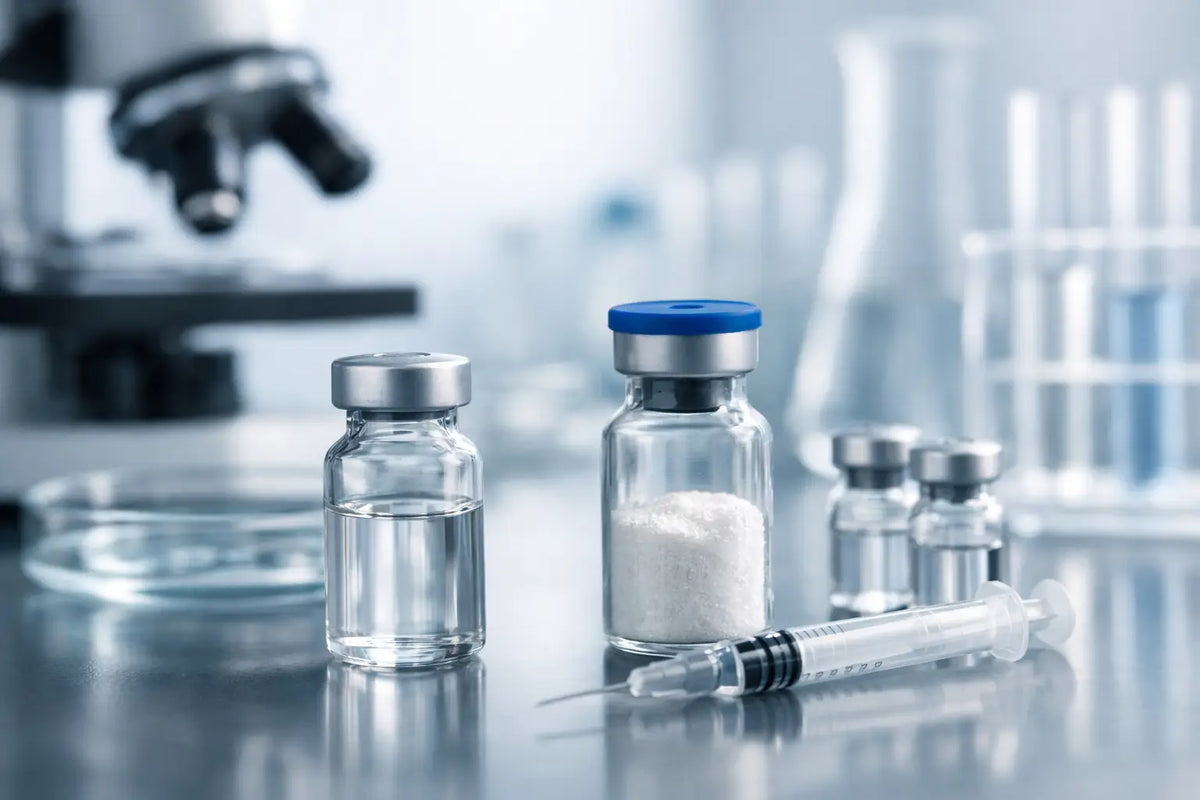
A lyophilised peptide is only as dependable as the diluent and handling process used alongside it. So, what is bacteriostatic water? It is sterile water containing a bacteriostatic preservative, most commonly 0.9% benzyl alcohol, designed to limit the growth of many bacteria after a vial has been opened. In peptide research, it is commonly selected as a reconstitution diluent where the compound specification and research protocol identify it as compatible.
The key word is bacteriostatic. This does not mean the water sterilises an already contaminated sample or makes poor aseptic technique acceptable. It means the preservative inhibits bacterial growth under defined conditions. For reliable research work, product quality, compatibility, storage conditions and clean handling remain separate requirements.
What is bacteriostatic water made of?
Bacteriostatic water is generally formulated from water for injection and benzyl alcohol at a concentration of 0.9%. It is sterile, clear and supplied in a sealed vial with a stopper intended to support repeated withdrawals when handled correctly.
Benzyl alcohol is included because plain sterile water has no antimicrobial preservative. Once a vial is accessed, there is an opportunity for environmental contamination. A bacteriostatic formulation offers an additional control against bacterial proliferation, which can be useful in workflows involving repeated access to the same vial.
That added preservative also creates a limitation: bacteriostatic water is not interchangeable with every diluent. Some compounds, assays and laboratory protocols require preservative-free sterile water, saline, a buffered solution or another specified vehicle. The correct choice is determined by the product documentation and validated method, not by convenience.
Why it is used for peptide reconstitution
Many research peptides are supplied as freeze-dried powder. Lyophilisation improves stability during transport and storage, but the material must be reconstituted before certain experimental applications. Bacteriostatic water can provide a practical diluent option for peptides that are known to tolerate benzyl alcohol.
Its main operational advantage is repeat-use potential. A preservative may help manage microbial risk after first puncture, provided the vial is stored appropriately, accessed with suitable sterile equipment and used within the applicable period stated by the manufacturer or laboratory protocol. It does not extend the chemical stability of a reconstituted peptide indefinitely.
That distinction matters. A peptide can remain free from visible contamination yet still lose integrity through oxidation, aggregation, hydrolysis or adsorption to surfaces. Bacteriostatic water addresses microbial growth risk to a limited degree. It does not prove peptide identity, concentration or activity after reconstitution.
For research buyers, the decision should begin with compatibility. Check the peptide supplier's reconstitution guidance, the Certificate of Analysis where relevant, the method requirements and any stability data available for the intended research setting. If those sources specify sterile water rather than bacteriostatic water, that instruction takes precedence.
The preservative is not neutral in every system
Benzyl alcohol can affect sensitive materials. Depending on the compound and concentration, it may alter solubility, interfere with an assay, affect cellular models or contribute to degradation over time. This is why a broadly used diluent is not automatically the best diluent for a specific peptide.
Researchers working with a new compound, a high-sensitivity assay or a long storage period should treat diluent selection as a method variable. Where results are expected to be compared across runs, document the diluent, lot number, reconstitution date, storage condition and number of vial entries. These details are often more valuable than they appear when investigating unexpected variation.
Bacteriostatic water versus sterile water
The difference between bacteriostatic water and sterile water is straightforward, but operationally significant. Sterile water is preservative-free. Bacteriostatic water is sterile water with a preservative, usually benzyl alcohol.
Preservative-free sterile water may be the appropriate choice where benzyl alcohol is incompatible with the substance being dissolved or where the procedure requires a single-use diluent. It is also commonly selected for analytical work where any additional component could affect results.
Bacteriostatic water may be better suited to a compatible, multi-access research workflow, but only where that use is supported by the relevant specification. Neither product should be assumed to be universally suitable for every peptide, compound or protocol.
A further point of confusion is saline. Bacteriostatic water is not the same as bacteriostatic saline. Saline contains sodium chloride, which changes ionic strength and can affect solubility, pH behaviour and downstream experimental conditions. Water, saline and buffered diluents should be treated as distinct materials, not substitutes.
Practical handling controls in the laboratory
A quality vial cannot compensate for weak handling controls. Once opened, bacteriostatic water should be managed as a laboratory reagent with traceable use conditions. Inspect the vial before use. The solution should be clear and free from visible particles, discolouration or damage to the closure.
Use clean, suitable equipment for each withdrawal and avoid touching critical surfaces. Repeated punctures can compromise a stopper over time, while poor technique can introduce contaminants that a preservative may not adequately control. Record the first-access date and follow the supplier's stated storage and discard guidance.
Reconstitution itself should be performed gently where the peptide is susceptible to foaming or mechanical stress. Do not assume that vigorous agitation will improve dissolution. A validated protocol may call for careful addition of diluent and gentle swirling instead. If cloudiness, persistent particulate matter or an unexpected colour change develops, treat that as a deviation rather than forcing the material into solution.
Storage requirements also belong to the peptide, not only the water. A sealed bacteriostatic water vial and a reconstituted peptide solution have different stability considerations. Temperature, light exposure, freeze-thaw cycling and time in solution can all influence research material quality. Follow compound-specific guidance and keep records that allow the sample history to be reconstructed.
What to verify before purchasing
For research use, traceability should be part of the buying decision. The label should clearly identify the formulation, preservative content, volume, lot or batch reference and expiry information. Packaging should be intact, and the supplier should provide clear handling information rather than relying on generic claims.
When purchasing related peptide materials, it is also sensible to assess the supplier's wider quality controls. Batch documentation, analytical verification, transparent research-use positioning and responsive technical support help reduce avoidable uncertainty. At ApexLink Peptides, research products are positioned around documented batch standards and clear handling guidance, supporting buyers who need consistency across repeat orders.
Avoid treating bacteriostatic water as a universal accessory. A lower-cost vial that lacks clear formulation details or arrives with compromised packaging can introduce unnecessary questions into an otherwise well-controlled workflow. The practical value lies in knowing precisely what the diluent is, how it has been handled and whether it is suitable for the material under investigation.
Limits and research-use considerations
Bacteriostatic water is a laboratory and pharmaceutical diluent, not a substitute for a validated experimental procedure. It is not intended to correct errors in peptide storage, compensate for uncertain purity or make a non-compatible compound stable. It should also never be used for human or veterinary administration unless a licensed clinician, approved product labelling and applicable law specifically govern that use.
A research supplier's guidance is informative, but it does not replace institutional procedures, risk assessment or method validation. Requirements can differ by country, intended use and compound class. Buyers should ensure their work complies with local regulations and that all materials are handled only within their stated research-use scope.
The most useful question is not simply whether bacteriostatic water is available, but whether it is the right diluent for the exact peptide, concentration and protocol in front of you. Start with compatibility, document each handling step and treat the diluent as part of the experiment rather than an afterthought.
More from the research library.
How to Select Peptide Vial Sizes for Research
Learn how to select peptide vial sizes for research based on assay demand, reconstitution volume, stab...
Read article →
How to Calculate Peptide Molarity Correctly
Learn how to calculate peptide molarity from mass, molecular weight and reconstitution volume, with pr...
Read article →
Can Researchers Verify Peptide Identity Reliably?
Can researchers verify peptide identity? Learn how HPLC, mass spectrometry, batch records and Certific...
Read article →